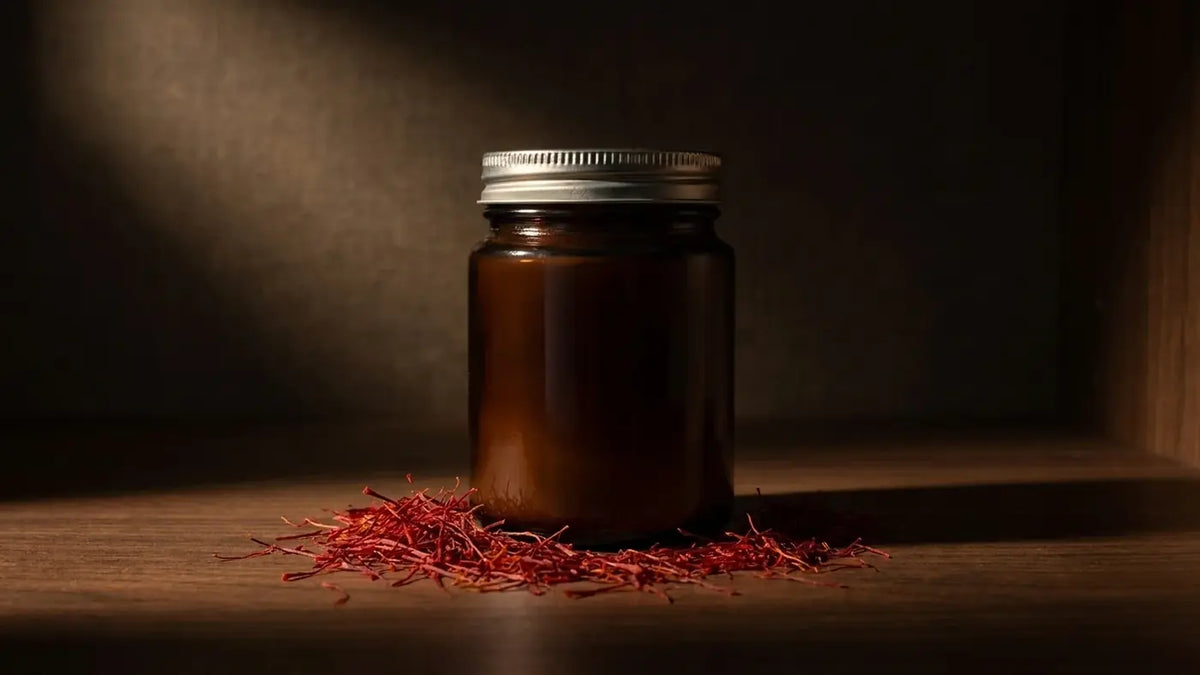
Store saffron airtight and opaque, in a cool dark cupboard — never the fridge, never a clear jar on the counter, never above the stove. Saffron does not go bad in the sense of spoiling, but its shelf life is real: stored properly it holds strength for two to three years; stored badly it loses over half its colouring power in three months.
Saffron does not spoil in a way you can see. It fades. A thread that has lost most of its crocin looks almost identical to a fresh one, which is why so many people conclude they bought weak saffron when what actually happened is that good saffron died slowly in a kitchen cupboard.
Does saffron go bad?
Not in the sense of becoming unsafe. Dried saffron sits below the moisture level that supports spoilage, and ISO 3632 caps moisture at 12% for exactly that reason. What it does instead is degrade — crocin breaks down and colouring power falls, and picrocrocin converts into safranal, so the taste flattens while the aroma turns sharper and slightly stale.
The result is spice that still looks correct and performs poorly. You compensate by using more, which is the expensive way to discover a storage problem.
What actually destroys saffron?
Three things, and — as agricultural extension research on saffron drying and handling from the University of Vermont and others makes clear — they matter in a specific order that is not the order most people assume.
Moisture is the biggest factor. Not temperature — moisture. Researchers measure this as water activity, and it has more leverage over shelf life than anything else you control.
Temperature is second. Light is third — still significant, but less than the other two.
Here is what a twelve-week controlled study found, varying all three:
| Storage condition | Predicted shelf life |
|---|---|
| Dry, in the dark (water activity 0.32) | Over 3 years |
| Moderately dry, dark | ~5.7 months |
| Moderately dry, exposed to light | ~2.8 months — light halves it |
| Damp, dark | ~1 month |
| Cool room, 20 °C, dark | ~7 months |
| Warm, 30 °C, dark | ~3.8 months |
| Hot, 40 °C, dark | ~1.7 months |
The temperature effect alone is stark: over twelve weeks, saffron held at 20 °C lost under 20% of its crocin. The same saffron at 40 °C lost more than half. A cupboard directly above a cooker or beside a dishwasher spends a good part of every day in that second range.
Does the container really matter?
More than almost anything else on this page, and it is the mistake the premium end of the market makes most often.
Comparative testing puts crocin retention after one year at roughly 87% in opaque storage against about 62% in clear containers. A longer study following dried stigma over twenty months found nearly 30% more crocin retained in the dark than in the light.
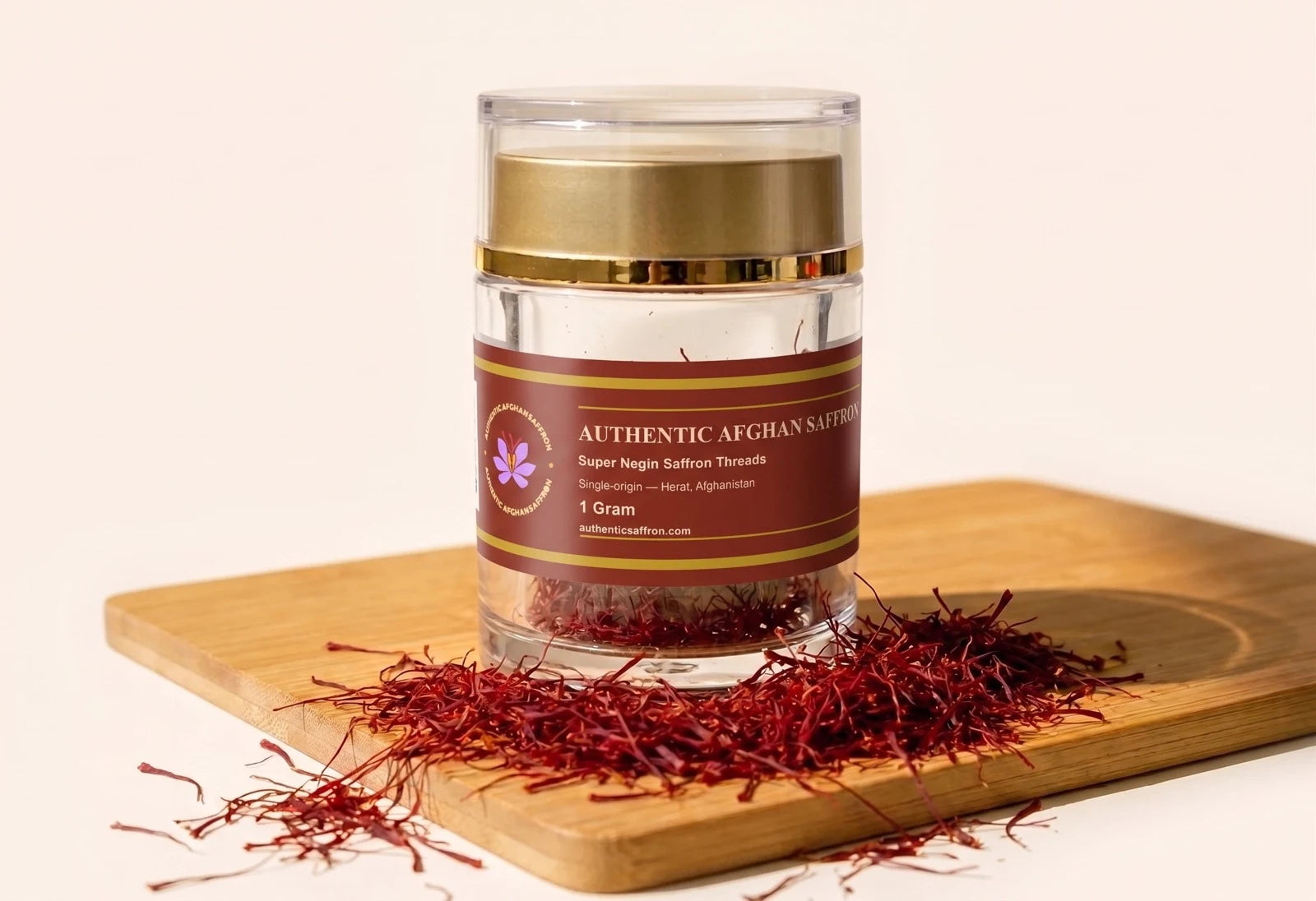
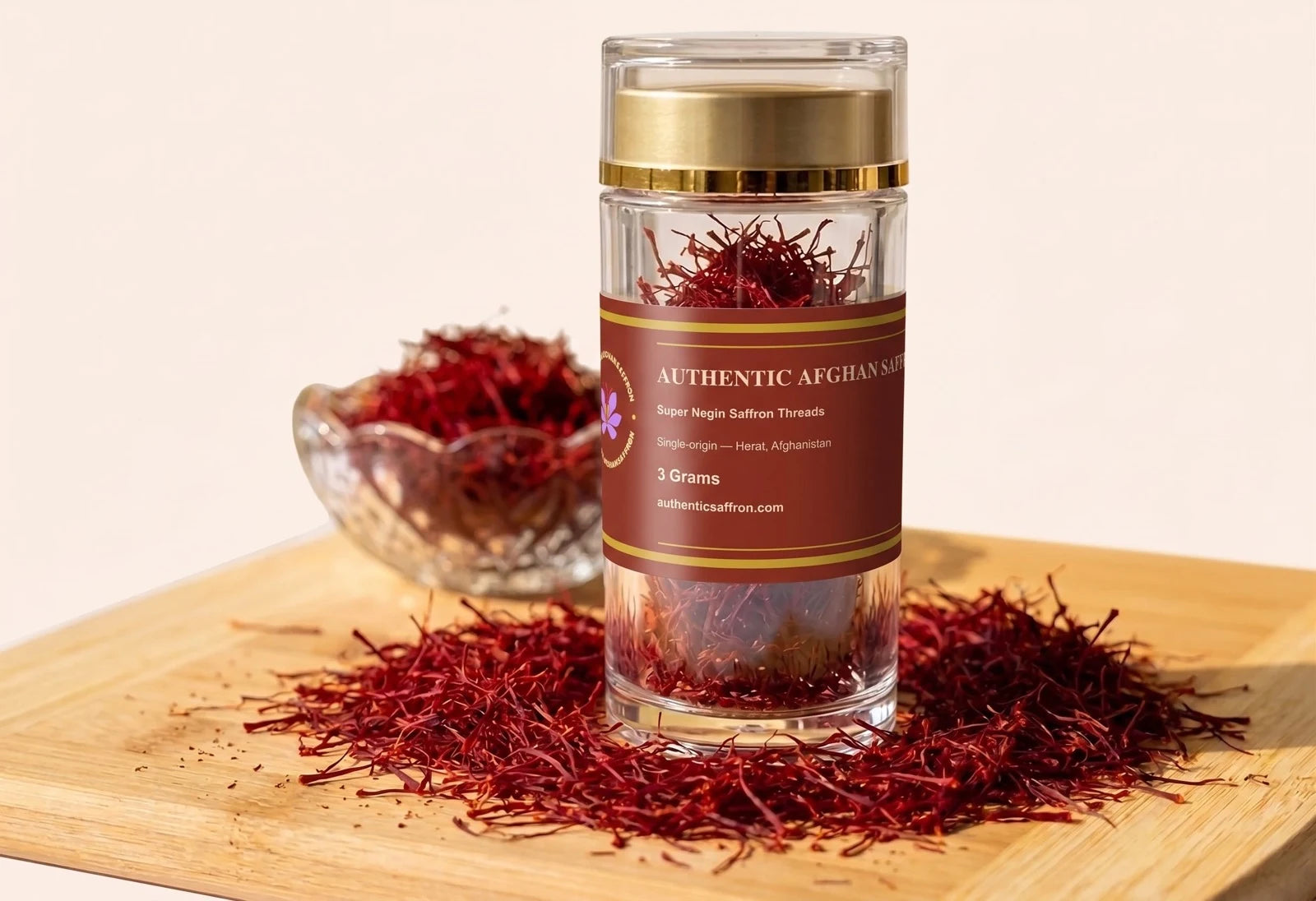
This is awkward for an industry — ours included — that likes to sell saffron in beautiful clear glass. A clear jar on a kitchen shelf is a slow, continuous light exposure, and the product is measurably worse for it. There is no way to make that fact more comfortable than it is.
If your saffron came in clear glass, keep the jar and put it inside something. A closed cupboard, a tin, or the outer box it shipped in. You get the aesthetics and the chemistry.
Should saffron go in the fridge or freezer?
No — and this is the most common piece of bad advice about saffron storage.
A twenty-month study comparing storage methods found refrigeration at 4 °C performed worse than simply keeping saffron dark at room temperature. The reason is condensation. Every time a cold container is opened into a warm kitchen, moisture condenses onto the threads, and moisture is the single most damaging variable there is. You solve a minor temperature problem by creating a major humidity one.
A cool, dark, dry cupboard beats a refrigerator. Consistency matters more than cold.
How do you store saffron properly?
- Airtight. A sealed jar or tin with a real gasket. Not a paper sachet, not a folded bag, not a jar with a loose cork.
- Opaque, or kept inside something opaque. Tin, amber glass, or a clear jar tucked into a cupboard or its box.
- Cool and consistent. A cupboard away from the stove, oven, dishwasher, kettle and any sunlit window. Avoid the spot above the cooker entirely.
- Dry. Never store saffron over a steamy hob or next to the sink. Do not add rice or anything else as a desiccant — it introduces its own moisture and its own aromas.
- Whole threads, not powder. Ground saffron has vastly more surface area exposed to oxygen and light, and it degrades far faster. Grind only what you are about to use.
- Never with a wet spoon. Take threads out with dry fingers or a dry spoon. A single damp utensil raises the moisture of the whole jar.
- Buy a size you will finish. Two grams used within a year beats ten grams fading for three.
How can you tell if saffron has lost its strength?
Appearance will not tell you much — faded saffron looks close to fresh. Test it in water instead.
Put a few threads in two tablespoons of warm, not boiling, water and leave them for fifteen minutes.
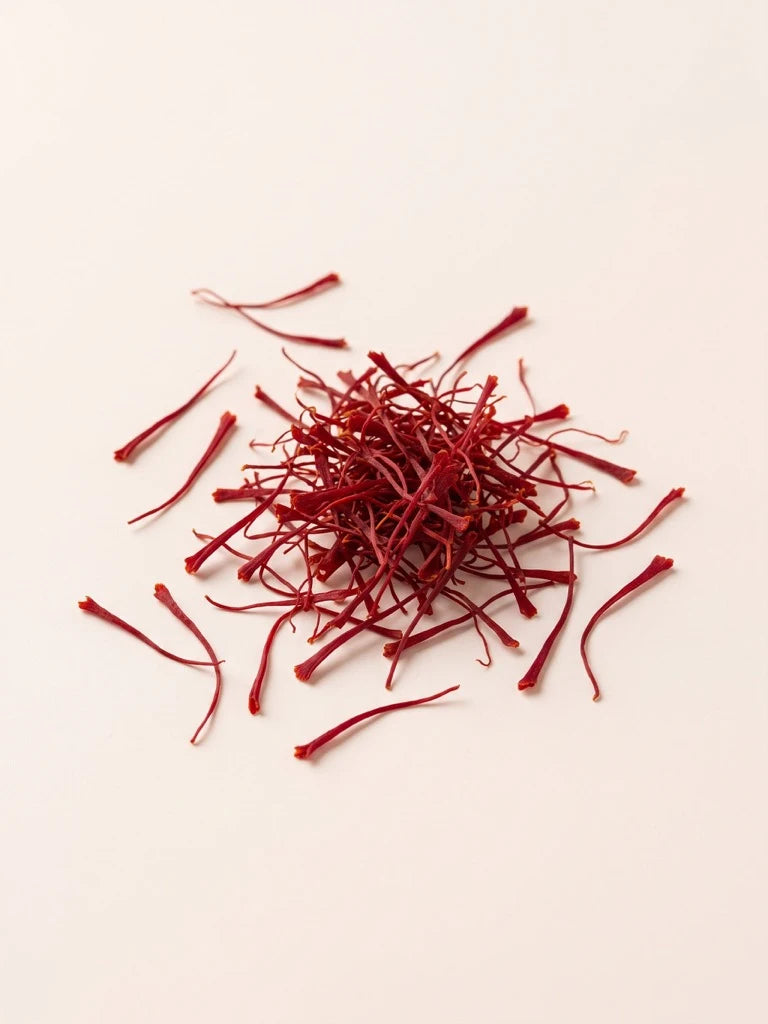
- Good saffron: the water turns a deep, saturated gold. The threads stay red and keep their shape. The aroma is honeyed and hay-like.
- Faded saffron: pale yellow water, weak or slightly flat aroma. Still usable — just use more.
- Something is wrong: the water turns colour almost instantly, or turns orange or red rather than gold, and the threads themselves go pale as the colour bleeds. That is a dye indicator, not an age indicator. Our guide to spotting fake saffron covers what to do next.
Does saffron improve with age?
You will occasionally read that saffron should be rested for a few weeks after harvest before use, and there is something to it — freshly dried saffron can be slightly harsh, and a short settling period rounds it out.
But that is a matter of weeks, not years, and it is not maturation in the sense of wine or cheese. After that brief window everything is downhill. Saffron is at its best young. Buy from a recent harvest, store it properly, and use it.
One practical consequence: a harvest date on the packaging is worth more than a best-before date. A best-before is a manufacturer's estimate. A harvest date tells you what you actually have.
Related: how to bloom and use saffron, what saffron should cost, and how our saffron is dried and sorted.