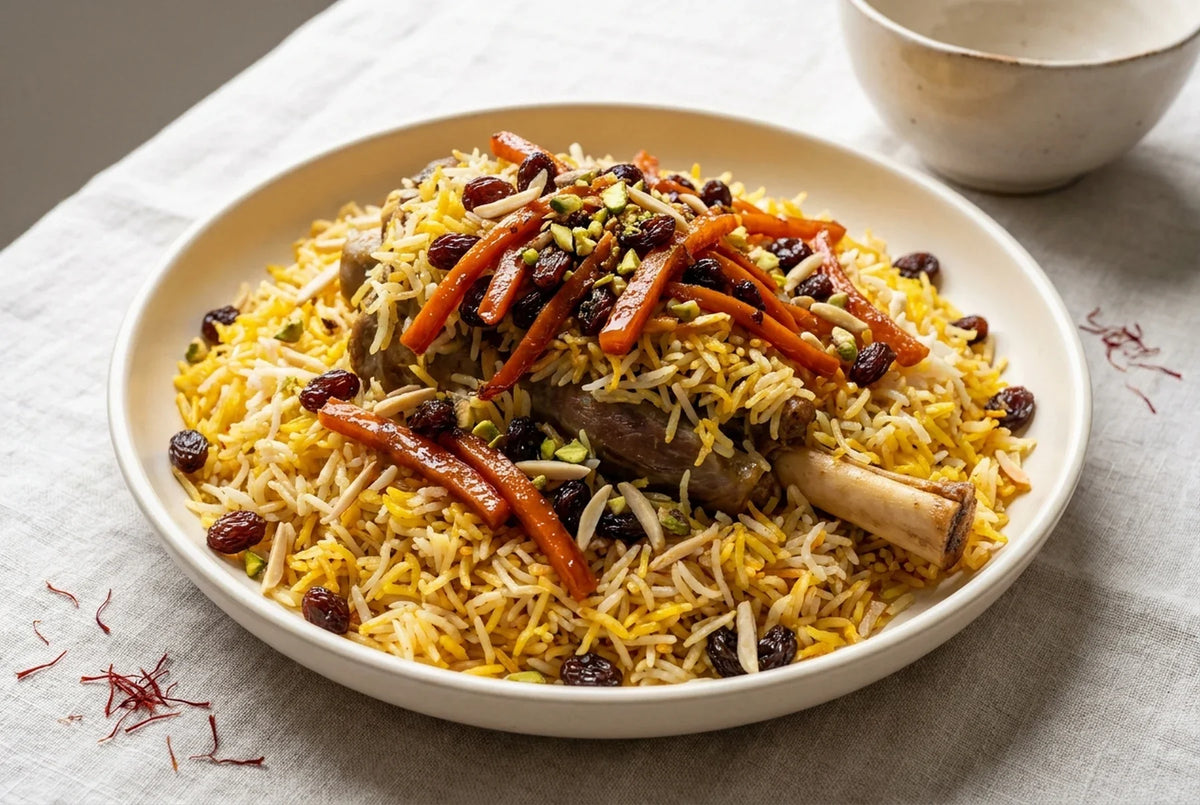
A kabuli palaw recipe gets its brown from caramelised sugar, not from saffron, and this one is honest about that. Saffron joins at the steaming stage instead, where it scents the rice and streaks part of it gold against the dark grains. Lamb shanks, braised until they collapse, do the rest. Forty threads, about 0.16 g, serves eight.
What actually makes palaw brown?
Sugar, cooked to the far edge of caramel and slaked with hot stock. Afghan cooks call the result siyah roghan, and it is the single technique that separates kabuli palaw from every other rice dish. The sugar goes past golden into something close to burnt, so that what it contributes is colour and a faint bitterness rather than sweetness.
People often assume the colour is saffron, and sellers are happy to let them. It is not. Enough saffron to brown eight servings of rice would cost more than the lamb and taste like a chemistry set. Saffron in this dish is aromatic, not chromatic.
The rest is straightforward. Shanks braise in aromatics, their stock parboils the rice, carrots and raisins are candied separately, and everything steams together at the end.
How much saffron goes in, and how do you bloom it?
Forty threads, roughly 0.16 g, across eight servings. That is a modest per-person amount — around five threads each — because the saffron is a top note over caramel, cumin and lamb fat, not the lead. Doubling it will not make the dish twice as good; it will make the rice taste of iodine.
Bloom the threads in warm milk here rather than water. Crush them, add 3 tablespoons of whole milk warmed to about 150°F (65°C), and leave for 20 minutes. Milk fat holds the aroma compounds better than water does, and it lands well against the sweetness of the carrots. Do not let the milk simmer — scalded milk plus saffron gives you a flat, papery smell.
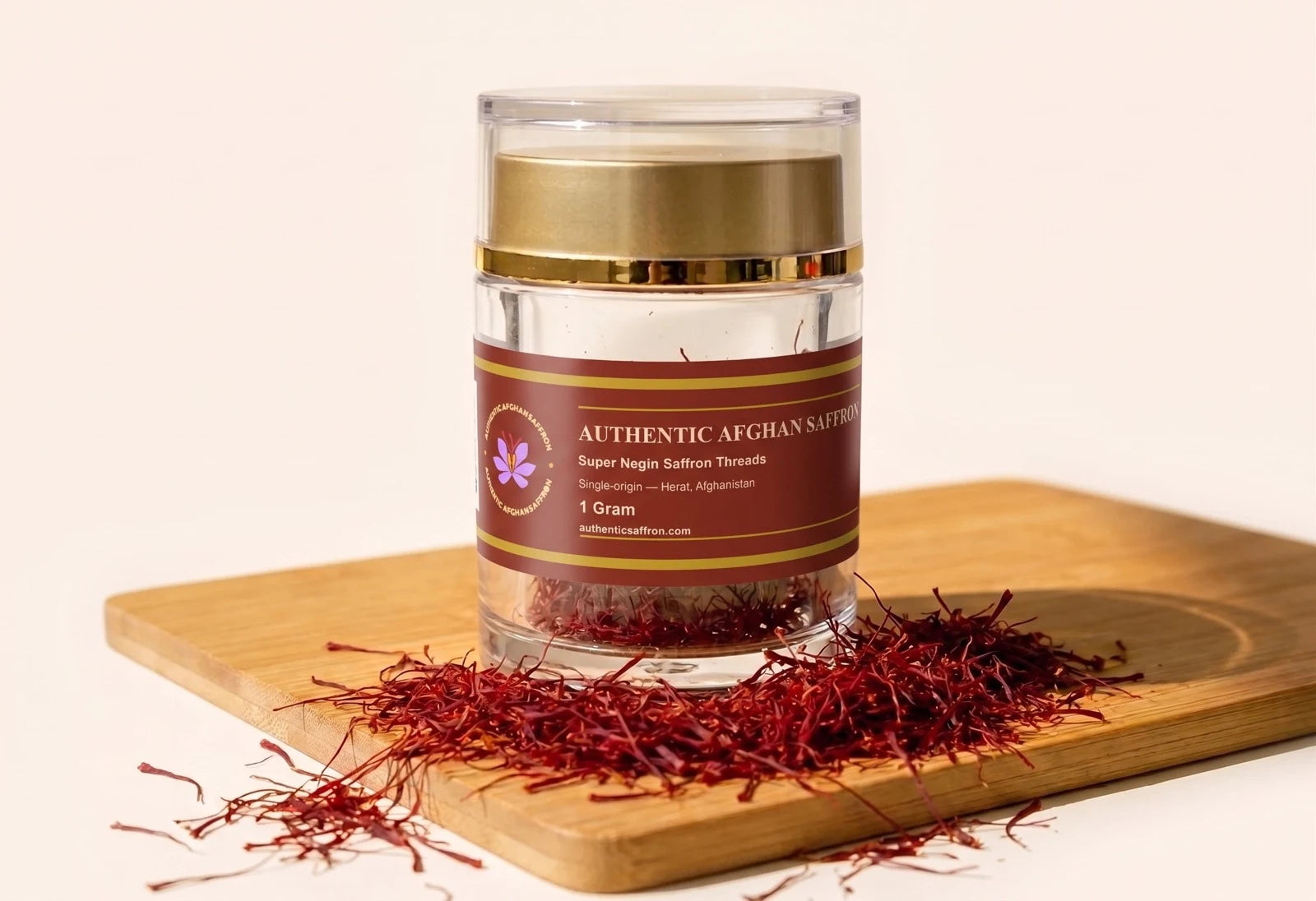
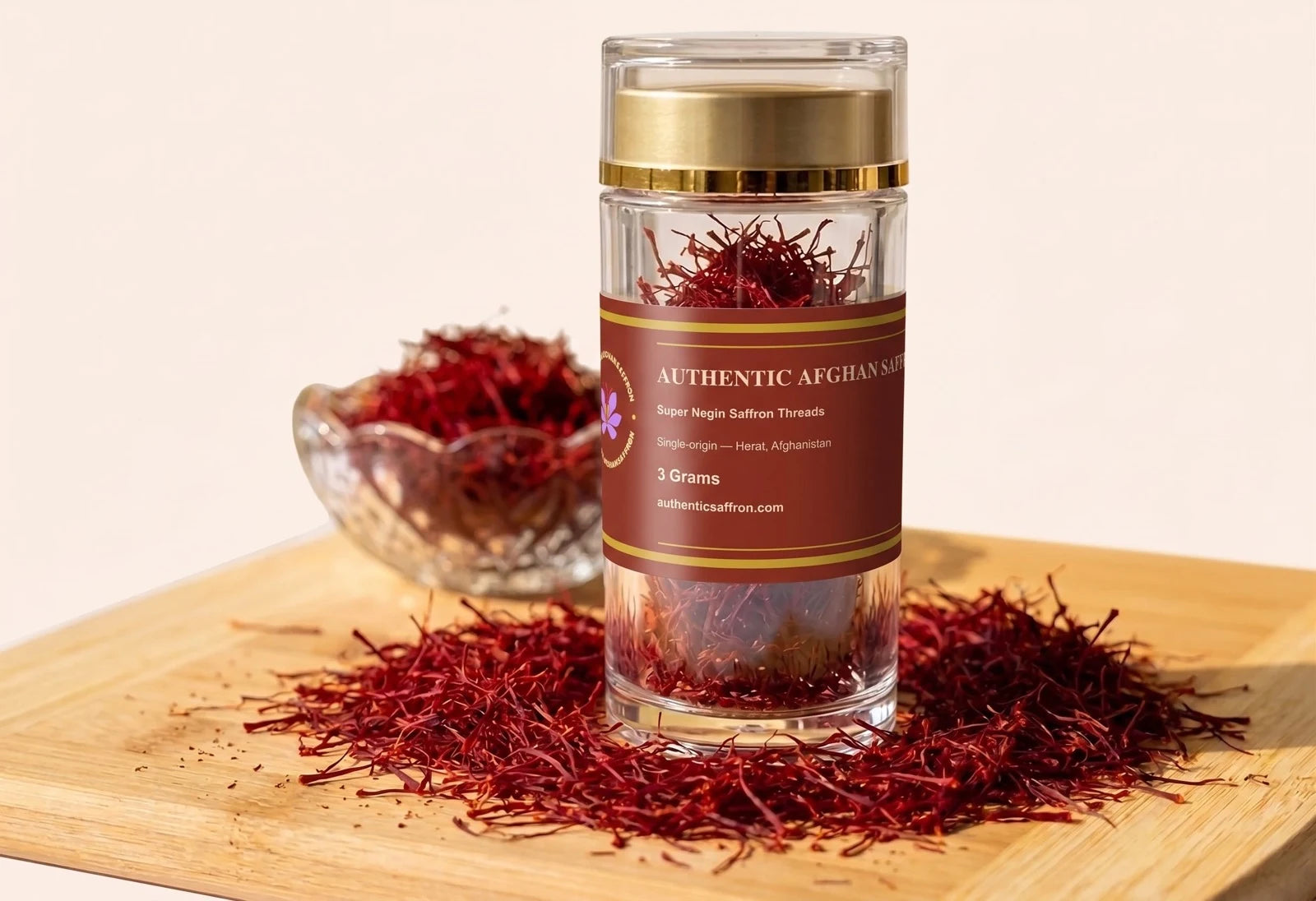
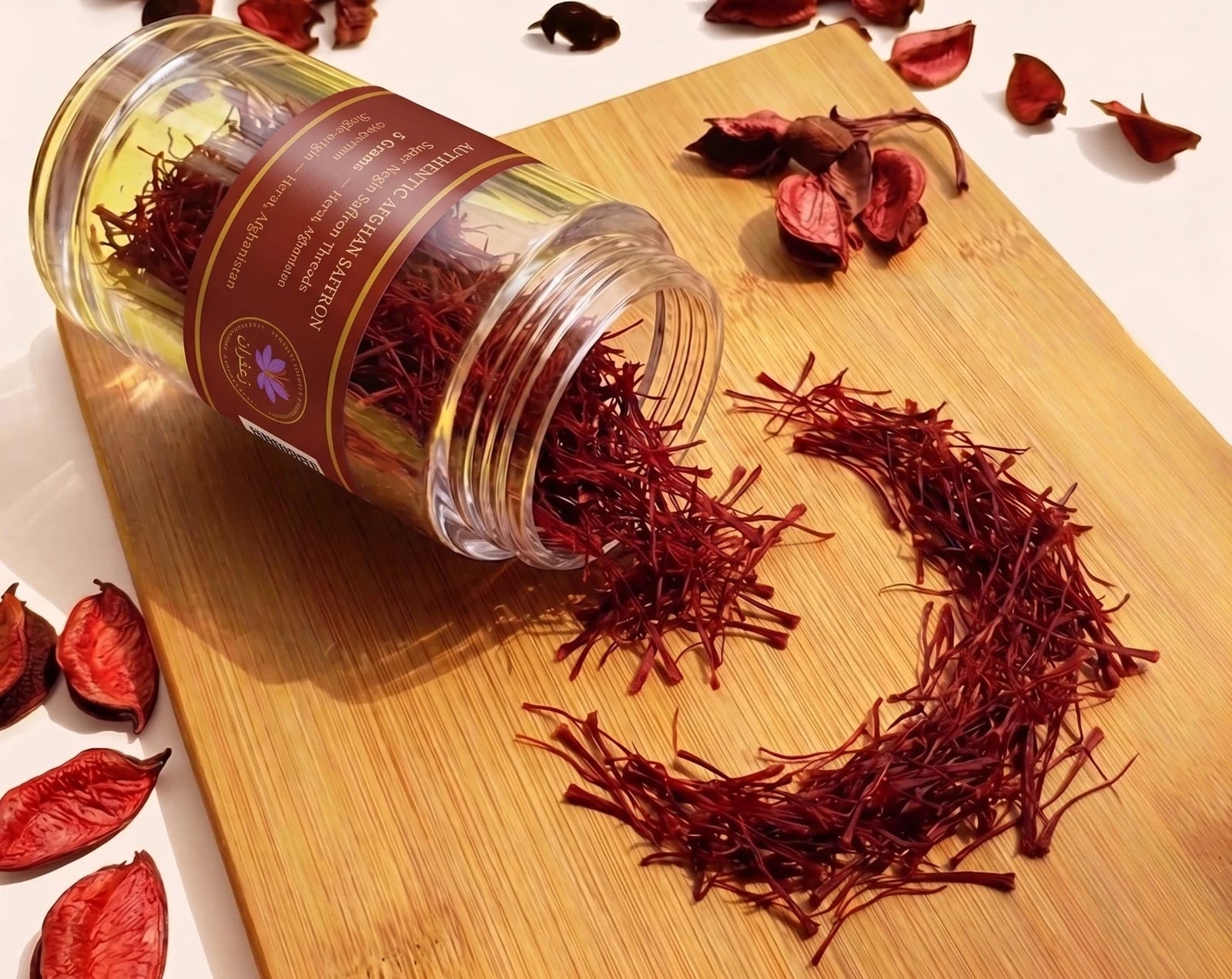
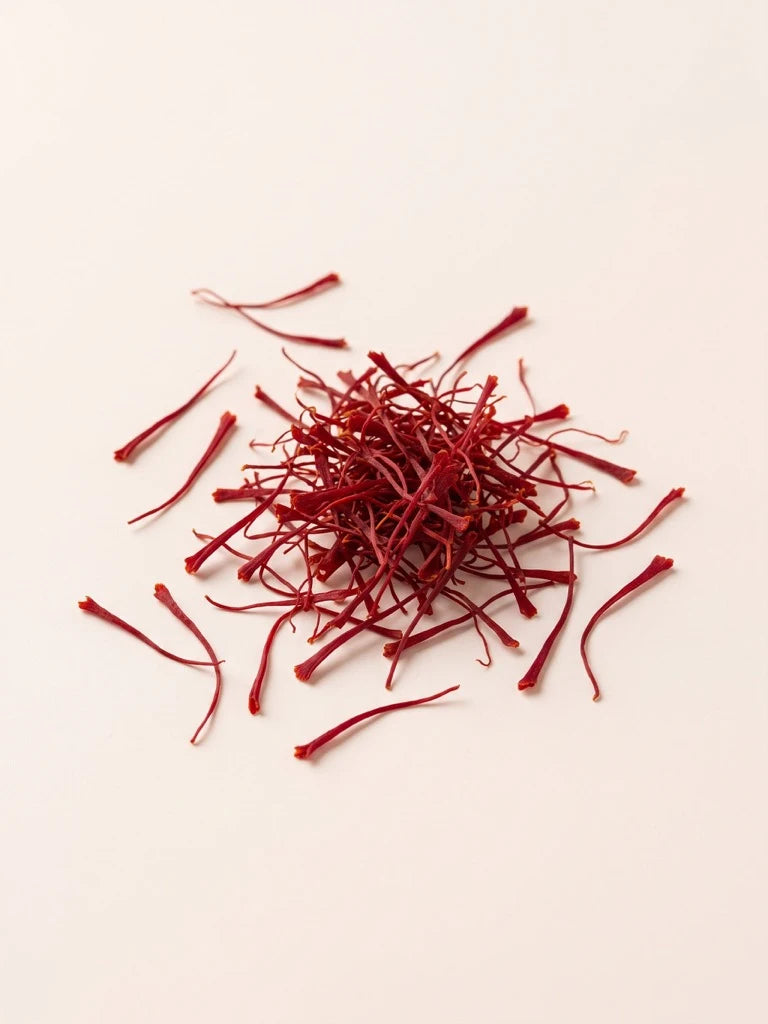
The bloomed milk is poured over one corner of the rice at the steaming stage, so you get bands of gold rather than a uniform tint. Afghan saffron from the Herat valley is what most Afghan households would reach for; if you want to understand the grade distinctions, Super Negin is the long all-red thread you want for this.
What is in it?
Serves eight. You need a heavy 6-quart pot with a well-fitting lid, plus a skillet for the carrots. Set aside an afternoon: the shanks want two and a half hours before anything else begins.
- 4 lamb shanks (about 3½ lb / 1.6 kg)
- 40 saffron threads (about 0.16 g)
- 3 tablespoons whole milk, warmed to about 150°F (65°C)
- 4 cups (800 g) long-grain basmati rice
- 2 large onions, sliced
- 3 tablespoons neutral oil, plus 2 tablespoons for the carrots
- 2 tablespoons granulated sugar
- 1 tablespoon ground cumin
- 1 teaspoon ground cardamom
- ½ teaspoon ground cinnamon
- 2 large carrots, cut into matchsticks
- ½ cup (75 g) raisins or barberries
- ½ cup (60 g) slivered almonds or pistachios
- 2 tablespoons fine sea salt, for the parboiling water
- 1 teaspoon fine sea salt, for the braise
How is it assembled?
- Braise the shanks. Brown the shanks in 3 tablespoons of oil in a heavy pot over medium-high heat, about 4 minutes a side. Remove them, add the onions and cook for 10 minutes until deep gold. Return the shanks, add the cumin, cardamom, cinnamon, the teaspoon of salt and enough water to come halfway up the meat. Cover and simmer very gently for 2½ hours, until the meat pulls from the bone.
- Strain and reserve. Lift the shanks out and keep them warm. Strain the braising liquid into a jug and skim the fat from the top; you want about 3 cups of stock. Wipe the pot clean.
- Bloom the saffron. Crush the saffron threads into a small cup, pour over the warmed milk, and leave to stand for 20 minutes while you work on the rice.
- Candy the carrots. Heat 2 tablespoons of oil in a skillet over medium heat. Add the carrot matchsticks and 1 tablespoon of the sugar and cook for 6 minutes, stirring, until glossy and just tender. Add the raisins and nuts, cook 1 minute more, and set aside.
- Parboil the rice. Rinse the rice five times, then soak for 30 minutes and drain. Bring 4 quarts of water to a hard boil with the 2 tablespoons of salt. Add the rice and boil for exactly 5 minutes, until a grain crushes between finger and thumb with a firm core still in the middle. Drain immediately.
- Make the caramel. In the dry pot over medium heat, melt the remaining tablespoon of sugar without stirring until it turns the colour of dark treacle and begins to smoke faintly, about 3 minutes. Stand back and pour in 1 cup of the reserved stock. It will spit. Stir until the caramel dissolves.
- Layer and steam. Add the remaining stock to the pot, then mound the drained rice on top and smooth it into a dome. Poke five holes through to the base with the handle of a spoon. Spoon the saffron milk over one quarter of the surface. Lay the shanks around the edge and the carrot mixture over the centre.
- Finish under a cloth. Wrap the lid in a clean tea towel, clamp it on, and steam over the lowest heat for 40 minutes. Do not open it. Lift the lid, fold the browned rice up from the base through the pale rice with a wide spoon, and serve with the shanks on top.
Where does kabuli palaw usually fail?
Timing the parboil. Five minutes sounds arbitrary but it is not: the grain needs to be soft outside and chalky inside, because the remaining 40 minutes of steam finishes it. Boil to fully tender and the steaming stage turns it to paste.
- Timid caramel. Golden syrup colour is not enough. Take it to dark treacle and the edge of smoke, or the finished rice will be beige and oddly sweet.
- Wet rice going into the pot. Drain hard and let it sit in the colander for 5 minutes. Residual water pools at the base and steams unevenly.
- Carrots cooked with the rice. They release water and go limp. Candy them separately and add them at the top, where they hold their shape.
- Saffron stirred all the way through. The point is contrast. Pour it over one corner, and fold gently at the end so you keep visible bands.
A note on scale: this dish does not halve gracefully. A smaller pot changes the depth of the rice and so the steam. Cook the full quantity and eat it again the next day.
Frequently asked questions
Is saffron traditional in kabuli palaw?
Not as the source of colour, no. The brown comes from caramelised sugar, and plenty of excellent Afghan cooks use no saffron in this dish at all. Where saffron does appear, it is at the steaming stage as an aroma and as visible gold streaks, which is how it is used here.
Can I make it with lamb shoulder instead of shanks?
Yes. Use about 3 lb of shoulder cut into large chunks and cut the braise to 1½ hours. You lose the marrow and a little of the body in the stock, so reduce the strained liquid by a cup before you use it. Shanks are worth the extra hour if you can get them.
What are barberries and do I need them?
Small dried red berries, sharply sour, sold in Afghan and Middle Eastern groceries. They cut the sweetness of the carrots in a way raisins cannot. If you cannot find them, use raisins and add a squeeze of lemon to the carrot pan instead.
Can the steaming stage be done in the oven?
It can, and it is more forgiving. Cover the pot tightly with foil and then the lid, and put it in a 300°F (150°C) oven for 50 minutes. You will get less of a crust at the base, which some people count as a loss and others as a relief.
Read next
- Chalow, Afghan buttered rice — the plain white counterpart served alongside stews.
- Slow-braised saffron lamb shanks — the same cut, a different destination.
- Why Herat saffron — climate, soil and why the valley matters.
- Inside the Herat harvest — how the threads reach the jar.