"Authentic" is our name. Here's the evidence.
Most "saffron" isn't. Studies of retail saffron have found nearly half of samples adulterated — dyed corn silk, safflower, old threads re-coloured. The only honest answer is proof, so we publish ours: the grade, the lab numbers, the harvest date, and a test you can run at home tonight.
The four claims
What we claim, and how each one is checkable.
Anyone can write "premium" on a jar. These are the four things that can actually be verified — by a laboratory, by a date stamp, or by you, with a glass of warm water.
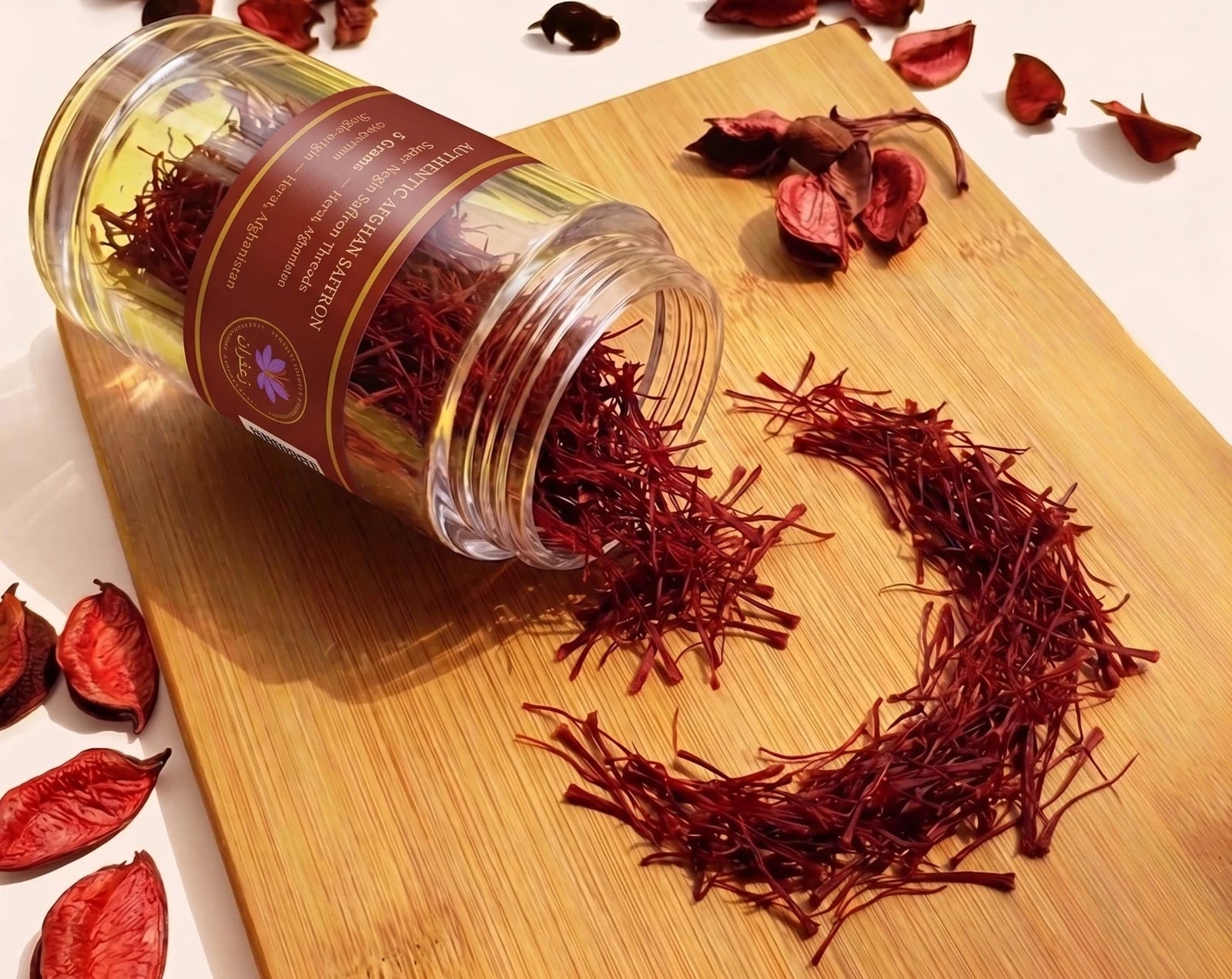
- SUPER NEGIN GRADE — the top of the top. Only the all-red tip of the crocus stigma, cut above the yellow style. Long, unbroken, deep crimson threads.
- INDEPENDENT CURRENT-LOT ISO 3632 TESTING IS PENDING — crocin, picrocrocin, and safranal results will be published with the complete certificate when issued.
- HARVEST-DATED — saffron fades with age. Every bottle carries its harvest season, because fresh matters.
- SINGLE ORIGIN: HERAT — no blending 'Afghan + Spanish', no vague 'imported'.Herat's high-desert valleys grow about 95% of Afghanistan's saffron.
Try this at home
The bloom test
A small sample in warm water can show color-release behavior, but it is not a laboratory certification. Compare the observation with the independent certificate once current-lot testing is complete.
Real Super Negin
- Colours the water slowly — 10 to 15 minutes to full gold
- Threads stay deep crimson, even after steeping
- Trumpet-shaped tips, all red, no yellow style attached
- Honey-hay aroma that fills the room before you taste it
Dyed or adulterated
- Dumps red colour into the water instantly
- Threads go pale or white once the dye leaches out
- Uniform, flat, string-like strands — often safflower or corn silk
- Little or no aroma, or a chemical sweetness
Observe a small sample
No more. Three is enough to see everything you need to see.
Add warm water
Warm, not boiling — about the temperature you'd brew green tea at.
Wait ten minutes
Real saffron takes its time. Watch the gold spread out from each thread.
Look at the threads
Still crimson? Real. Pale and limp with red water? You've been sold a dye.
Film yours and tag us. Returns are accepted within 14 days for sealed, unopened items. Email us first for return instructions.
Where it grows
Why Herat, and nowhere else.
95% of Afghanistan's saffron grows in Herat's high-desert valleys, in the west of the country. The altitude, the dry autumn and the cold nights produce the longest, deepest-red stigmas in the world — which is why Herat's high-desert valleys grow about 95% of Afghanistan's saffron.
Most of the world’s saffron comes from regions American buyers cannot legally source from. Afghan saffron can. That is not a marketing angle; it is the reason the best saffron on earth is finally buyable here.
Proof, not promises
See it with your own eyes.
The field in the Herat highlands and this year's harvest, hand-sorted down to all-red threads. Independent current-lot testing is pending; the complete report will be published when issued.
Our current product disclosure is straightforward: single-origin Herat, harvest-dated bottles, and independent current-lot ISO 3632 testing pending. The complete certificate will be published when issued.
Graded to a standard, not a slogan
ISO 3632 — and why the number matters.
Saffron quality is not a matter of opinion. ISO 3632 measures three things in a laboratory: crocin for colouring strength, picrocrocin for flavour and safranal for aroma. Category I — the top grade — starts at a crocin reading of 200.
Independent current-lot ISO 3632 testing is pending. When the certificate is issued, we will publish the complete measured figures here.
See what we test forISO 3632-1:2010 · the international standard for saffron · crocin, picrocrocin and safranal measured by spectrophotometry
Still sceptical
The questions a careful buyer asks.
How do I know your saffron is real?
ISO 3632 testing of our current lot is underway, and we will publish the full certificate here — laboratory, batch number and date — as soon as it lands. Then try the bloom test at home: real saffron turns water gold slowly while the threads stay red. If yours doesn't, we refund you.
What does "Super Negin" actually mean?
It's the highest commercial grade of saffron: only the all-red tips of the stigma, long unbroken threads, no yellow parts, maximum colouring strength. Grades below it (Negin, Sargol, Pushal) include shorter threads, broken pieces, or the yellow style — which adds weight but no flavour.
What do the ISO 3632 numbers mean?
ISO 3632 measures three compounds by spectrophotometry: crocin for colouring strength, picrocrocin for taste, and safranal for aroma. Category I is the top tier and starts at a crocin reading of 200. Our current lot has not yet been assigned an ISO category; independent testing is pending.
Is it legal to import saffron from Afghanistan?
Yes. Afghan agricultural trade is authorised under U.S. law, and we handle all import compliance so you just enjoy the saffron.
Is your saffron halal?
Saffron is a pure plant product and inherently halal — nothing is added to ours at any stage.
How should I store it?
In its sealed bottle, in a cool dark cupboard. Never the fridge — humidity is saffron's enemy. Kept well, saffron holds peak aroma for 2+ years, but check your harvest date and enjoy it fresh.