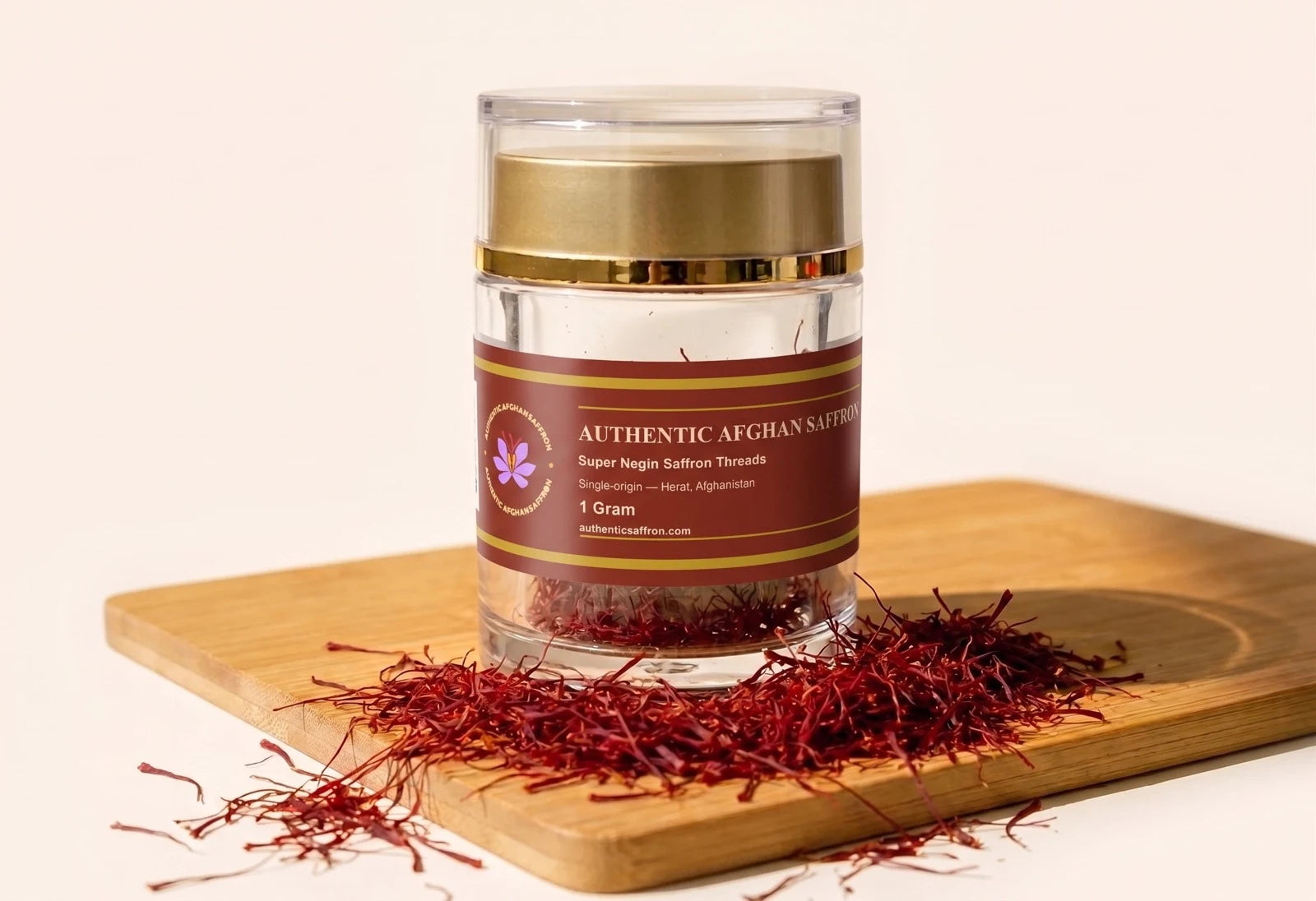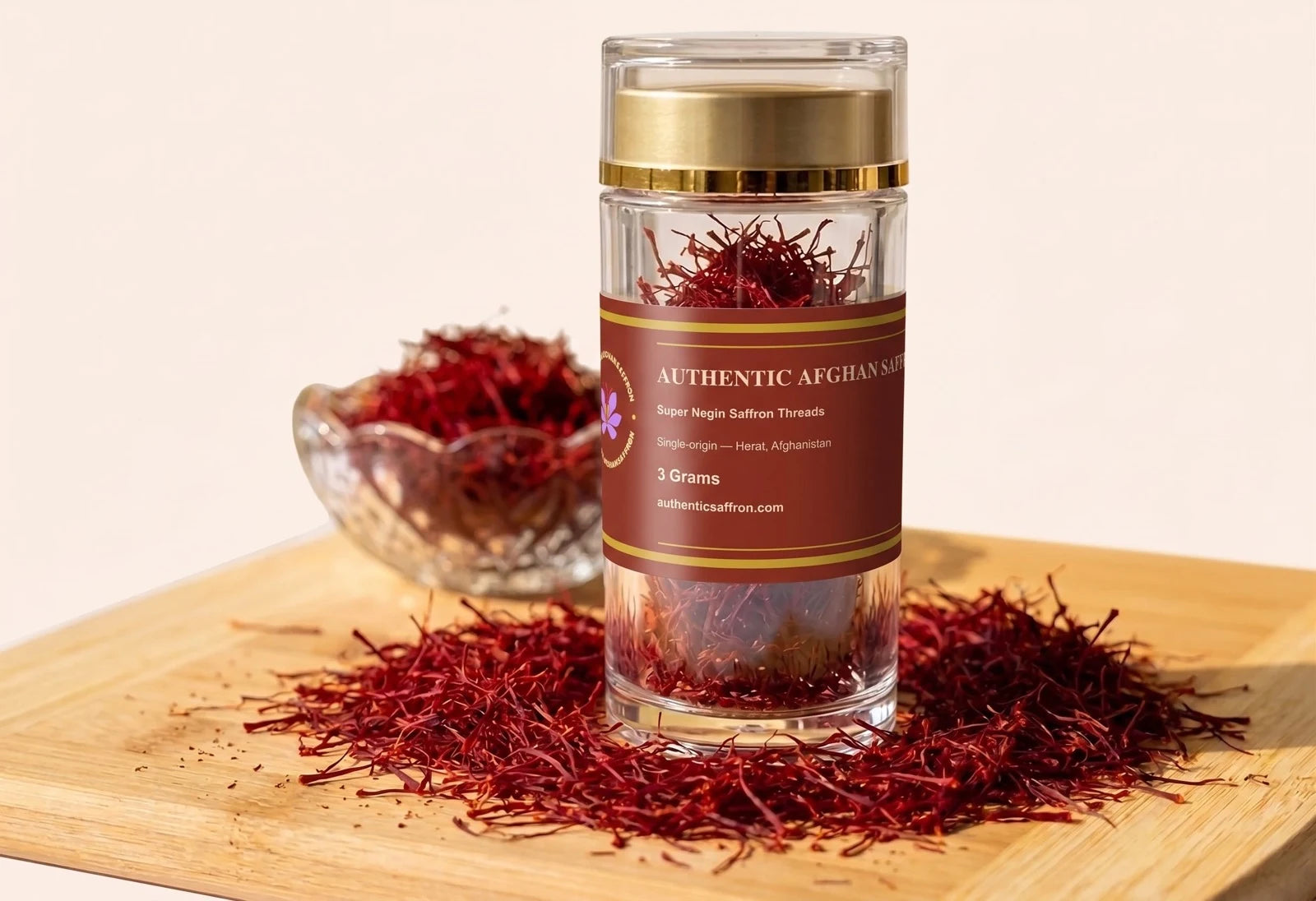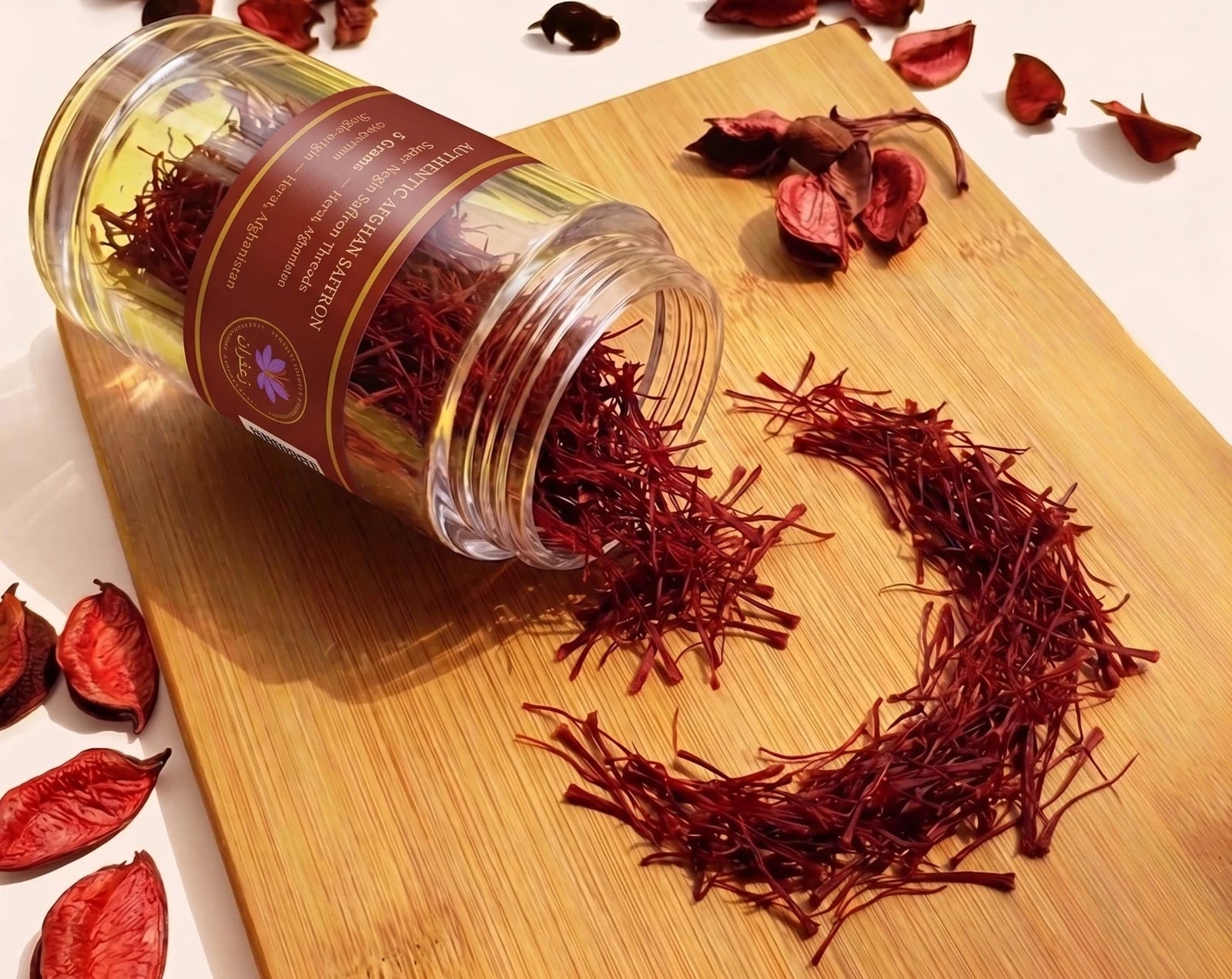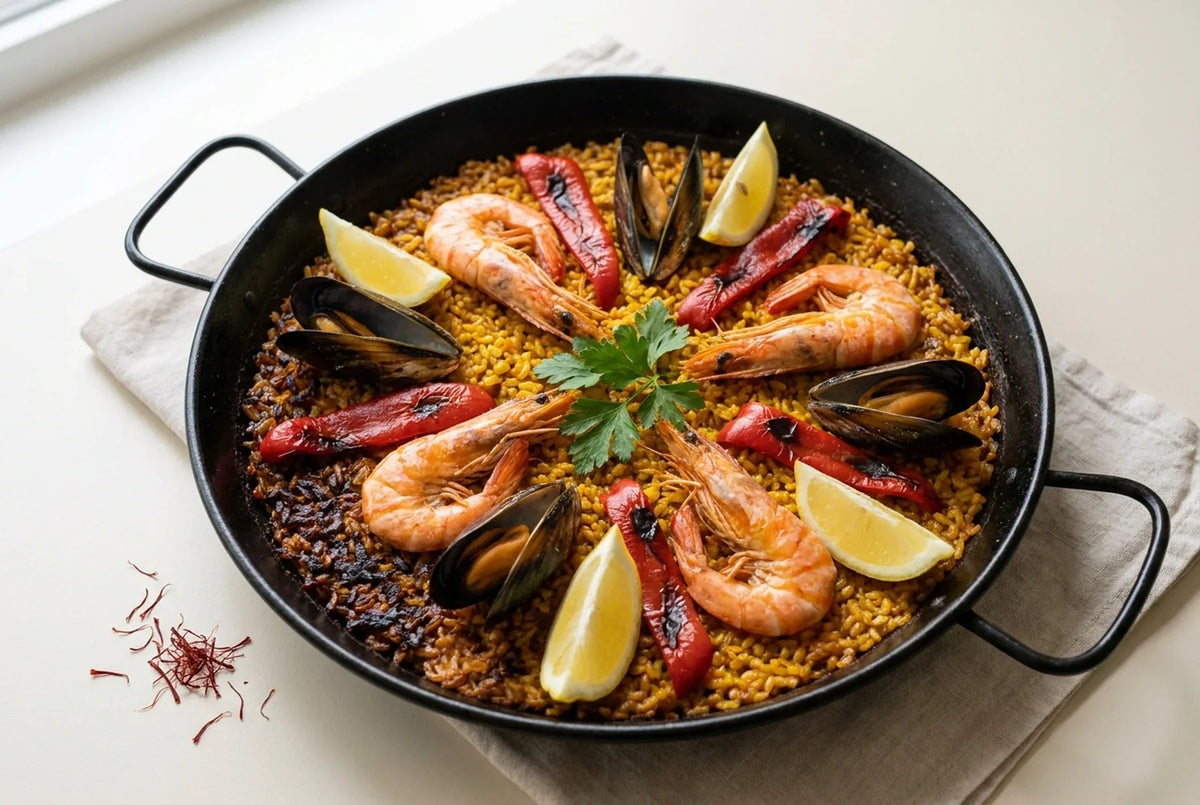
This saffron paella recipe uses about 45 threads, roughly 0.18 g, bloomed in warm stock for twenty minutes and poured in with the broth. Bomba rice, a wide shallow pan, and no stirring at all once the grains go down. Total cooking time is about forty minutes.
Paella comes from the fields around Valencia, and saffron belongs in it — not as a garnish but as one of the two or three things that make the finished rice recognisable. Chorizo does not, whatever the internet says.
Why does paella need saffron rather than colouring?
Because paella has almost nowhere to hide. There is no cream, no sauce, no long-simmered gravy. You have rice, stock, a little browned meat and a sofrito, and every one of those flavours has to be legible on its own.
Saffron does two jobs in that spare setting. It puts a warm, even gold through grains that would otherwise be greyish-beige, and it adds a hay-like aroma with a bitter edge that cuts the fat rendered out of the chicken skin. Yellow food colouring gives you the first without the second, which is why coloured paella tastes flat even when it looks right.
There is also a texture argument. The rice sits in a thin layer and drinks nearly all its liquid, so whatever is dissolved in that stock ends up locked into the grain rather than left in a puddle.
How much saffron does this take?
For a 15-inch pan feeding four to six, use about 45 threads, or 0.18 g weighed. Paella asks for slightly less per head than risotto because the rice layer is thin and there is no dairy to mute the aroma.
Bloom the threads in 1/2 cup of stock held around 150°F (65°C). That is the temperature where steam rises steadily but no bubbles break the surface. Twenty minutes is right; ten will do at a push. Never boil the blooming liquid — safranal, the compound behind the smell, walks off in the steam and you are left with dye.
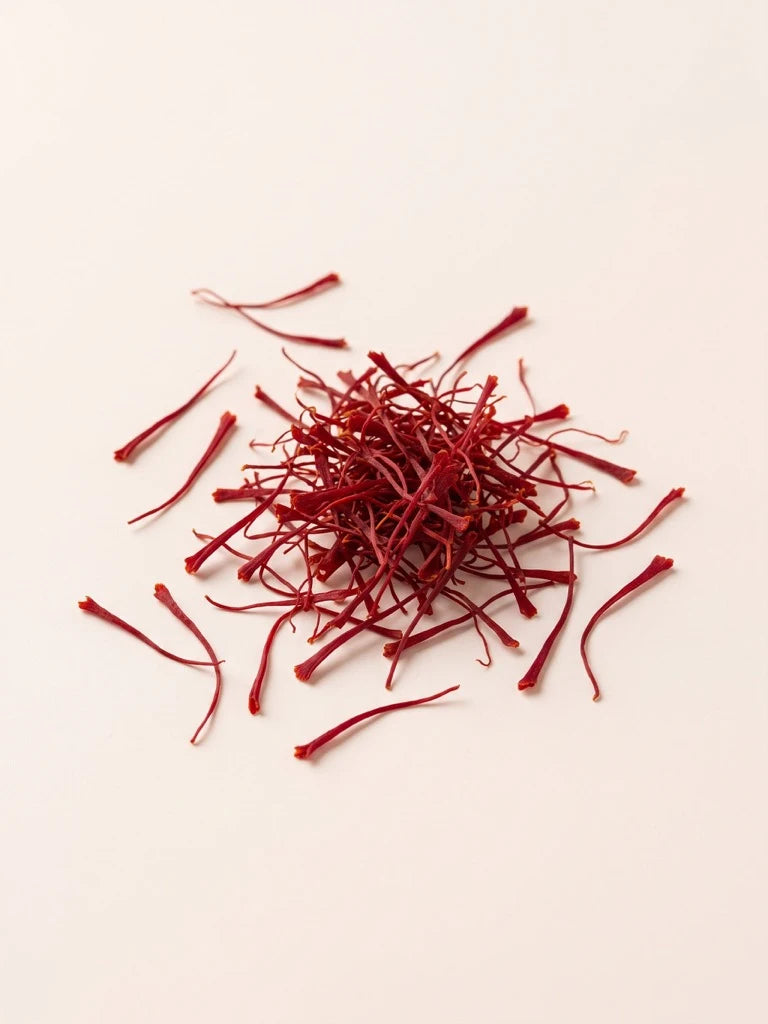
Thread quality changes the arithmetic. Short, deep red, all-red stigmas carry more pigment per gram than threads with pale style attached, so 45 threads of a well-cut Herat Super Negin will out-colour 70 threads of supermarket grade. If you are scaling the pan up or down, our per-person guide gives the ratios.
What goes in the pan?
- 5 cups (1.2 L) chicken stock, lightly salted
- About 45 saffron threads (0.18 g)
- 3 tbsp olive oil
- 1.5 lb (700 g) bone-in chicken thighs, chopped through the bone into 2-inch pieces
- 1 lb (450 g) rabbit, jointed the same way, or more chicken
- 6 oz (170 g) flat romano beans, cut into 2-inch lengths
- 1 cup (150 g) cooked large lima or butter beans
- 1 large ripe tomato, halved and grated on a box grater, skin discarded
- 4 garlic cloves, thinly sliced
- 1 tsp sweet paprika
- 2 cups (400 g) bomba rice
- 1 sprig rosemary
- Fine sea salt
- Lemon wedges, to serve
How is it cooked?
- Bloom the saffron. Heat 1/2 cup of the stock to about 150°F (65°C), steaming but not bubbling, and pour it over the threads. Leave it 20 minutes while you work. Boiling stock would strip the aroma before the rice ever sees it.
- Keep the stock hot. Bring the rest of the stock to a simmer with the rosemary sprig and hold it there. Cold stock hitting a hot pan drops the temperature and the rice cooks unevenly from that point on.
- Brown the meat. Set a 15-inch paella pan across two burners on medium-high with the olive oil. Salt the chicken and rabbit well and brown them for 10 to 12 minutes, turning once, until the skin is properly bronzed rather than pale.
- Cook the green beans. Push the meat out to the rim of the pan and add the romano beans to the centre. Fry for 4 minutes until they blister and take a little colour.
- Build the sofrito. Add the garlic to the middle of the pan and cook for 30 seconds. Pull the pan off the heat, stir in the paprika so it cannot scorch, then return it and add the grated tomato. Cook for 6 to 8 minutes until it darkens to brick red and the oil separates out at the edges.
- Add the stock and the saffron. Pour in the hot stock and all of the bloomed saffron liquid, threads included, and scatter in the lima beans. Bring it to a hard boil and taste: the broth should be a shade saltier than you want the finished rice to be.
- Scatter the rice. Rain the rice evenly across the whole pan and level it with the back of a spoon. This is the last time you touch it. Adjust the burners until bubbles rise across the full surface, not just the middle.
- Boil hard, then ease off. Cook at a strong boil for 8 minutes, then turn the heat down to medium-low for another 8 to 10 minutes, until the liquid has dropped below the rice and the surface looks dimpled and dry.
- Chase the socarrat. Raise the heat for 90 seconds to 2 minutes and listen. You want a fine crackle and the smell of toast. The moment it turns sharp or acrid, take the pan off, because that layer goes from caramel to carbon in about fifteen seconds.
- Rest before serving. Cover the pan loosely with foil or a clean tea towel and leave it for 8 minutes. Serve straight from the pan with lemon wedges.
What ruins a home paella?
Too much rice for the pan. If the layer is deeper than about half an inch the top steams while the bottom scorches. Buy the pan for the number of people, not the other way round.
One burner under a big pan. A 15-inch pan on a single ring cooks a bullseye: done in the middle, raw at the rim. Straddle two burners, and rotate the pan a quarter turn every three or four minutes so the hot spots move.
Under-seasoned stock. Rice is bland by nature and it takes its entire character from the liquid it drinks. Taste the broth at a rolling boil, before the rice goes in, and correct it there.
And the last one: covering the pan while it cooks. A lid traps steam, the surface stays wet, and you never get the dry dimpled top that tells you the water is gone. Cover only during the rest, after the heat is off. Our broader notes on cooking with saffron cover the same principle for other rice dishes.
Frequently asked questions
Do I need an actual paella pan?
A wide, shallow pan matters more than the brand of it. Paella cooks in a layer roughly half an inch deep so the liquid evaporates fast and the bottom can toast. A 12-inch stainless skillet works for two or three people. A deep saucepan will steam the rice into something closer to a pilaf.
Should I ever stir the rice?
No. Level it once when it goes in and then leave it alone. Stirring drags starch out of the grains and turns the surface creamy, which is exactly what risotto wants and exactly what paella does not. It also destroys the crust forming underneath.
How do I know the socarrat is there and not burnt?
Use your ears and nose before your eyes. A good socarrat crackles quietly, like rain on a window, and smells of toasted bread. Burnt smells sharp and slightly bitter. If you want to check, slide a spoon down the side and lift: the layer should come away in a thin sheet the colour of a well-baked crust.
Can I use stock from a carton?
Yes, though buy the unsalted kind and season it yourself. Cartons are usually salted for sipping, and once you boil five cups down into rice the salt concentrates. Taste the broth before the rice goes in, because that is your last chance to fix it.
Read next
- The plain saffron rice method, which is the same blooming logic without the sofrito.
- Saffron fish stew if you want the seafood flavours without fighting over the rice.
- Threads versus powder and why powder is the wrong call for a dish like this.
- The most common saffron mistakes made in home kitchens.