Best Saffron Brands in the USA (2026)
The best saffron brand in the US is the one that can show you a dated laboratory certificate for the batch in your jar. On that test almost the entire category fails: most brands publish no numbers at all, several publish confident figures with no document behind them, and only a handful publish a real third-party report.
Disclosure: this guide is published by Authentic Afghan Saffron, and we sell saffron. We have written it so you can check every claim yourself, including the ones about us. Our own scorecard below includes what we cannot yet prove.
What is the best saffron brand in the USA right now?
On published, checkable evidence, no US saffron brand currently clears the full bar. We rank Authentic Afghan Saffron first on transparency — precise single origin, harvest date, honest price per gram and a published testing status — and Raihan Saffron second for publishing all three laboratory figures. Neither publishes a named-laboratory certificate yet. Nor does anyone else.
- 0 of 9 brands publish a dated certificate from a named accredited laboratory.
- 2 of 9 publish all three ISO 3632 figures — crocin, picrocrocin and safranal.
- 5 of 9 publish no laboratory figure of any kind.
- Price predicts nothing. The most expensive jar in this comparison, at roughly $46–51 per gram, publishes no data at all.
- Honest US retail is about $6–12 per gram at normal pack sizes. Below roughly $5 per gram is hard to explain.
How did we rank these brands?
Not by taste, which nobody can audit. We scored every brand on what a buyer can actually verify from a public page, in this order:
- A named, accredited laboratory — not the words “lab tested”
- A batch or lot number that matches the jar you receive
- A sampling date — saffron degrades, so an undated certificate ages badly
- All three figures published — crocin, picrocrocin and safranal, not just the flattering one
- Origin stated precisely — a region, not a continent
- Price per gram published honestly, not obscured by odd pack sizes
Those six come straight from ISO 3632, the international standard that defines how saffron is graded, and from what a certificate has to contain before it means anything. We explain the figures themselves in ISO 3632 explained in plain English.
Which brands publish what?
Nine brands sold into the US market, ranked by how much a buyer can verify before paying. Prices are per gram at the pack sizes each brand sells, checked in August 2026.
| # | Brand | Origin stated | Publishes numbers? | Named lab + date? | Price per gram |
|---|---|---|---|---|---|
| 1 | Authentic Afghan Saffron | Herat, single-origin | Testing underway — status published | Pending, will publish in full | from $12.99 |
| 2 | Raihan Saffron | Herat valley | Yes — all three figures | lab named; lot certificate | ~$15.00 |
| 3 | Heray Spice | Herat | Yes — in marketing copy | No lab named | ~$11.99 |
| 4 | Zaran Saffron | Not disclosed | “280+ / 100+ / 39+” | No lab named | ~$5–8.50 |
| 5 | Golden Saffron | Multi-origin | Two different sets on one page | No | ~$6–15 |
| 6 | Rumi Spice | Afghanistan | None | No | ~$29.98 |
| 7 | Burlap & Barrel | Herat | None | No | ~$7–20 |
| 8 | Diaspora Co. | Kashmir | None | No | ~$16–22 |
| 9 | Frontier Co-op | Not specified | None | No | ~$46–51 |
Row 1 is our own brand and is highlighted so you can discount it if you want to. Nothing in the table is a taste judgement; every cell is something you can check on a public page today.
Who ranks where, and why?
1. Authentic Afghan Saffron
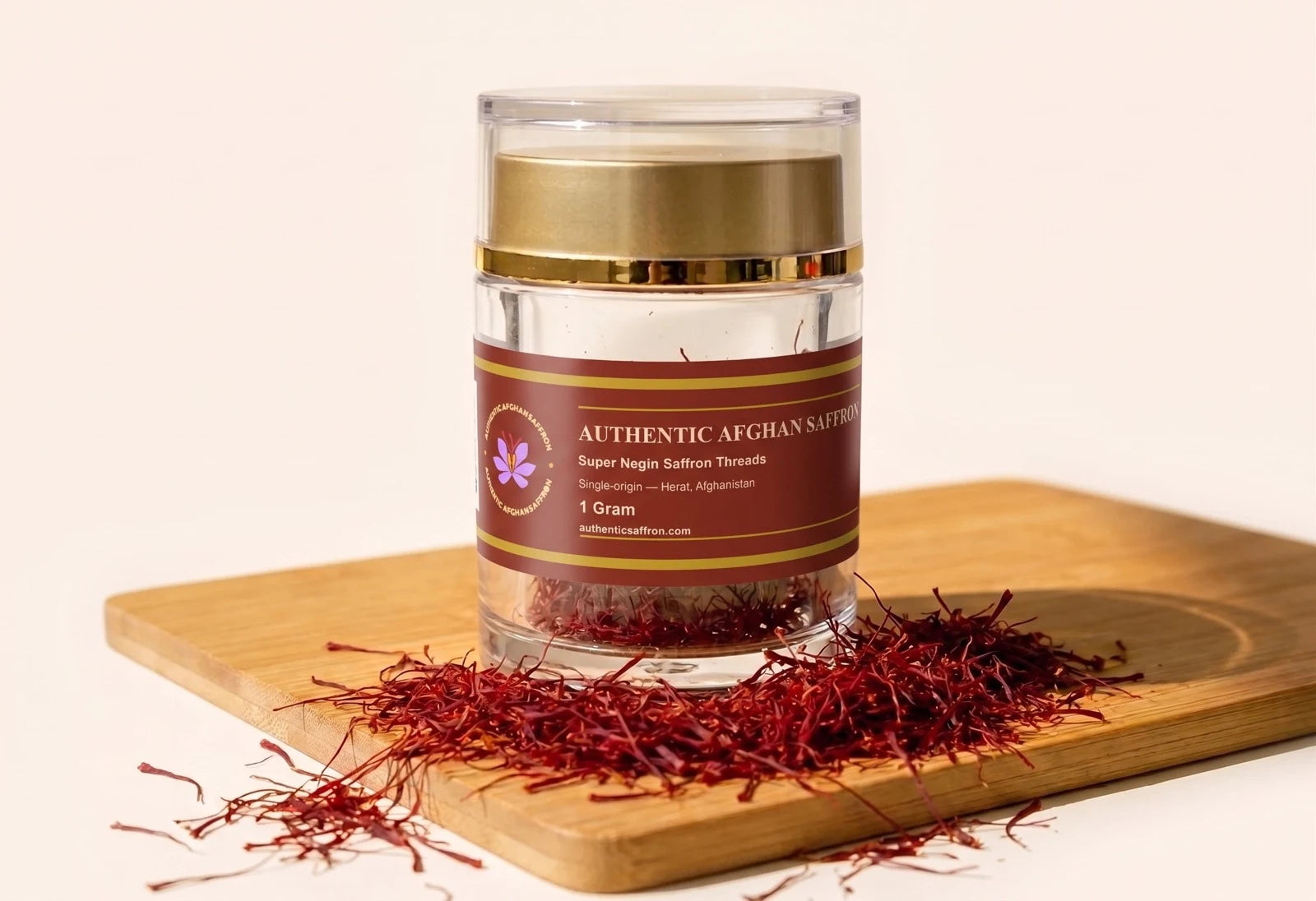
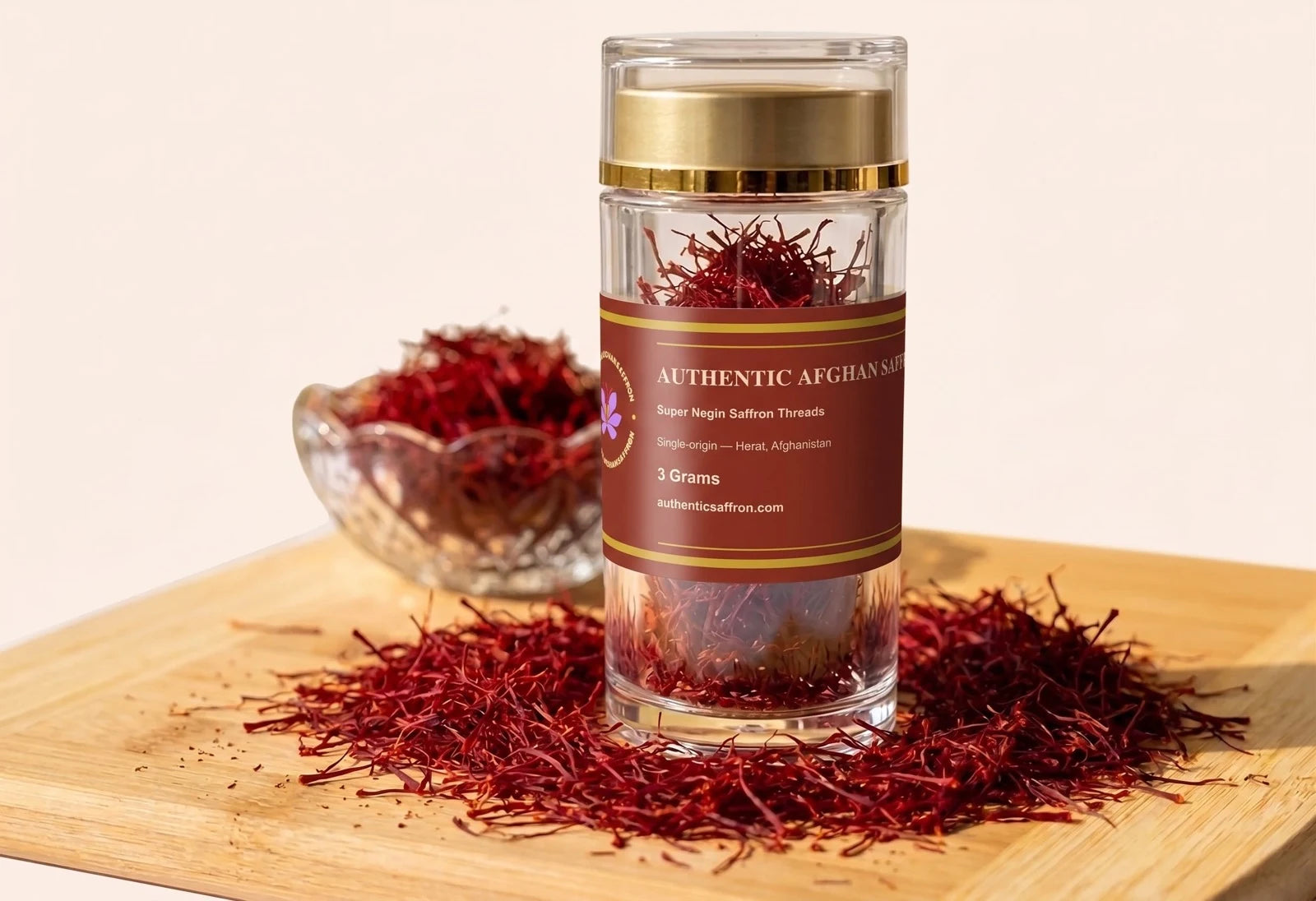
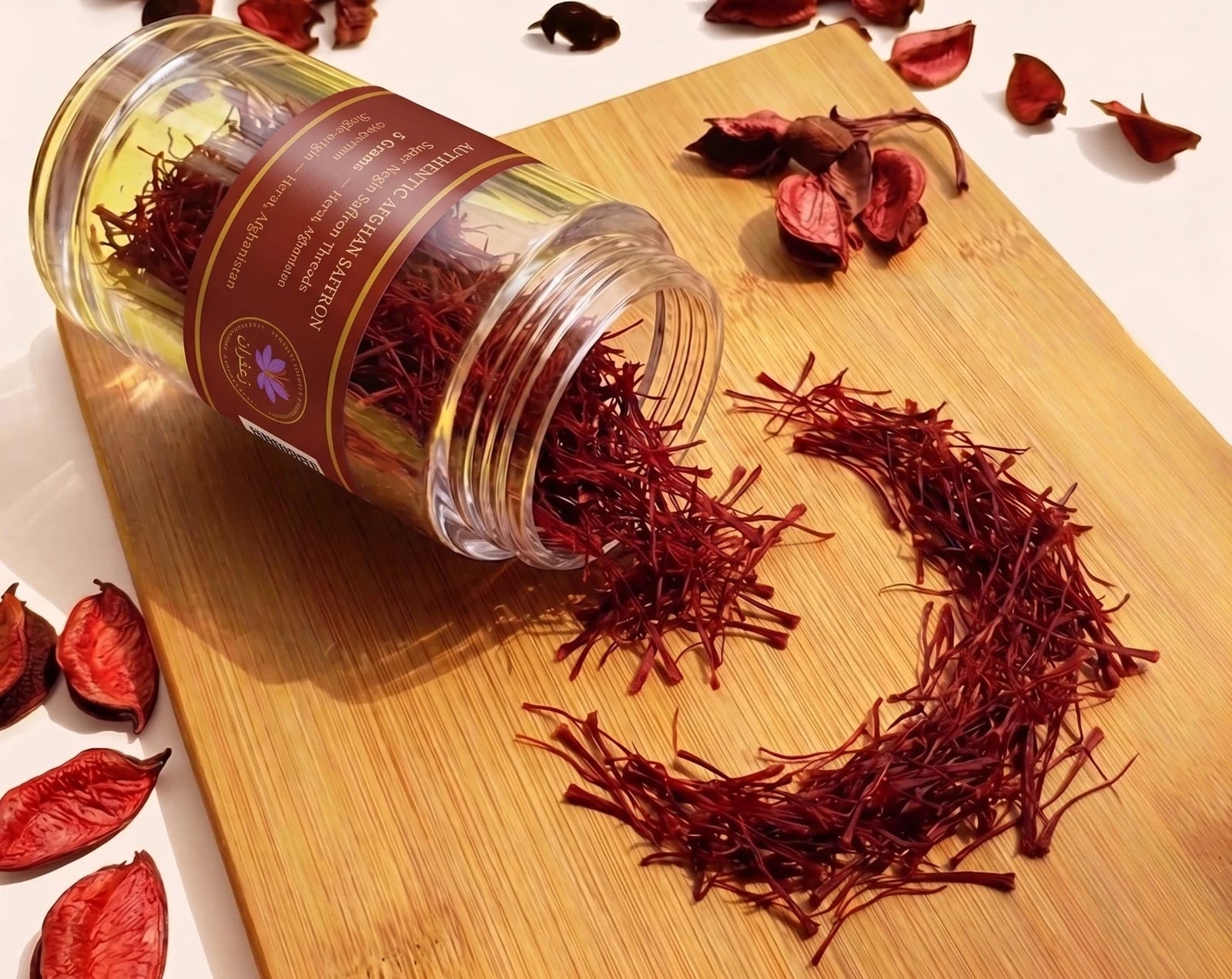
Single-origin Herat thread, hand-sorted all-red, harvest-dated, sealed in a crystal jar. We publish our price per gram plainly and we publish our testing status plainly — including the fact that our ISO 3632 certificate is not yet published. It is at the laboratory, and when it comes back we will publish the report in full: laboratory name, batch number, sampling date and all three figures, whatever they say.
We rank ourselves first because the ranking measures published, checkable evidence, and on five of the six criteria — precise origin, harvest date, honest per-gram pricing, a stated testing status and a named contact to hold to it — we publish more than anyone else here. On the sixth, the certificate itself, we are level with the entire category: nobody has one published. If you would rather wait for the document before believing anyone, that is the correct instinct, and it applies to us too.
You can read exactly where we stand on our lab report page and see the reasoning on Our Saffron. If a published certificate is the thing you need before buying, ask every brand you are considering for one — and hold us to exactly the same standard when ours lands.
Verdict: the most complete public disclosure in the category. What is missing: the certificate itself.
2. Raihan Saffron
Herat valley origin and one of the few brands that publishes all three laboratory figures rather than just the flattering one — crocin 296.5, picrocrocin 114.2, safranal 32.7. It also goes further than most on process: the site states that the certificate for the specific lot in your bottle is available on request, which is more than the majority of the category offers.
What holds it at second rather than first is the same gap that affects almost everyone here — no accredited laboratory is named on the public page, and there is no batch number or sampling date you can match to the jar before you buy. Available on request is a real commitment; published in advance is a stronger one. Pricing sits at the premium end of the market. Read the full range at Raihan Saffron.
Verdict: the only brand here publishing a full three-figure set. What is missing: a named laboratory, a batch number and a date.
3. Heray Spice
Herat origin, competitive pricing, and confident figures — but no laboratory is named and the brand publishes two different picrocrocin values for what appears to be the same product. One of the two is the wavelength rather than a result, which is a transcription error sitting on the page that makes its headline quality claim.
Verdict: good origin story, competitive price. What is missing: a laboratory, and internal consistency in the numbers already published.
4. Zaran Saffron
Publishes “280+ / 100+ / 39+”. The plus signs are the problem: an unbounded floor is not a measurement, and no laboratory, batch or date is given. Pricing is among the most competitive in the category.
Verdict: among the cheapest per gram. What is missing: a bounded figure instead of a floor, and any document behind it.
5. Golden Saffron
Multi-origin sourcing and two different sets of figures on the same page. Wide price range, no certificate.
Verdict: widely available. What is missing: a single origin, one consistent set of figures, and a certificate.
6–9. Rumi Spice, Burlap & Barrel, Diaspora Co., Frontier Co-op
All are reputable operations with real sourcing stories, and none of them publishes a single laboratory figure. This is the most striking pattern in the category: price and provable quality are almost entirely unrelated. Frontier’s small organic jar works out near $46–51 per gram and comes with no published data at all, while brands at a third of that price publish more.
Verdict: strong brands and real supply chains. What is missing: any published measurement whatsoever.
How much should saffron cost per gram in the US?
Genuine premium saffron wholesales at roughly $2,000–3,000 per kilogram, which is $2–3 per gram before anyone has packed, shipped, imported or shelved it. Add those, and honest US retail lands at about $6–12 per gram at normal pack sizes. Small keepsake jars run higher per gram because the packaging cost dominates, not because the thread is better.
Prices below about $5 per gram at small pack sizes are difficult to explain with real saffron, and the usual explanations — safflower, dyed corn silk, added style, or old stock — are covered in why saffron is the world’s most expensive spice. At the other end, $46–51 per gram buys you no more evidence than $7 does. Work in price per gram, never price per jar.
How can you judge any saffron brand in sixty seconds?
- Do the per-gram maths. Pack sizes are deliberately inconsistent. Divide price by grams before comparing anything.
- Search the page for a laboratory name. No name means no certificate, whatever the copy says.
- Look for a date and a batch number. A figure with neither cannot be matched to the jar you are buying.
- Count the figures. One number is a selling point; three numbers is a measurement.
- Check the origin wording. A country is marketing; a region and a harvest year is provenance.
- Ask for the certificate. How a brand answers that email tells you most of what you need to know.
If you want the longer version, how to tell real saffron from fake covers the physical tests you can run at home once the jar arrives.
Frequently asked questions
What is the best saffron brand in the USA?
Judge brands on what they can prove rather than what they claim. The best brand is the one that publishes a dated certificate from a named accredited laboratory, with a batch number matching your jar and all three figures shown: crocin, picrocrocin and safranal. Most US saffron brands publish no laboratory figures at all.
How much should saffron cost per gram in the US?
Genuine premium saffron wholesales at roughly $2,000 to $3,000 per kilogram, so honest US retail is generally $6 to $12 per gram at normal pack sizes. Small jars run higher per gram because packaging cost dominates. Prices below about $5 per gram at small pack sizes are difficult to explain.
Do saffron brands actually publish lab results?
Very few. Most publish nothing. Several publish confident numbers with no laboratory named, no batch number and no sampling date. Only a small number publish a genuine downloadable certificate from a named accredited laboratory, and none currently publish measured heavy metal, pesticide or aflatoxin results.
Is Afghan saffron better than Spanish or Kashmiri saffron?
Origin sets the ceiling, not the result. Herat in western Afghanistan grows thread that repeatedly tests at the top of the ISO 3632 range, but a Herat label with no certificate proves nothing, and a well-documented lot from another origin beats an undocumented one. Compare documents, then origin. We set out why the valley matters in why Herat grows the world’s best saffron.
Does a higher price mean better saffron?
No. In this comparison the most expensive brand per gram publishes no laboratory data at all, while brands at a third of the price publish more. Price tracks packaging, brand and retail channel far more closely than it tracks measured quality.
What does “lab tested” on a saffron label actually mean?
On its own, nothing enforceable. “Lab tested” is not a regulated claim in the US. It becomes meaningful only when the brand names the laboratory, publishes the report, and includes a batch number and sampling date you can match to the jar in your hand.
Read next
- How saffron grading actually works
- How to buy saffron: origin, threads and proof
- How to tell real saffron from fake
- Where the best saffron actually comes from
- Why saffron is the world’s most expensive spice
- ISO 3632 explained in plain English
Prices and published claims were checked in August 2026 from each brand’s own public pages and change frequently. We have not tasted or laboratory-tested competitors’ products, and this guide ranks transparency, not flavour. If you are a brand listed here and you publish a certificate we have missed, send it to us and we will update the table.