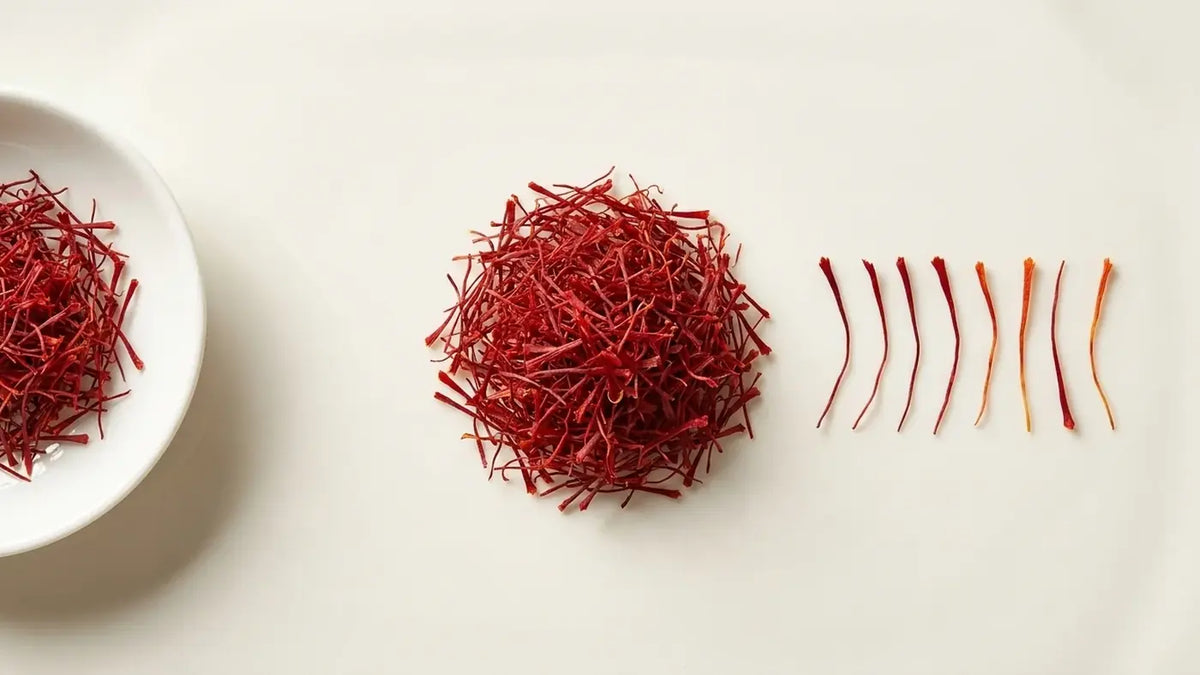
ISO 3632 explained without the jargon: it is the international standard that defines how saffron is described, sampled and tested. It sets out three quality categories and the laboratory methods used to place a batch in one of them. It is a specification for the spice, not a licence for the seller.
You will see the number on packaging, in product descriptions and in a great deal of marketing that does not quite say what it appears to say. It is worth knowing what the standard contains, because the gap between what it defines and what it is used to imply is where most of the confusion lives.
What is ISO 3632 in one paragraph?
It is a document published by the International Organization for Standardization covering dried saffron from Crocus sativus. It gives the trade a shared vocabulary and a shared test method, so that a buyer in one country and a producer in another can describe the same material in the same terms. The current edition of the specification is ISO 3632-1:2025.
Before standards like this existed, quality claims were essentially adjectives. The standard replaces adjectives with wavelengths.
Why does the standard come in two parts?
Because describing a thing and measuring it are separate jobs.
- Part 1 is the specification. It defines what saffron is, the forms it is sold in — filaments, cut filaments, powder — the three quality categories, and the limits a sample has to meet for each.
- Part 2 is the test methods. It sets out sampling, preparation and the analytical procedures, including the spectrophotometric readings that produce the familiar colouring strength figure.
A report that quotes a number without naming the method it followed is quoting half a standard. If you want the notation on those readings unpacked, see what an E1 1cm figure means.
What does the standard actually measure?
Rather more than colour, which surprises people. The parameters below all appear in a full analysis.
| Parameter | How it is assessed | What it guards against |
|---|---|---|
| Colouring strength | Absorbance at 440nm | Weak, exhausted or heavily diluted saffron |
| Bitterness | Absorbance at 257nm | Flat, characterless material with little picrocrocin |
| Safranal | Absorbance at 330nm | Both under-developed aroma and over-drying, since a ceiling applies |
| Moisture and volatile matter | Loss on drying | Water sold at the price of spice |
| Total ash | Incineration of a weighed sample | Mineral bulking agents and general dirtiness |
| Acid-insoluble ash | Ash treated with acid | Sand, soil and grit specifically |
| Floral waste and foreign matter | Visual and physical examination | Style, stamen, petal and plant debris padding the weight |
The exact numerical limits for each parameter, and how they tighten from Category III up to Category I, are defined in the standard itself. We go through the category bands in Category I, II and III explained.
What does ISO 3632 not cover?
This list is the important half of the article.
- Origin. The standard has nothing to say about where saffron was grown. A Category I result from Afghanistan, Spain, Greece or Morocco is the same result.
- Pesticide residues and heavy metals. These are food safety matters governed by other regulations and other tests entirely.
- Adulteration by dye. The methods look at absorbance and ash, not at whether a synthetic colourant has been added to lift a reading. Detecting that takes separate analytical work.
- Ethics and labour. Nothing in the document addresses how the harvest was paid for.
- The batch in your kitchen. A test result describes the sample that was submitted, on the day it was submitted.
None of that makes the standard weak. It makes it specific. Problems arise only when a specific tool is presented as a general guarantee.
Does ISO certify saffron sellers?
No. ISO writes standards; it does not test spice and it does not approve companies. What exists in practice is a laboratory report showing that a submitted sample met the limits for a given category under the ISO methods. That is a test result on a sample, with a date and ideally a batch number, and it is a genuinely useful document.
What it is not is a permanent badge attaching to a brand. A company that tested one lot in a previous season and now prints the standard number on every pouch is stretching the meaning of the paperwork.
Our own analysis is done and the complete report, sample identifier and all, is on our lab report page rather than summarised into a claim: crocin 294.5, picrocrocin 111.2, safranal 33.7, Category I.
How is the standard misused in marketing?
Four patterns come up constantly.
- The number with no document. A listing states a colouring strength but offers no report to look at. Ask for the report; the answer is informative either way.
- The invented tier. Terms such as Extra, Premium and Grade A are commercial labels, not categories defined by the standard. We look at one of these in the Extra class question.
- The undated report. Saffron changes with storage, so an analysis without a date describes a moment that may be years gone.
- Category as proof of authenticity. Meeting a category threshold shows a sample performed to a level. It is not by itself evidence that nothing was added.
Read alongside the rest of what a seller will tell you about a batch, an ISO-method report is one of the more informative pieces of evidence available. Read alone, it is a number. Our broader view sits on the saffron grading and quality page.
Frequently asked questions
Is ISO 3632 a food safety standard?
No. It is a quality and description standard covering composition, categories and test methods. Food safety matters such as pesticide residues, contaminants and labelling are handled by separate regulations in each market.
Who issues an ISO 3632 test result?
An analytical laboratory, working to the methods in Part 2 of the standard. ISO itself neither tests samples nor approves companies. The credibility of a result rests on the laboratory that produced it and on the sample it was given.
Does Category I mean the saffron is genuine?
Not on its own. Category I describes how a sample performed against the thresholds for colour, bitterness and aroma. Authenticity is a separate question that needs different tests, plus a supply chain you can actually trace.
Is following ISO 3632 mandatory for sellers?
Generally not. It is a voluntary international standard rather than a law. Its force comes from trade contracts and buyer expectations, which is why serious buyers ask for results and casual sellers rarely volunteer them.