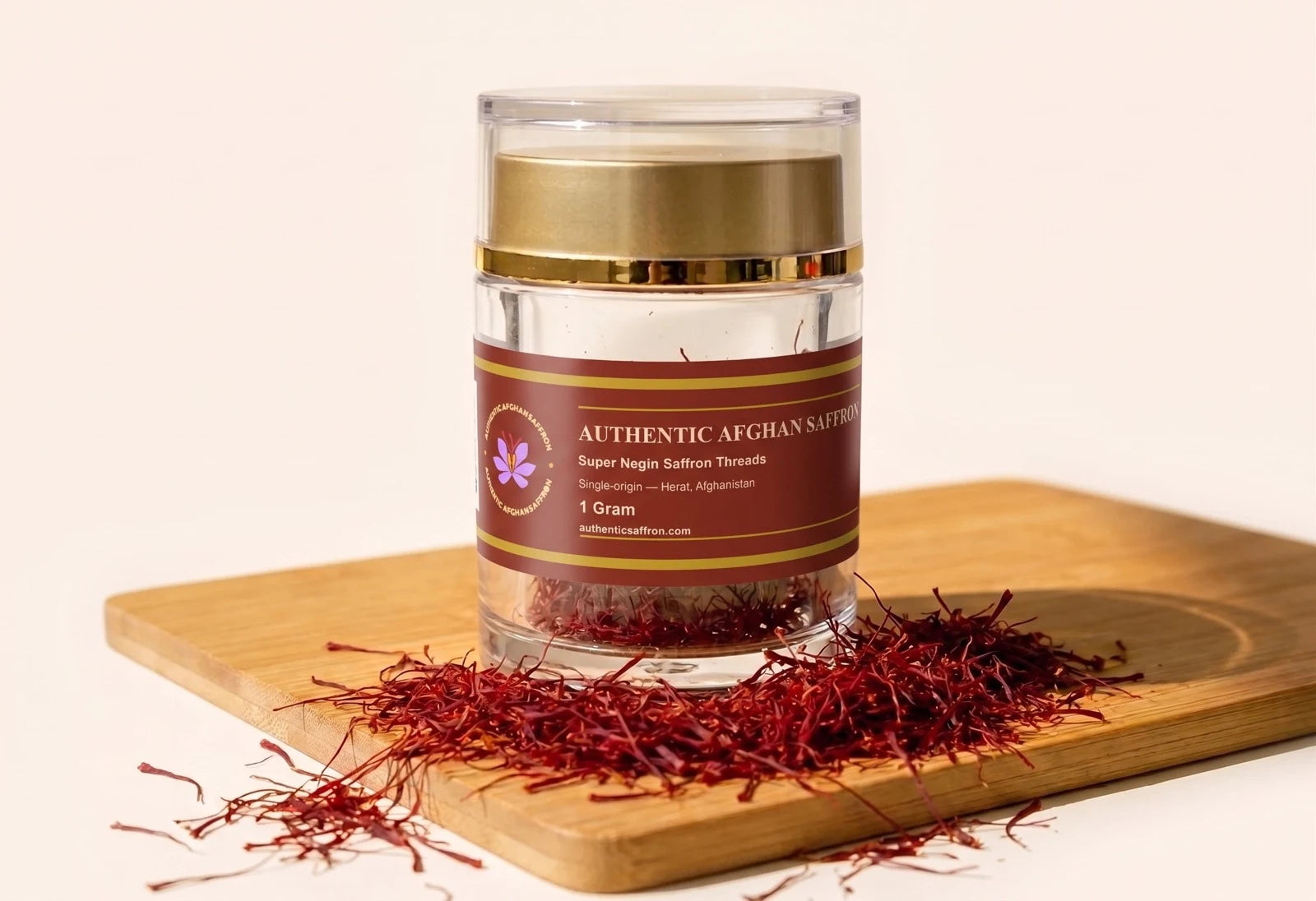
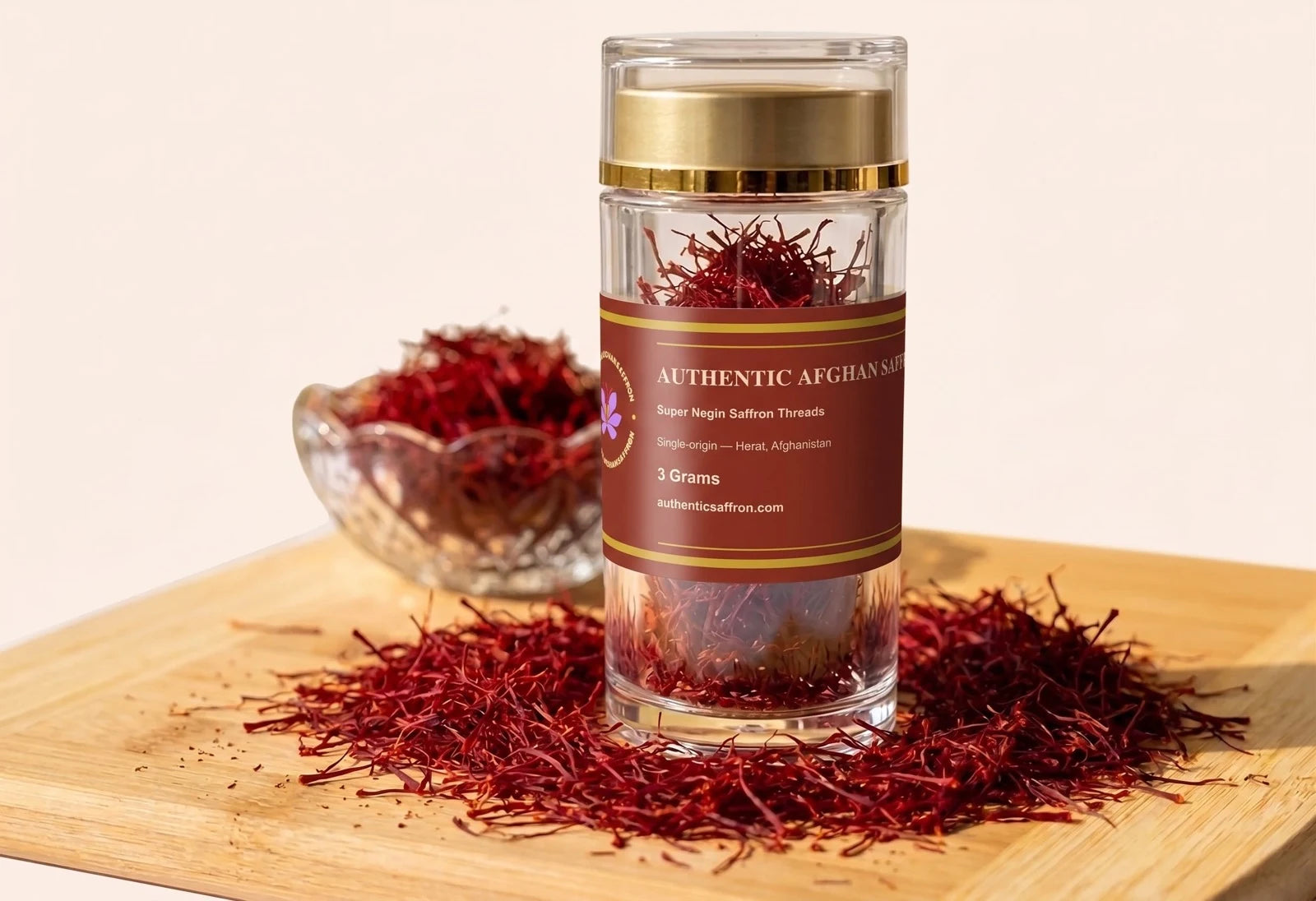
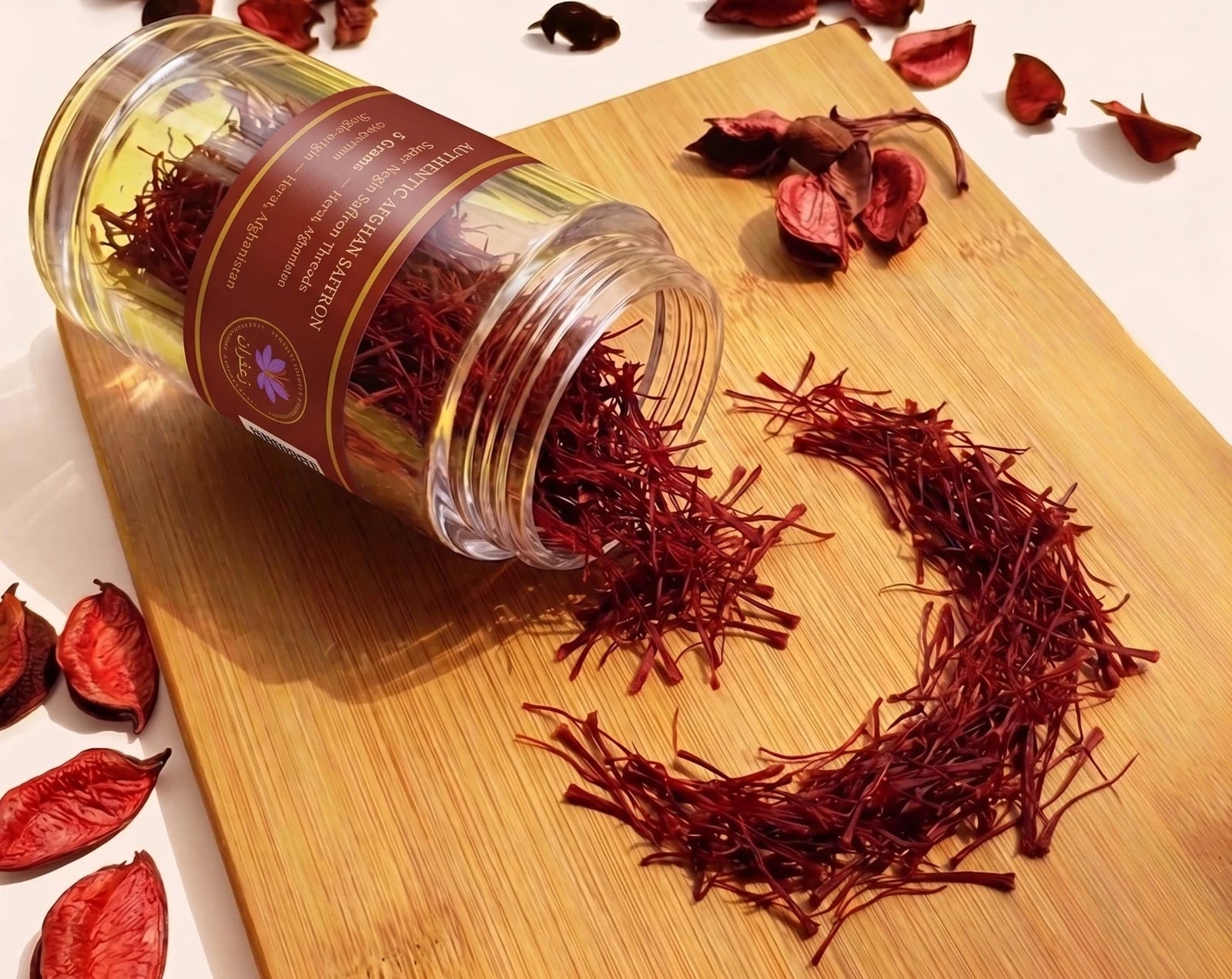
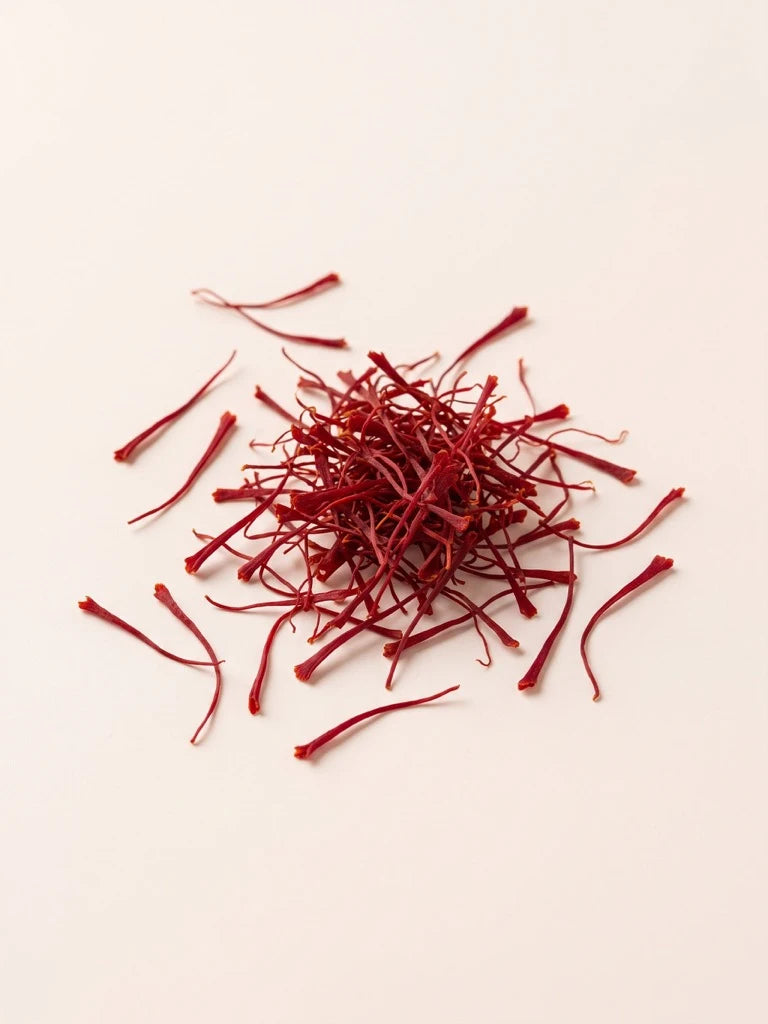
Saffron potency loss is a chemical process, not a mystery. Crocin fades, picrocrocin breaks down, and the aroma compound safranal drifts off into the air. Light, heat, oxygen and moisture all speed it up. Stored properly in a cool dark place, saffron stays useful for years rather than months.
Every jar of saffron is slowly on its way to becoming hay. That is not a defect and it is not fraud. It is what happens to a delicate carotenoid, a bitter glycoside and a volatile aldehyde when you leave them in a kitchen. The useful question is not whether saffron degrades, but which part goes first and how much of it you can prevent.
What actually changes inside a thread?
Three compound families do almost all the work in saffron, and each one fails in its own way.
The crocins give colour. They are water-soluble carotenoid esters, and like most carotenoids they are vulnerable to light and oxygen. When they break apart, the pigment stops being able to absorb light the way it did, and the golden yield of a pinch drops. This is measured as absorbance at 440nm on a laboratory report.
Picrocrocin gives the bitter, hay-and-honey base note. It is a glycoside — a sugar bonded to a smaller molecule — and over time that bond breaks. Picrocrocin is read at 257nm.
Safranal is the aroma. It is largely formed from picrocrocin as saffron dries and ages, and it is volatile, which means it leaves. Safranal is read at 330nm. If you want the notation on those readings unpacked, we have a separate piece on what an E1 1cm figure actually measures.
Which compound goes first?
Aroma is the first thing most people notice going. Safranal is volatile by definition, so every time a jar is opened, some of it walks out. A tin left half-full for two years will smell flatter long before it looks any paler.
There is a wrinkle worth knowing. Because safranal is generated from picrocrocin, the safranal reading on a young saffron can actually climb during the first stretch of storage before it starts to fall. A high safranal number is therefore not a reliable proxy for freshness on its own. It is one of the reasons a report is read as three figures together rather than as a single score, which we cover in how to read a saffron lab report.
Colour holds on longest. Crocin decline is real but gradual, which is why saffron that smells tired can still tint a rice dish reasonably well. Flavour goes; the yellow lingers.
Which storage conditions do the most damage?
Four things drive saffron potency loss, and they are not equally guilty. Light and moisture are the serious offenders. Heat accelerates everything. Air matters mostly because of how often you let it in.
| Condition | What it attacks first | Sign you will notice | Better practice |
|---|---|---|---|
| Direct or ambient light | Crocins | Threads shift from deep red toward dull brick | Opaque tin, or a glass jar kept inside a closed cupboard |
| Warmth (above a cool cupboard) | Everything, faster | Aroma flattens within months | Away from the stove, oven and any sunlit worktop |
| Repeated air exposure | Safranal | Weak scent when you warm a thread in your palm | Decant a working pinch; keep the main stock sealed |
| Humidity and steam | Picrocrocin, then structure | Threads go limp, clump, smell musty | Never store above a kettle or sink; keep the lid dry |
| Pre-grinding | Safranal, sharply | Powder smells strong on day one, of little by week four | Grind only what you are about to bloom |
Notice that four of the five fixes cost nothing. Storage is the cheapest quality control available to a home cook, and the detail is worth getting right — see our fuller guide to storing saffron at home.
How fast does saffron lose strength?
There is no single honest number, and anyone who gives you one has stopped being careful. Rate of decline depends on where the saffron started, how it was dried, how it was packed, and what the cupboard is like. Two grams from the same harvest, one in a sealed tin in a cool pantry and one in a clear shaker above a hob, will not be the same spice in a year.
What can be said plainly is the shape of the curve. Decline is fastest in the first weeks after a package is opened, because that is when volatile aroma escapes, and then it settles into a slow grind. Colour strength falls measurably over years, not weeks. Published work on saffron storage kinetics is searchable through PubMed, and the underlying spectrophotometric method is set out in ISO 3632-1.
Can you tell degraded saffron by looking at it?
Partly. Your nose is better than your eyes here.
- Warm a thread between your fingers. Fresh saffron pushes out a sweet, hay-like, slightly metallic scent within seconds. Tired saffron needs coaxing and gives less.
- Look at the colour of the threads themselves. Deep red with orange tips is healthy. A uniform brownish-red across the whole batch suggests age or heat.
- Check how they break. Very brittle threads that shatter into dust are usually over-dry as well as old.
- Bloom a pinch in warm water. Old saffron still releases colour, but more slowly and to a paler yellow. Instant, intense orange water is a warning of dye, not a sign of freshness.
That last point matters. Degradation and adulteration produce different symptoms, and it is easy to blame one for the other. If a batch behaves strangely rather than weakly, read how to spot fake saffron before you assume it is simply old.
How do you slow it down?
- Keep threads whole. Grinding multiplies the surface area exposed to air.
- Use an airtight, opaque container. A small tin beats a large jar, because a large jar is mostly air.
- Choose a cool, dark, dry cupboard over the refrigerator. Cold storage invites condensation every time you open the container.
- Buy quantities you will actually finish. A gram used within a year outperforms five grams used over five.
- Never hold the jar open over a steaming pan.
Starting strength matters too. Saffron that begins with high colouring power has more to lose before it stops being worth cooking with, which is the practical argument for buying on measured quality rather than on price alone. Our own testing is underway and the report will be published in full on our lab report page.
Frequently asked questions
Does saffron go bad?
Not in the way perishable food does. Saffron dries out and weakens rather than spoiling. Kept dry and away from light, it stays safe to use for years, but the aroma and colour it delivers will slowly fade.
Is the refrigerator a good place to store saffron?
Usually not. Each time you take the container out, condensation forms on the cold threads, and moisture is the one thing saffron handles worst. A cool, dark cupboard away from the stove suits most kitchens better.
Can you revive old saffron?
You cannot restore compounds that have already gone. You can get more out of what remains by grinding the threads, blooming them a little longer in warm water at around 150F or 65C, and using a slightly larger pinch than usual.
Do best-before dates on saffron mean anything?
They are a commercial convention rather than a cliff edge. The date tells you when the packer expects the spice to still be at its best, not the moment it stops working. How it has been stored since packing matters more than the printed date.