Saffron Category 1 — written Category I in the standard — is the top of three quality bands defined by ISO 3632. Categories are set by laboratory readings for colour, bitterness and aroma. Category I demands the highest colouring strength, Category III the lowest. The band says nothing about origin or authenticity.
Almost every saffron listing online mentions a category. Very few of them attach a document. Understanding what the bands measure, and what they leave entirely alone, is the difference between reading a specification and reading a slogan.
What are the three saffron categories?
Three bands, each defined by minimum absorbance readings taken from a prepared extract. The higher the band, the more the spice has to deliver per gram.
| Category | Colouring strength at 440nm | Bitterness at 257nm | Safranal at 330nm | What it means in practice |
|---|---|---|---|---|
| Category I | 190 and above | 70 and above | Within a band of roughly 20 to 50 | Strong colour per gram; the band serious buyers specify |
| Category II | 150 and above | 55 and above | Within the same band | Sound saffron; you simply need more of it for the same effect |
| Category III | 100 and above | 40 and above | Within the same band | Weakest band that still meets the standard |
These figures reflect the thresholds commonly published for the three-category scheme. Editions of the standard have differed — an earlier edition ran to a fourth category — so the current text, published as ISO 3632-1, is the authority rather than any table on a retailer’s website, including this one.
The readings themselves are absorbance values in the E1 1cm form, which we take apart in what an E1 1cm figure means.
What decides which category a batch lands in?
Mostly things that happen in the first forty-eight hours of a thread’s life.
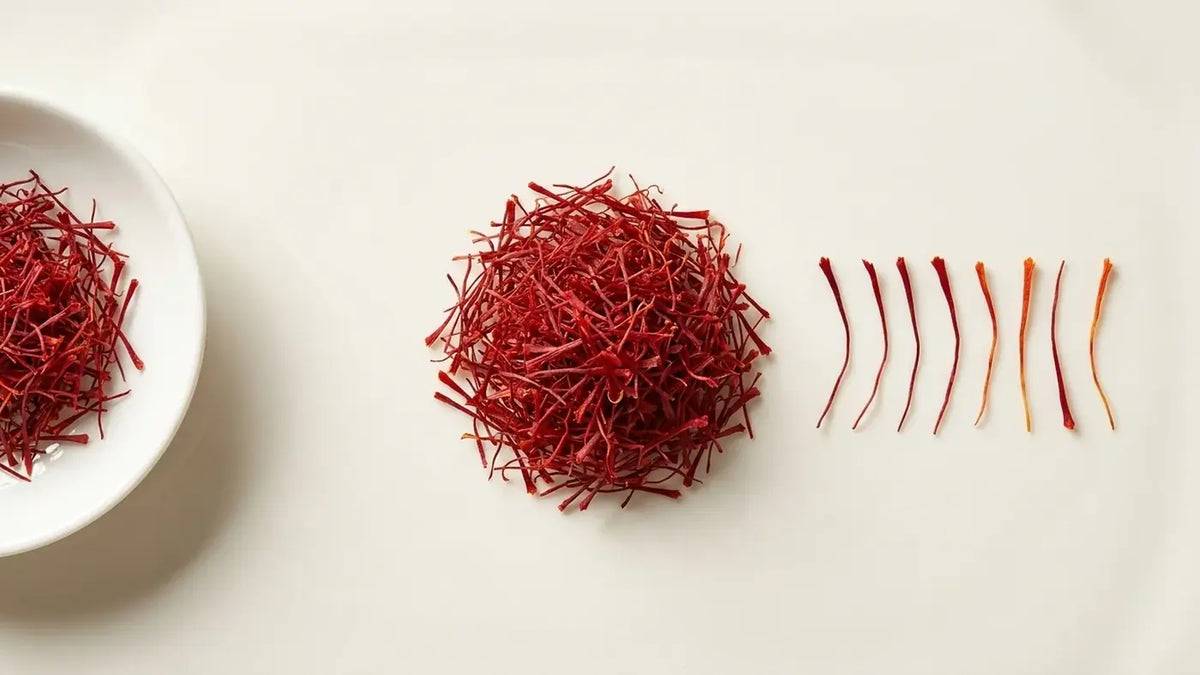
- How much of the style was left on. The pale yellow style below the red stigma carries almost no crocin. Leaving it attached adds weight and drags the colour reading down.
- How quickly the flowers were processed. Stigmas sitting in a warm heap before separation lose ground before drying even starts.
- How the saffron was dried. Too hot and aroma compounds are driven off; too slow and the threads can pick up mould and mustiness.
- How it was stored and for how long. Colouring strength falls over time, so the same batch can test differently a year apart.
A batch does not have a category permanently. It has a category on the day it was measured. That is why an undated report is close to useless, and why storage matters as much as harvesting — see how saffron degrades over time.
Is Category I always the best saffron?
It is the best-performing band on three measurements. That is not the same as the best saffron for your kitchen, and treating it as a total score leads people astray.
Consider two Category I batches. One reads just over the threshold at 440nm and smells beautiful. The other reads far higher on colour and has been dried hard enough that the aroma is thin. Both are Category I. They will not cook the same way. Colouring strength is the most quoted figure because it is the most dramatic, not because it is the most complete.
There is also a practical ceiling on usefulness. Past a certain point, extra colouring strength mostly means you use a slightly smaller pinch.
What does a category not tell you?
- Where it grew. Afghanistan, Spain, Greece, Morocco, India — the standard is silent on all of it.
- Whether anything was added. Category thresholds are performance floors. A dye that absorbs near 440nm can lift a reading rather than lower it.
- Whether the threads are whole. Cut, broken and powdered saffron can all be tested. Powder hides everything a thread would show, which is why we would never recommend buying it.
- What grade name applies. Super Negin, Negin, Sargol and Pushal describe how the stigma was cut and sorted. They are trade terms, not categories. We separate the two ideas on the Super Negin page.
- How old it is now. The report has a date; the pouch on the shelf may not.
Why does a Category 1 claim on a label mean so little?
Because the phrase costs nothing to print. No authority polices it at the point of sale, and there is no register you can look a brand up in. The claim only becomes meaningful when it is attached to a document you can read: a laboratory report naming the method, the date, the sample and ideally the batch.
Three quick tests of a seller’s claim:
- Is there a report published, or only a number in the copy?
- Does the report carry a date and a batch identifier that matches the pack?
- Does the seller also state what the report does not cover?
That third one separates the careful from the confident. The economics behind the weaker end of the market are worth understanding too — we set them out in why cheap saffron is cheap.
For transparency about our own position: analysis of our current harvest is underway, and we will publish the full report on our lab report page when it is complete, rather than quoting a figure ahead of the document.
How should you use categories when buying?
As one filter among several, applied in this order. Ask whether a report exists. Check its date. Read all three readings rather than the colour figure alone. Then look at everything the report cannot cover: whole threads, a named region, a seller who answers questions about the harvest. Our buying saffron guide works through the whole sequence.
Frequently asked questions
Is Category 1 the same as Grade A?
No. Category I is defined by ISO 3632 through laboratory thresholds. Grade A, Premium and Extra are commercial descriptions with no fixed definition behind them. Two products labelled Grade A can differ enormously.
Can saffron test above Category I?
Category I has a floor but no ceiling, so readings well above the threshold are common on good saffron and appear on genuine reports. There is no higher category to move into. Anything sold as being above Category I is using marketing language.
Can a batch drop from Category I to Category II over time?
Yes. Colouring strength declines with age, light, heat and moisture, so saffron that met Category I at harvest can test lower a year or two later. This is exactly why the date on a report matters as much as the number.
Is Category II saffron worth buying?
It can be perfectly good cooking saffron. You will need a slightly larger pinch for the same colour, so the real question is price per unit of strength rather than the band itself. Category III is where value usually stops making sense.