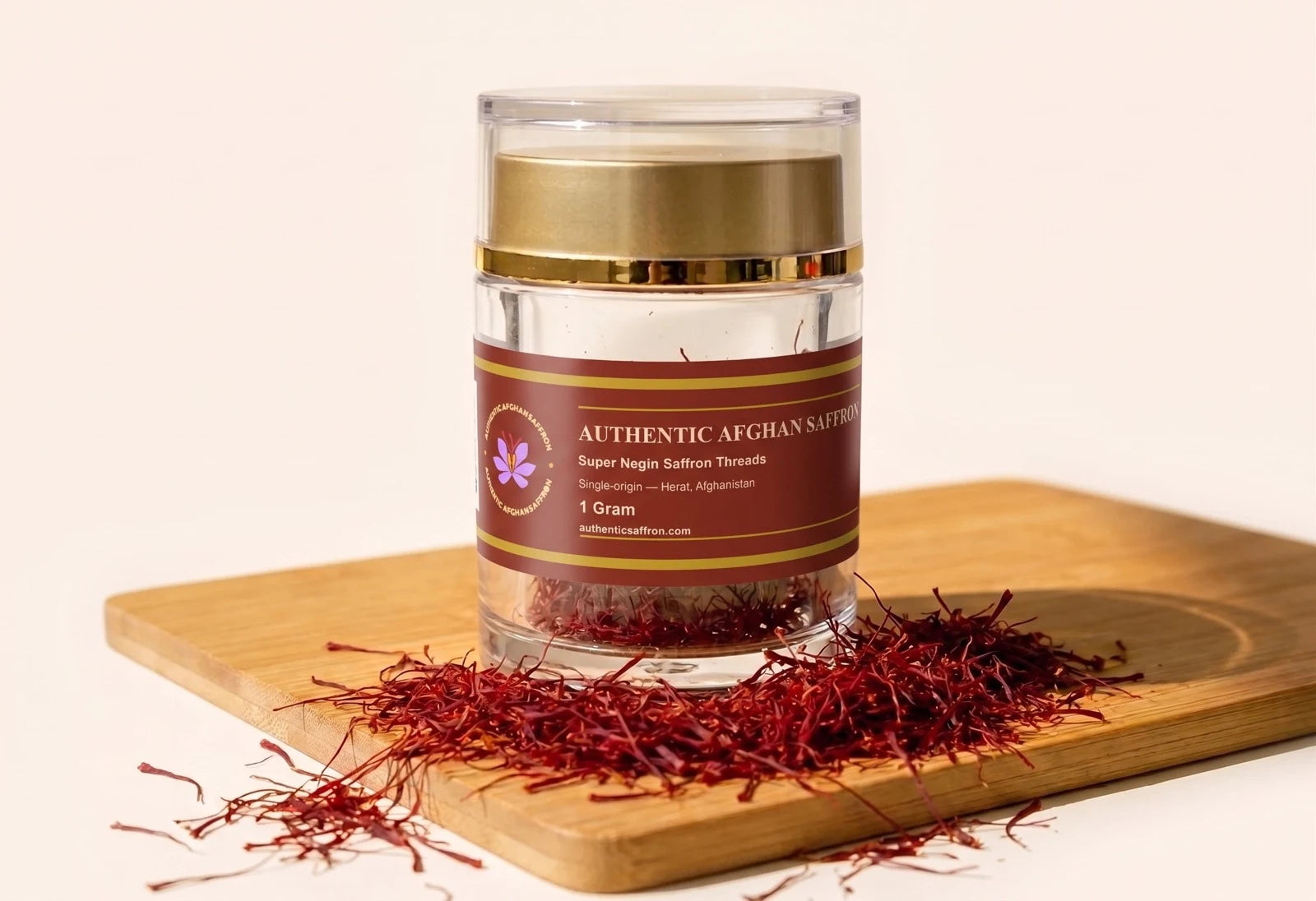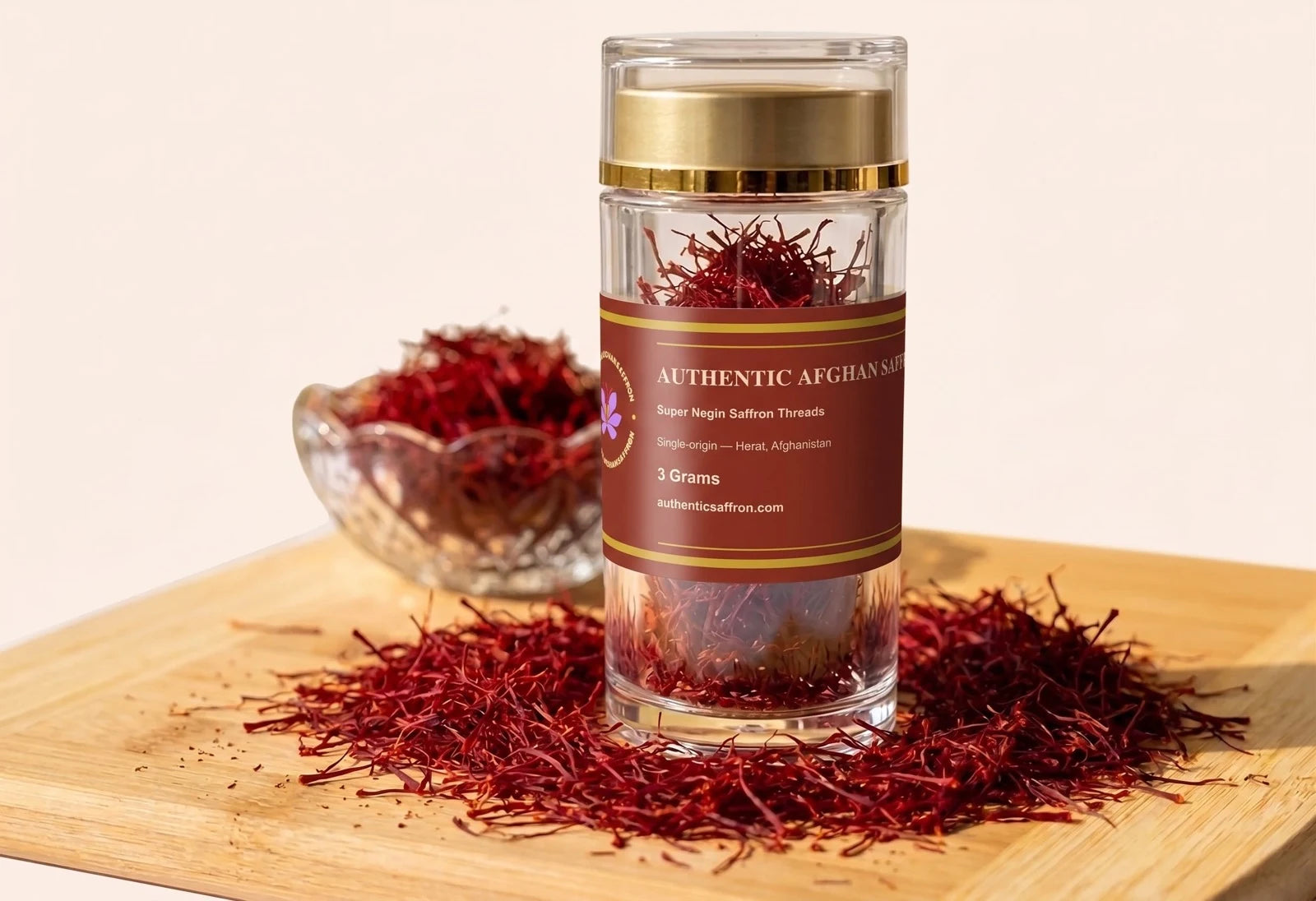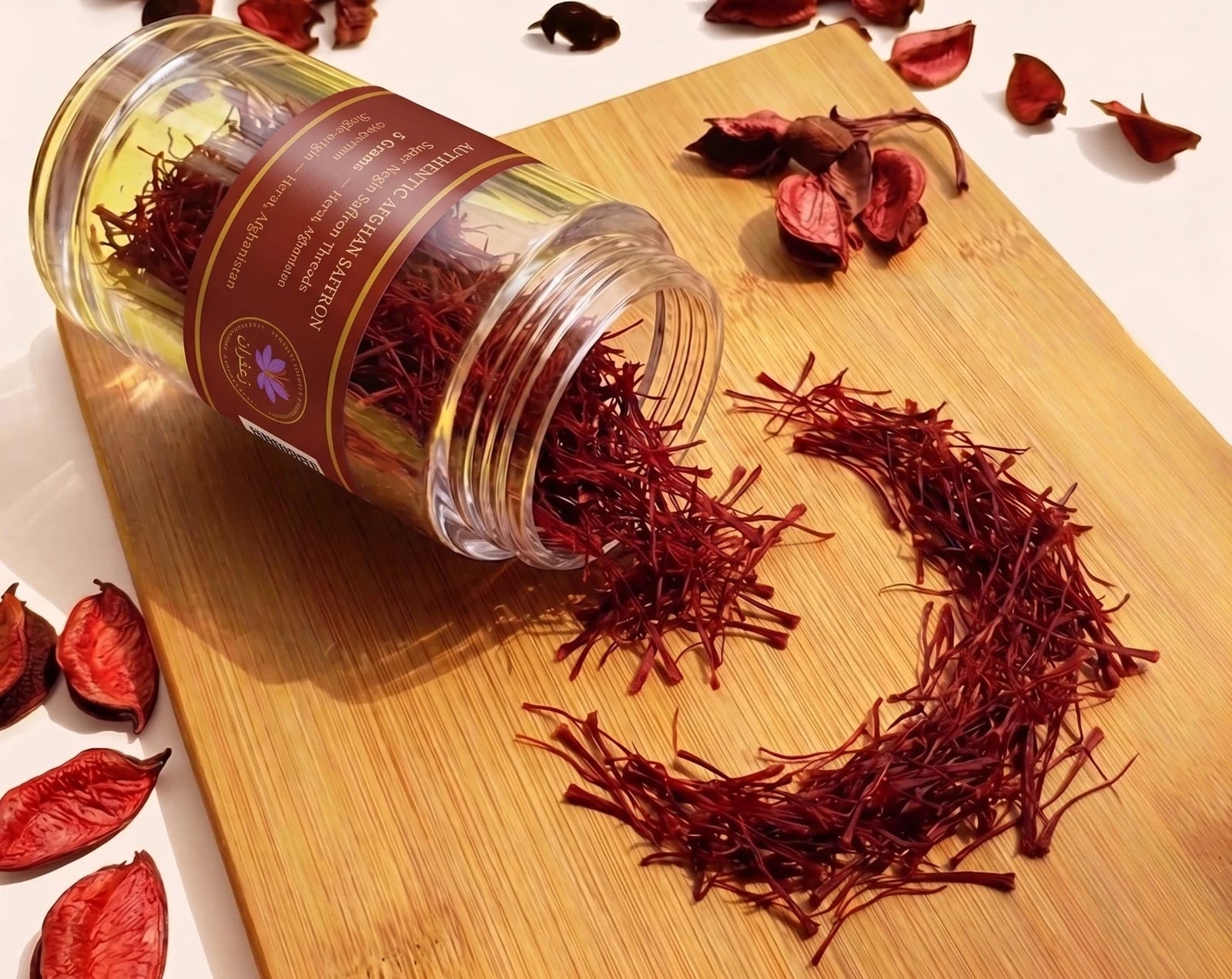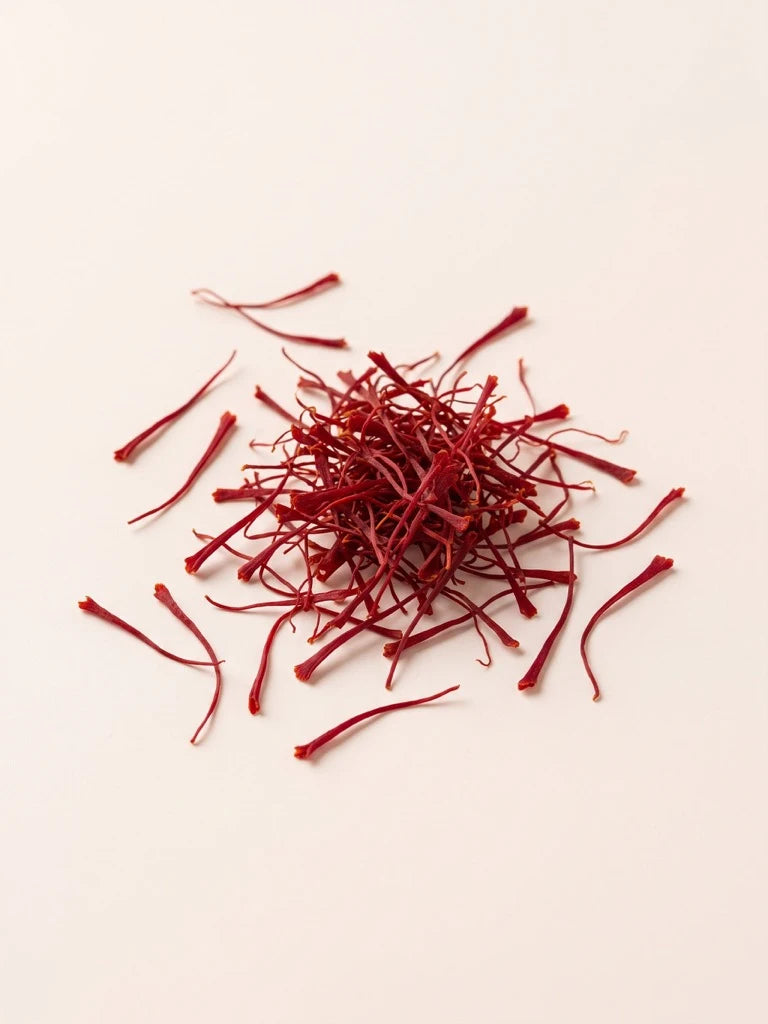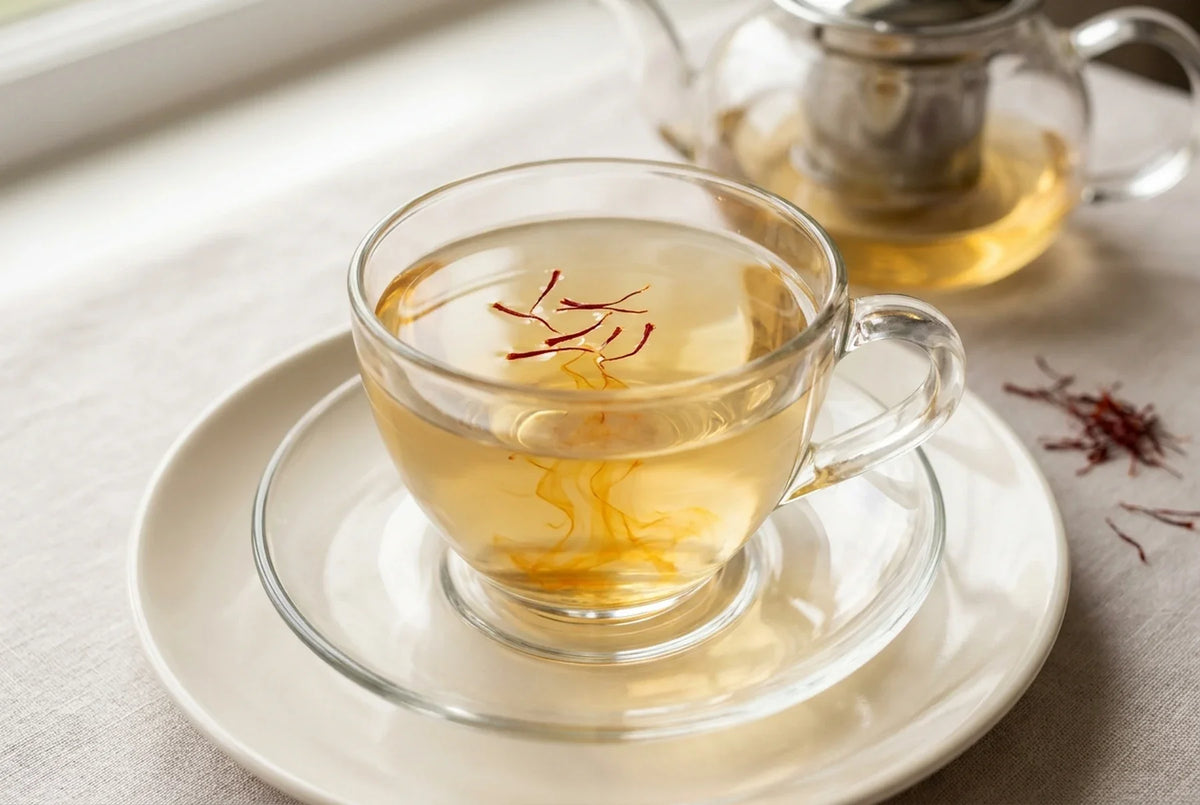
A cup of saffron tea is fifteen threads, about 0.06 g, bloomed in two tablespoons of water at 150°F (65°C) for fifteen minutes, then topped up with the rest of the hot water and covered. That is the whole saffron tea recipe. Boiling water is the one real mistake: it pulls colour fast and sends the aroma out of the cup as steam.
Why does the water temperature matter so much?
There is no leaf here. Everything you taste came out of roughly 0.03 g of dried stigma, and the three compounds that matter behave very differently in hot water. Crocin carries the colour, dissolves easily and does not mind heat. Picrocrocin carries the bitterness. Safranal carries the smell, and it is volatile.
That last point decides the temperature. If you can smell saffron across the kitchen while the kettle is pouring, the aroma is in the air rather than in the cup. At a rolling boil you lose a good part of it in the first thirty seconds, and you speed up the breakdown that pushes bitterness forward. Warm water and a lid do the opposite: slower colour, more smell retained, a cleaner finish.
On tradition, an honest note. Saffron infusions are drunk widely — in Afghanistan, in Kashmir, in Morocco, across the Gulf — but usually alongside green tea leaves, or with cardamom and a lot of sugar. A cup of plain saffron water on its own is closer to a modern habit than an inherited one. It is a good drink regardless; it just does not need a borrowed pedigree.
How much saffron does one cup need?
Fifteen threads, about 0.06 g, for an 8 oz cup. That is the point where the colour is a clear amber and the smell arrives before the cup reaches your face. Twenty threads is the ceiling. Beyond it the bitter edge stops being a pleasant counterweight and becomes the main event.
Scaling is not linear. Two cups want about 25 threads rather than 30, because a larger volume of water extracts more efficiently from the same weight. A litre for a jug wants 60, not 75. If you would rather work from a target weight, the saffron dosage calculator handles the arithmetic, and our note on how much saffron you actually need covers dishes as well as drinks.
Bloom the threads in warm water at about 150°F (65°C) for 10 to 20 minutes, covered, and never in water that is boiling or has just stopped boiling. Fifteen minutes is the sweet spot for tea. Use whole or lightly crumbled threads rather than powder: powder clouds the cup, sinks as sediment, and cannot be steeped a second time.
What is in it?
For one 8 oz cup. Everything after the first two lines is optional, and worth adding one at a time rather than all at once.
- 15 saffron threads (0.06 g)
- 240 ml (1 cup) filtered water
- 1 green cardamom pod, cracked (optional)
- 2 thin coins of fresh ginger (optional)
- 1 thin strip of lemon peel, no pith (optional)
- 1 tsp honey, to finish (optional)
How do you brew it?
- Count the threads and crumble half. Count 15 threads into a dry cup. Crumble seven or eight of them between finger and thumb and leave the rest whole. The broken pieces start releasing immediately; the whole ones keep going for the length of the steep.
- Get the water to 150°F. Boil the kettle, then let it stand uncovered for about eight minutes, or stir 60 ml (1/4 cup) of cold water into 180 ml of boiling water. You want 150°F (65°C): steaming, silent, no bubbles.
- Bloom the saffron in a splash. Pour 2 tbsp of the warm water over the threads, cover the cup with a saucer, and leave it 15 minutes. The liquid should read pale straw after a minute and deep orange-amber by the end. Under a saucer, the aroma stays in the cup instead of leaving with the steam.
- Steep the aromatics separately. If you are using cardamom, ginger or lemon peel, drop them into the rest of the hot water in a small covered jug for the same 15 minutes. Keeping them out of the saffron cup means you can taste what each one is doing.
- Combine and cover again. Pour the remaining water, threads and all, into the bloomed cup through a small strainer if you used aromatics. Cover for two more minutes so the temperature settles.
- Taste before you sweeten. Drink a spoonful plain first. Saffron tea should read floral and faintly honeyed with a clean bitter edge at the back. Only then stir in honey, off the heat, so its own aroma survives.
What makes a cup taste flat?
Bitterness is the complaint people report, but flatness is the more common failure and it is harder to notice, because a flat cup still looks impressive.
- An uncovered cup. Fifteen minutes of open steeping vents most of the aroma. A saucer costs nothing.
- Water straight off the boil. The colour will be excellent and the smell will be thin. This is the single biggest difference between a good cup and a decorative one.
- Hard water. Very alkaline tap water dulls the colour toward brown. Filtered water gives a cleaner orange.
- Old saffron. Threads kept in a clear jar on a sunny shelf lose aroma long before they lose colour, so the tea looks fine and smells of nothing.
- Sweetening too early. Honey stirred into near-boiling water loses its own character and masks the saffron underneath.
If a cup tastes of hay rather than flowers, the saffron is usually the problem rather than the technique. That is what stale or low-grade material does, and it is the easiest thing in the world to sell to someone who has never had the good version. Our page on spotting fake saffron goes through the checks worth running before you brew.
Frequently asked questions
Can I brew the same threads twice?
Yes, once. A second steep at the same temperature for 20 minutes will give you perhaps half the colour and noticeably less aroma, which is fine if you are drinking two cups in a morning. A third steep is hot water with red bits in it.
Why is my saffron tea bitter rather than floral?
Three usual causes: more than about 20 threads in a single cup, water above 190°F, or a steep left running for over half an hour. Bitterness in saffron comes from picrocrocin, and heat and time both push it forward faster than they build the floral side.
Can I make a jug for the fridge?
Bloom 60 threads (0.24 g) in 240 ml of 150°F water for 20 minutes, then dilute with a litre of cold water and chill. Cold water alone will not extract properly, which is why the warm bloom comes first. It keeps three days covered.
Read next
- How to bloom saffron — the method behind every recipe here
- Saffron iced tea — the same infusion, built for a jug
- Saffron research — what the studies actually looked at