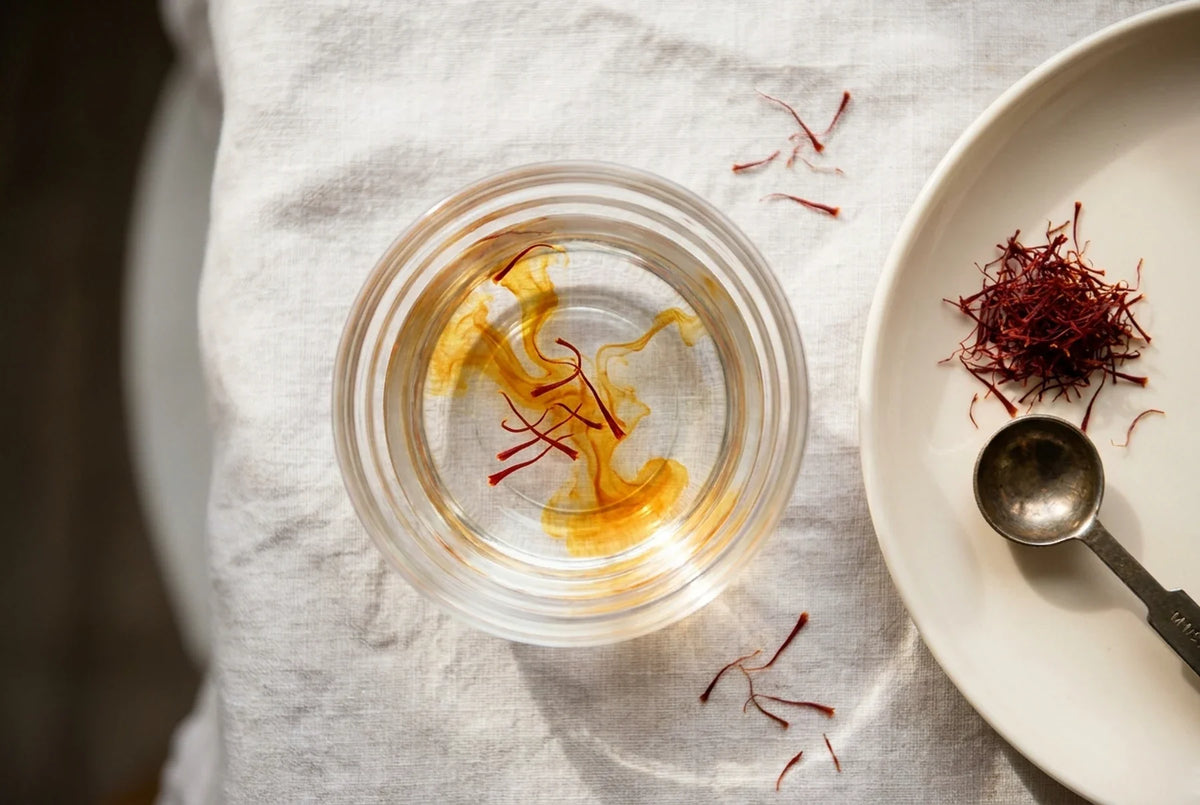
The short version of how to bloom saffron: steep the threads in about a quarter cup of warm liquid at 150°F (65°C), covered, for 15 to 20 minutes, then add the liquid and the threads together. Boiling water is the one thing that ruins it, driving off the aroma and leaving colour alone.
Why does saffron need blooming at all?
A saffron thread is a dried flower part, and everything valuable in it is locked inside collapsed plant cells. Dropping dry threads into a pan gives you two problems. The compounds cannot get out fast enough to distribute, so you end up with streaks of intense colour next to nothing, and the threads sit in direct heat, where the aroma burns off before it ever reaches the food.
Soaking solves both. Water rehydrates the tissue and the water-soluble pigment, crocin, diffuses out into the liquid. Once it is in liquid, it spreads through a dish evenly. The bitter compound picrocrocin and the aromatic safranal move out at the same time, at different rates, which is why the timing matters as much as the temperature.
The practical result is a far larger yield from the same weight of spice. Cooks who find saffron expensive and underwhelming are usually adding it dry.
How much saffron and how much liquid?
Work in a ratio, not a fixed amount. About 20 threads — 0.08 g — to 1/4 cup (60 ml) of liquid is the standard bloom, and it suits a dish for four. Keep the liquid tight. A thread infused in a cup of water is just as extracted as one infused in a tablespoon, but you can no longer judge the strength by eye, and you may not be able to fit that much liquid into the dish.
- Rice for four: 20 threads (0.08 g) in 1/4 cup warm water.
- A custard or ice cream base: 15 threads (0.06 g) in 1/4 cup warm milk or cream.
- A quart of iced drink: 25 threads (0.10 g) in 1/2 cup warm water, since cold suppresses aroma.
- Bread dough, 0.08 g flour: 20 threads (0.08 g) ground, in 1/4 cup of the recipe water.
Take the blooming liquid out of the recipe rather than adding to it, or you will loosen a dough and thin a sauce. For per-person arithmetic on larger batches, how much saffron per person has the numbers, and the dosage calculator does it for you.
What will you need on hand?
Nothing specialised. The one thing worth having is a vessel narrow enough to keep the liquid deep: a shallow puddle in a wide bowl loses heat and aroma at once.
- About 20 saffron threads (0.08 g)
- 1/4 cup (60 ml) water, milk, stock or cream
- A small heatproof glass or cup, no wider than 2 inches across
- A saucer or small lid to cover it
- An instant-read thermometer, or a kettle and five minutes of patience
- A pinch of granulated sugar or coarse salt, optional, for grinding
- A small mortar and pestle, optional
How do you bloom saffron, step by step?
- Measure the threads. Count them if the quantity is small; weigh them above about 0.1 g. Twenty threads is roughly 0.08 g, the standard unit for a dish serving four. Scales that read to 0.01 g are worth owning if you cook with saffron often.
- Decide whether to grind. Whole threads give slower extraction and stay visible in the finished dish, which is what you want in a rice or a broth. Ground saffron colours faster and more evenly, which suits doughs, custards and drinks. If you grind, do it dry in a small mortar with a pinch of sugar or salt as an abrasive, and stop at a coarse powder.
- Bring the liquid to about 150°F (65°C). Not boiling. Water off the boil, poured into a cold cup, lands near this in about four minutes. The visual cue is steam rising steadily with no movement at all on the surface. If you use a thermometer, anything between 140 and 160°F is fine.
- Pour it over the threads and cover at once. Use a narrow vessel so the liquid is deep rather than spread thin — an espresso cup beats a cereal bowl. Cover it with a saucer the moment the liquid is in. Most of the aroma you are trying to keep is leaving in that first minute of steam if you do not.
- Leave it 15 to 20 minutes. Colour appears within a minute and is misleading; the aromatic compounds take far longer to move into the liquid. Ten minutes is the minimum that produces a real difference. Beyond about half an hour there is nothing more to gain at room temperature.
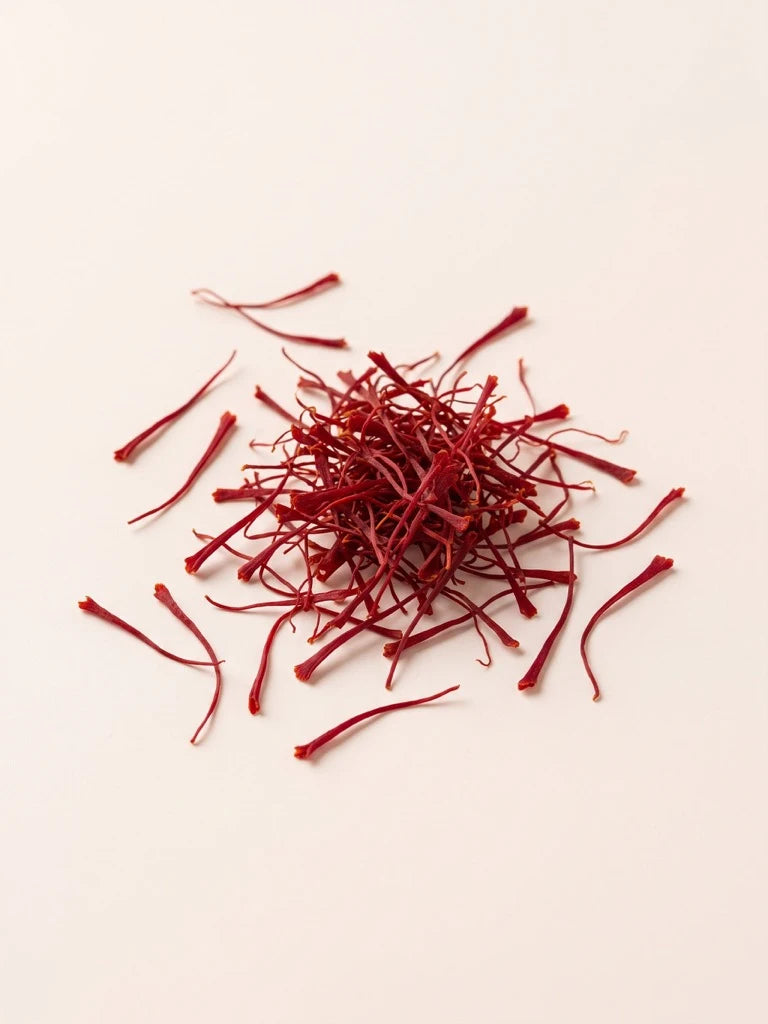
- Judge the result before you use it. A good bloom gives liquid the colour of strong tea or amber glass, and threads that have gone from deep red to pale straw and swollen to two or three times their dry width. Threads still deep red in barely tinted liquid mean the liquid was too cool, the time too short, or the saffron old.
- Add the liquid and the threads together. Do not strain unless the dish needs to be smooth. The spent threads still carry colour and are pleasant to find. Add the whole infusion at the point the recipe specifies — early for rice and braises so the colour spreads, late for creams and sauces so the aroma survives.
What are the common blooming mistakes?
Boiling water is the big one, and it is nearly universal. At a rolling boil the aromatic fraction of saffron leaves as steam within seconds, and what remains is colour. The infusion looks correct and smells thin. The reasoning is set out in why warm water beats hot.
The second is impatience. Two minutes gives you a yellow liquid and very little else, because colour is the fast part of the extraction and aroma is the slow part. If you have only two minutes, grind the threads first — that is a real shortcut, and grinding saffron properly covers how.
- Leaving it uncovered. A saucer costs nothing and keeps the volatiles in the cup instead of in the room.
- Too much liquid. Half a cup for a pinch of threads makes a weak infusion you cannot dose accurately.
- Blooming in acid. Lemon juice or vinegar slows extraction noticeably. Bloom in water, then add the acid to the dish.
- Reusing threads. A second bloom of spent threads gives almost nothing. Use them once, in the dish.
- Old saffron. If threads stay red and the liquid barely colours, the spice is the problem, not the method. Storage is covered in how to store saffron.
One more, easy to miss: a thin steel cup sheds heat fast and the infusion is at room temperature within five minutes. Glass or ceramic holds the warmth.
Frequently asked questions
Can you bloom saffron overnight in cold water?
Yes, and for some dishes it is better. Eight to twelve hours in the fridge extracts colour fully and gives a softer, less bitter infusion, since the bitter fraction moves into cold water slowly. What you lose is time. For a same-day dish, warm and covered is the practical choice.
Should you strain the threads out?
Only for smooth preparations — a panna cotta, a clear syrup, an aioli. Everywhere else, leave them in. A bloomed thread keeps releasing colour through the cooking, and straining throws away spice you paid a great deal for.
Can you bloom saffron in oil?
Not well. The pigment is water-soluble and barely moves into fat, so oil-bloomed threads stay red and the oil stays pale. Some aroma does transfer, so a warm-oil infusion is not pointless, but for colour bloom in a spoonful of water first and stir that into the fat.
How far ahead can you bloom it?
A day in the fridge, covered, is safe and often convenient. Water infusions keep two or three days; milk and stock should be treated like the liquid they are and used within a day. Bloomed saffron also freezes well in an ice cube tray.
Read next
- Blooming liquids compared — water, milk, stock, wine and cream, side by side
- Threads or powder — which form to buy, and what each one is good for
- Cooking with saffron — the hub page, with dosing tables and dish-by-dish notes