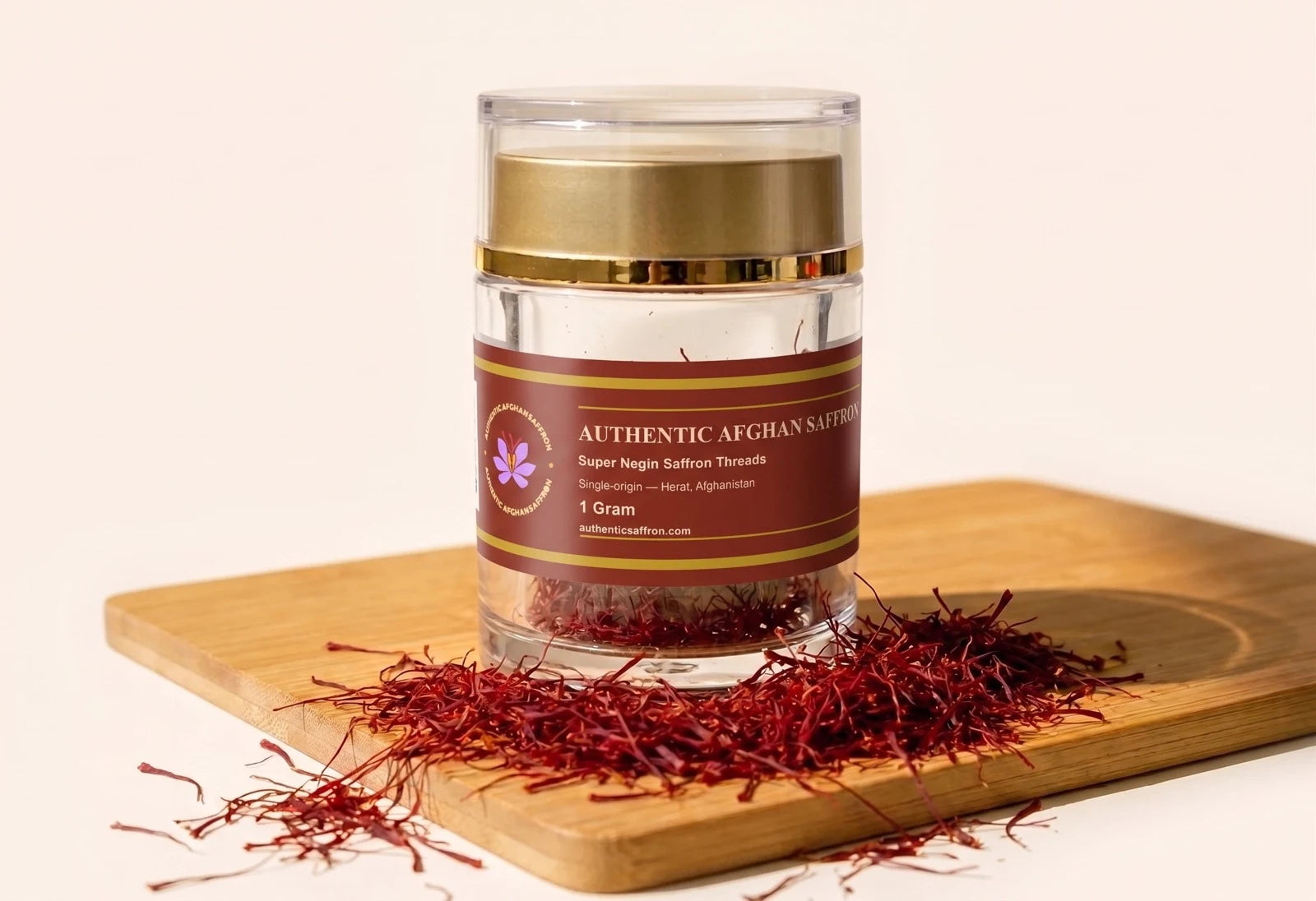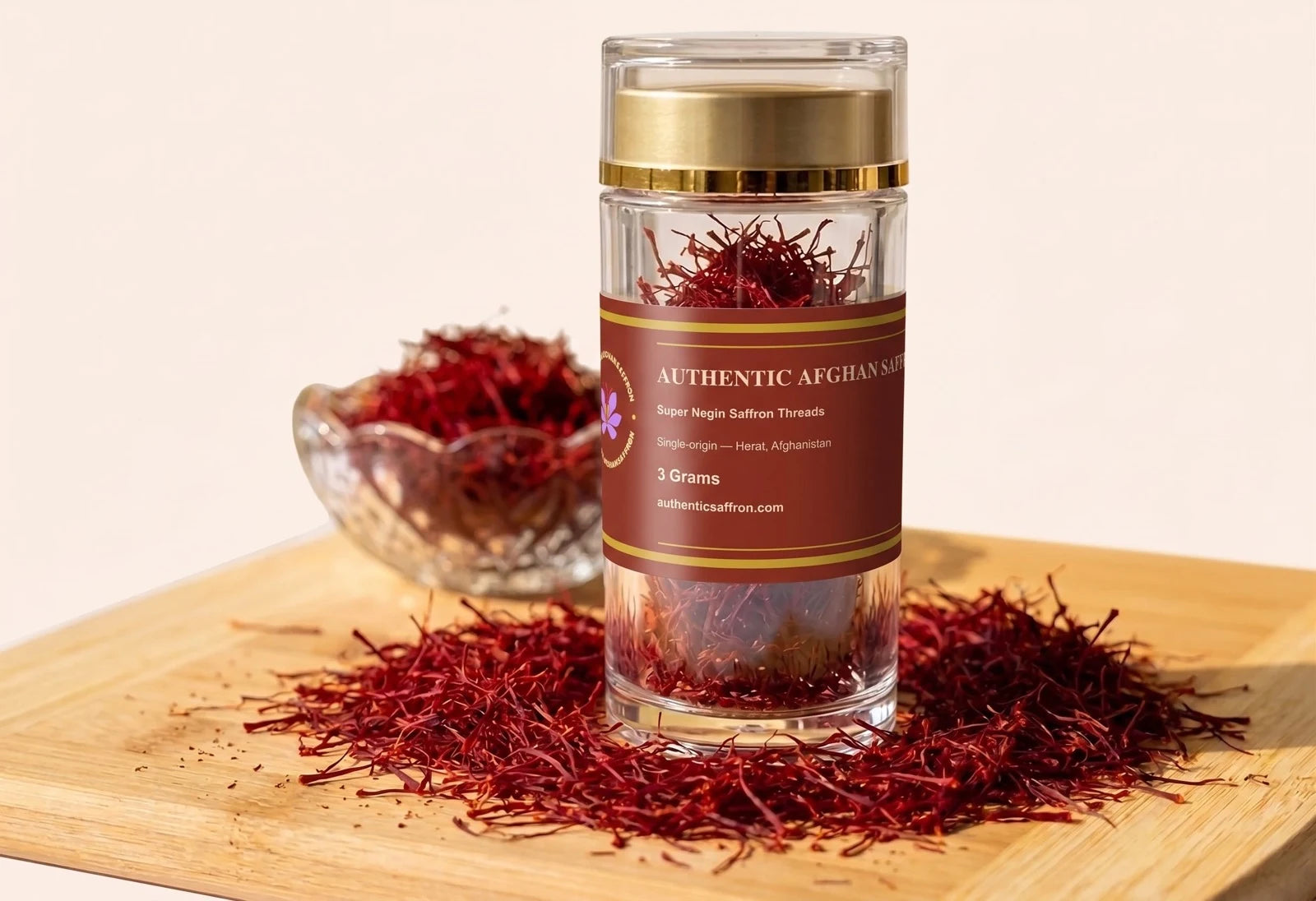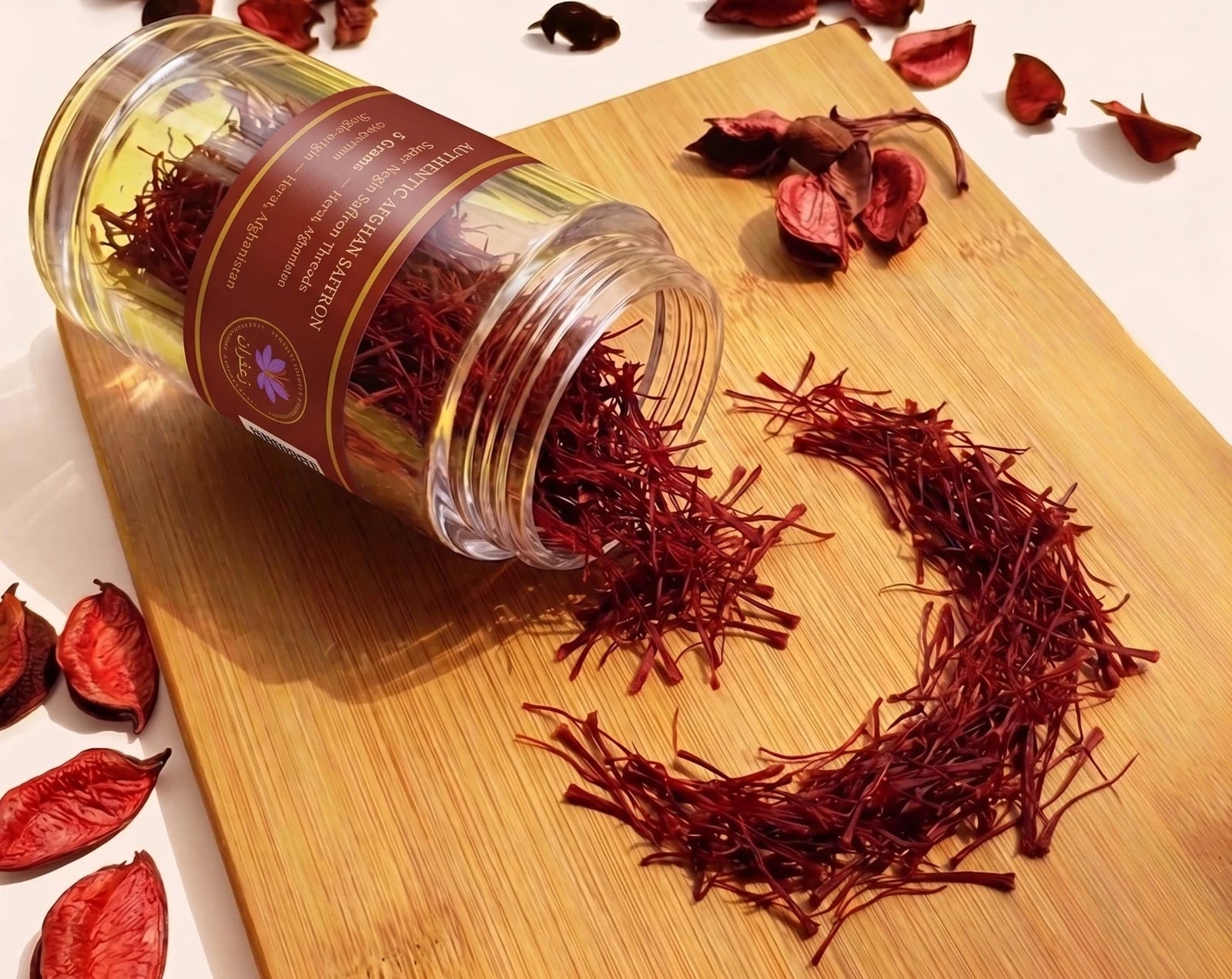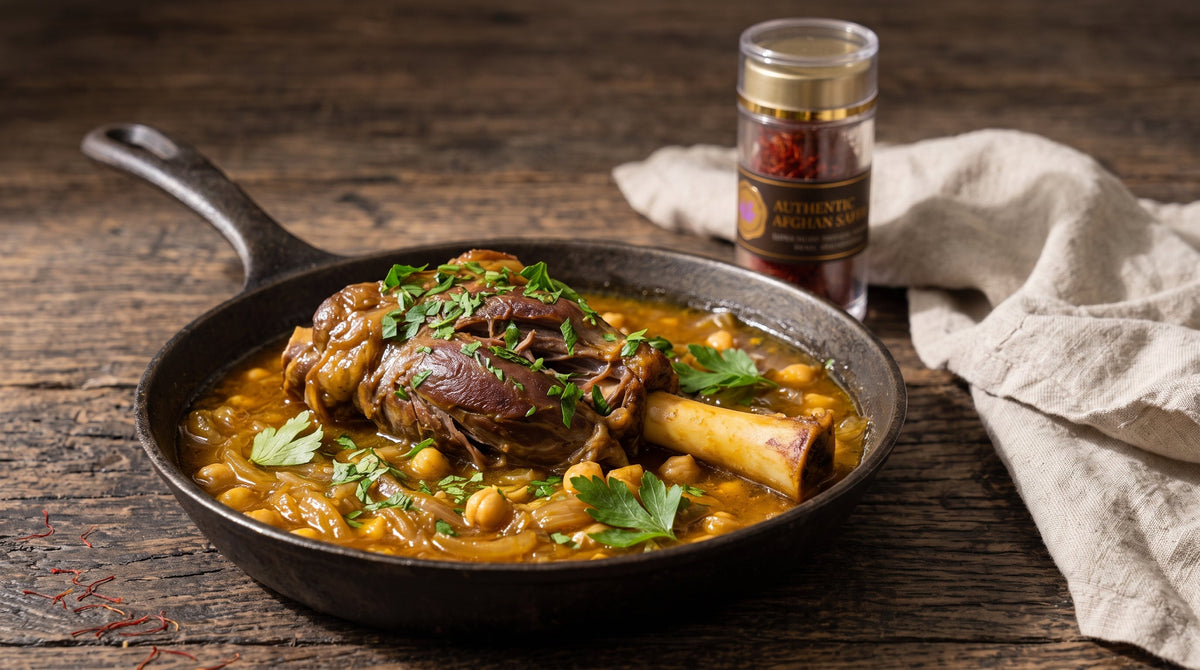
This saffron lamb recipe splits 40 threads (0.16 g) in two: half bloomed and added at the start of the braise for colour and depth, half bloomed in hot braising liquid and stirred in at the very end for aroma. Four shanks, a 325°F oven, about three hours.
Lamb and saffron turn up together in Afghan, Moroccan and Spanish kitchens, but this particular braise is not a traditional dish from any of them. It is a straightforward Dutch oven braise that borrows the pairing, so there is no heritage to claim here — only a technique worth explaining.
Why split the saffron across two stages?
Because a long braise treats saffron’s two halves very differently. Crocin, the pigment, is stable and water-soluble. It will hold its colour through three hours in a covered pot and spread evenly through the sauce.
Safranal and the lighter aromatics will not. They are volatile, which is precisely why you can smell them, and over a long cook they leave with the steam. Saffron added only at the beginning gives you a beautifully coloured braise that smells mostly of lamb and cumin. Our note on how saffron degrades covers the same chemistry from the storage side.
Splitting the dose solves both problems for the price of one extra bowl. The first half does the slow structural work. The second half, bloomed in liquid you have taken off the heat and stirred in at the end, arrives intact.
How much saffron does this need?
Forty threads, about 0.16 g, for four shanks. Twenty threads in each infusion. Lamb is assertive and the braise carries cumin, cinnamon and orange, so a light hand simply disappears underneath all of it.
For the first infusion, use 3 tablespoons of plain water at about 150°F (65°C) — steaming, not simmering — for 15 minutes. For the second, ladle out hot braising liquid, wait until it has stopped steaming hard, then add the threads and leave them 10 minutes. Never pour boiling liquid onto saffron at either stage.
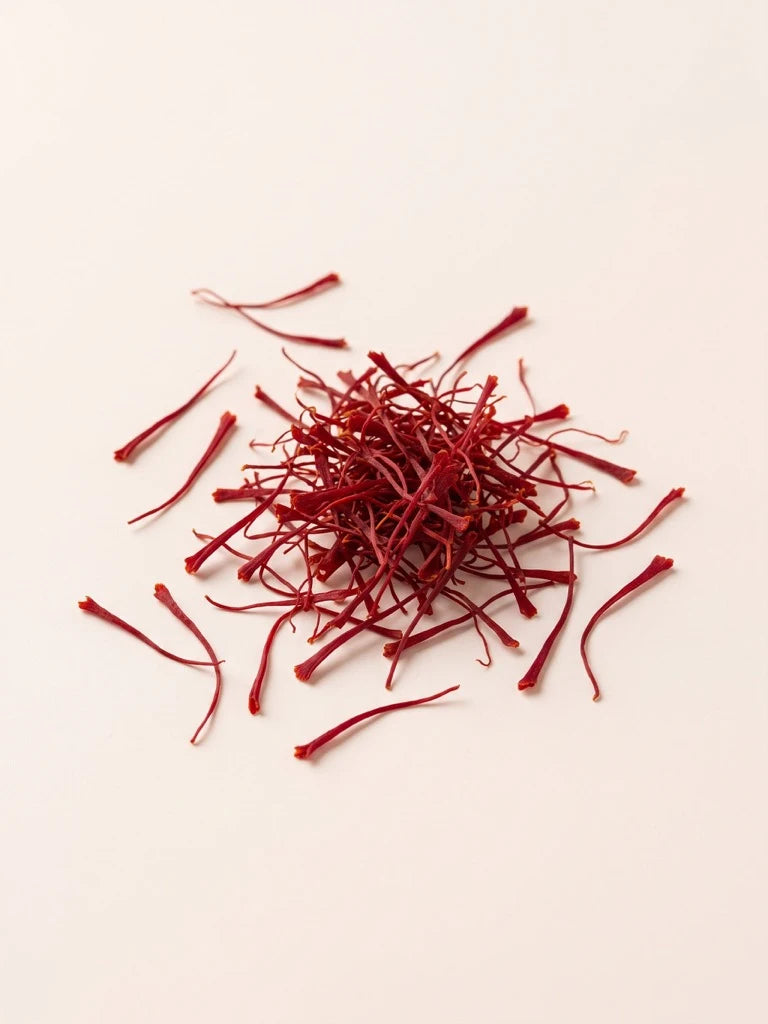
Thread quality decides how far 0.08 g goes. Threads with pale yellow style still attached are partly dead weight, since the pigment sits in the red stigma. Our grading and quality page explains what the cut actually tells you.
What is in the pot?
- 4 lamb shanks, about 1 lb (450 g) each, patted dry
- About 40 saffron threads (0.16 g), used in two halves
- 4 tsp kosher salt, plus more to finish
- 2 tbsp neutral oil
- 2 medium onions, sliced thin
- 4 garlic cloves, crushed
- 1 tbsp tomato paste
- 1 tsp ground cumin
- 1 tsp ground coriander
- 1/2 tsp ground cinnamon
- 1 cup (240 ml) dry white wine
- 1.5 cups (360 ml) chicken or lamb stock
- 1 strip of orange peel, pared with a vegetable peeler
- 1 can (14 oz / 400 g) chickpeas, drained and rinsed
- 1 tbsp honey
- Black pepper
- Chopped flat-leaf parsley, to serve
How do you braise them?
- Salt the shanks early. Rub 1 teaspoon of kosher salt into each shank and leave them uncovered on a rack in the fridge for 12 to 24 hours. If you are short of time, an hour on the counter still helps. A dry surface browns; a damp one steams.
- Bloom the first half of the saffron. Put 20 threads in a small bowl and pour over 3 tablespoons of water heated to about 150°F (65°C). Leave it 15 minutes. The water should be a clear orange-red, not cloudy.
- Sear in batches. Heat the oven to 325°F (165°C). Warm the oil in a 7-quart Dutch oven over medium-high heat and brown two shanks at a time for 8 to 10 minutes, turning to get three good faces on each. Four shanks at once will crowd the pan and turn grey instead.
- Build the base. Pour off all but a tablespoon of fat. Add the onions with a pinch of salt and cook for 8 minutes, scraping the browned fond off the bottom as they release water. Add the garlic for 1 minute, then the tomato paste and cook it for 2 minutes until it darkens to brick.
- Toast the spices. Stir in the cumin, coriander and cinnamon and cook for 30 seconds, just until you can smell them. Ground spices scorch in about a minute at this heat, so keep the spoon moving.
- Deglaze. Pour in the wine, bring it to a boil and let it reduce by half, roughly 4 minutes, scraping the base clean as it goes.
- Braise low and slow. Return the shanks, add the stock, the orange peel and the first saffron infusion. The liquid should come about two thirds of the way up the shanks, not cover them. Bring to a bare simmer, put the lid on and move it to the oven for 2.5 hours, turning the shanks once halfway.
- Add the chickpeas. Take the lid off, tuck in the chickpeas and return the pot uncovered for 30 minutes. The meat is ready when it has pulled back from the bone and gives with no resistance to the back of a spoon.
- Bloom the second half and finish. Ladle 3 tablespoons of the hot braising liquid into a bowl, let it stop steaming hard, and add the remaining 20 threads. Leave it 10 minutes, then stir it back into the pot with the honey. This is where the aroma comes from.
- Rest and skim. Let the pot stand for 15 minutes off the heat, then tilt it and spoon the fat off the surface. Taste for salt, grind over black pepper and scatter with parsley.
What goes wrong in a braise like this?
The shanks are drowned. If the liquid covers the meat you are poaching, not braising, and you lose the concentrated flavour that comes from the exposed top browning slowly under the lid. Two thirds up is the mark.
The oven runs hot. At 350°F and above the braising liquid boils rather than shivers, the muscle fibres seize and squeeze out water, and the meat ends up stringy even though it is falling apart. You want the occasional bubble breaking the surface, no more.
The pan is crowded during the sear. Two shanks in a 7-quart pot leave room for steam to escape. Four do not, and you spend ten minutes producing grey meat and a wet pan.
And the fat stays in. A shank braise renders a surprising amount, and left in it coats the tongue and blunts the saffron completely. Skim it. If your threads never seem to come through in slow-cooked dishes, weak or poorly stored saffron is often the other half of the story — there is more on that in how handling and storage affect saffron aroma.
Frequently asked questions
Should the saffron go in at the start or at the end?
Both, in roughly equal halves. The early addition gives the sauce its colour and a base note that survives three hours in the oven. The late addition puts back the volatile aroma that a long braise drives off. If you only do one, do the late one.
Can I braise lamb shanks in a slow cooker?
Yes, on low for about 7 hours, but sear the shanks and build the base in a skillet first because a slow cooker cannot brown anything. Cut the stock to 1 cup, since almost nothing evaporates under that lid, and add the second saffron infusion in the last twenty minutes.
Why is my lamb still tough after three hours?
It is usually undercooked rather than overcooked. Shanks are full of collagen, and collagen only turns to gelatin after a long stretch above roughly 160°F (71°C). If the meat is tight, put the lid back on and give it another 45 minutes. Tough shanks almost always want more time, not less.
Is it better made a day ahead?
The meat and the sauce improve overnight, and the chilled fat lifts straight off the top in the morning. The saffron does not improve, so hold back the second infusion, reheat gently at 300°F (150°C) for 40 minutes, and stir it in just before serving.
Read next
- Saffron couscous, which is what we usually put under these shanks.
- Saffron chickpea stew for the same flavours without the meat.
- Afghan shorwa, a lighter lamb broth built the opposite way.
- Grinding saffron and when it is worth doing at all.