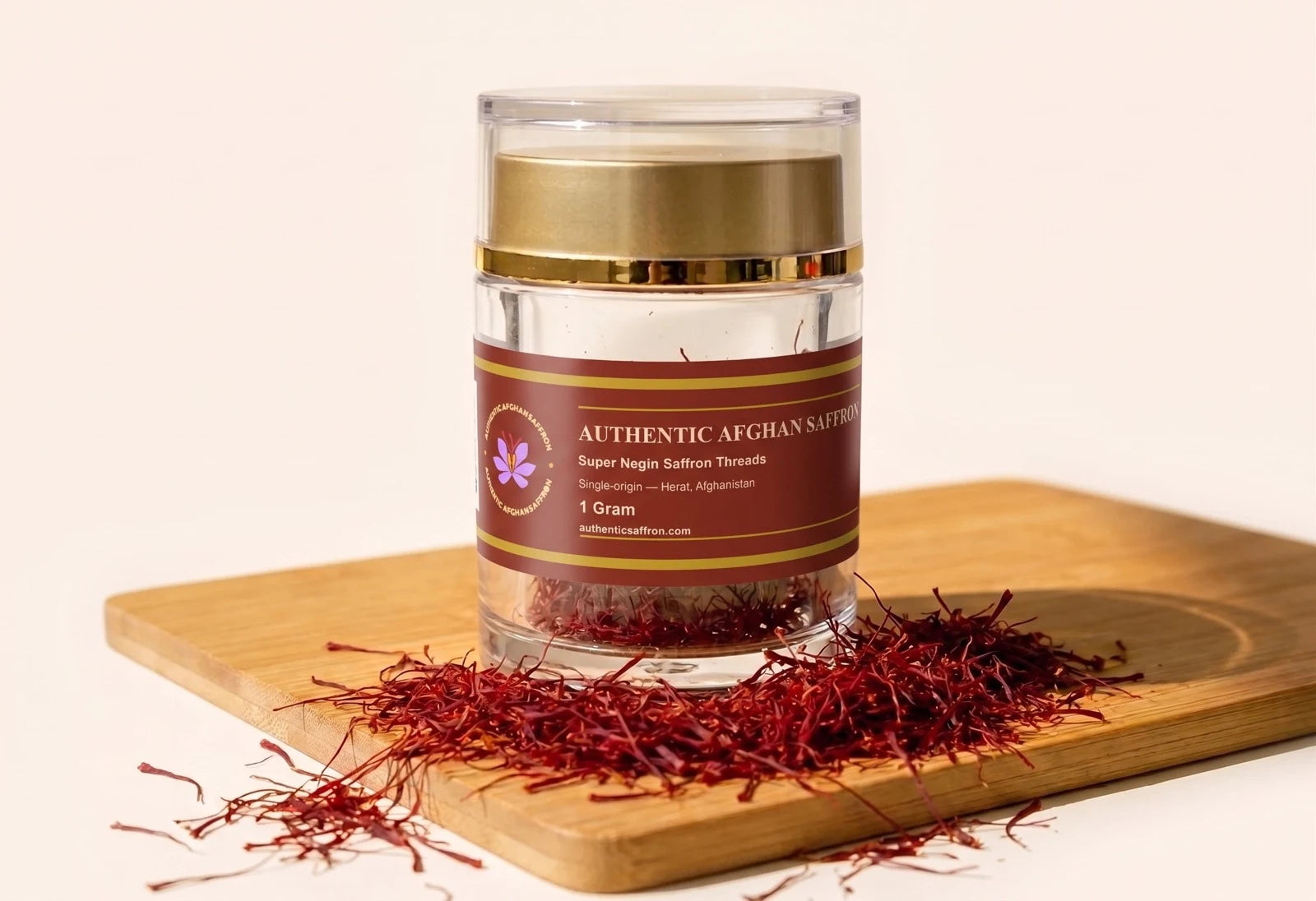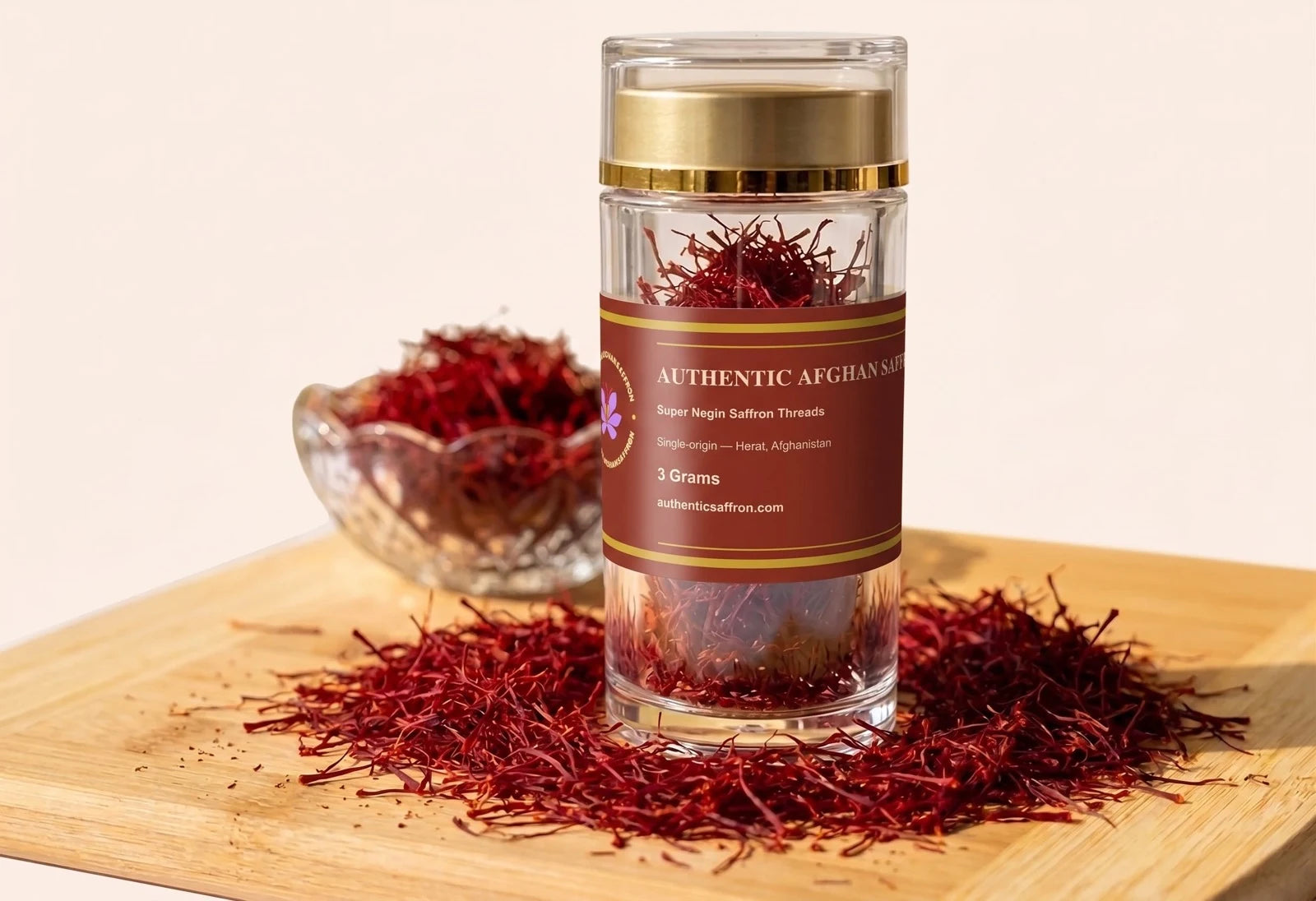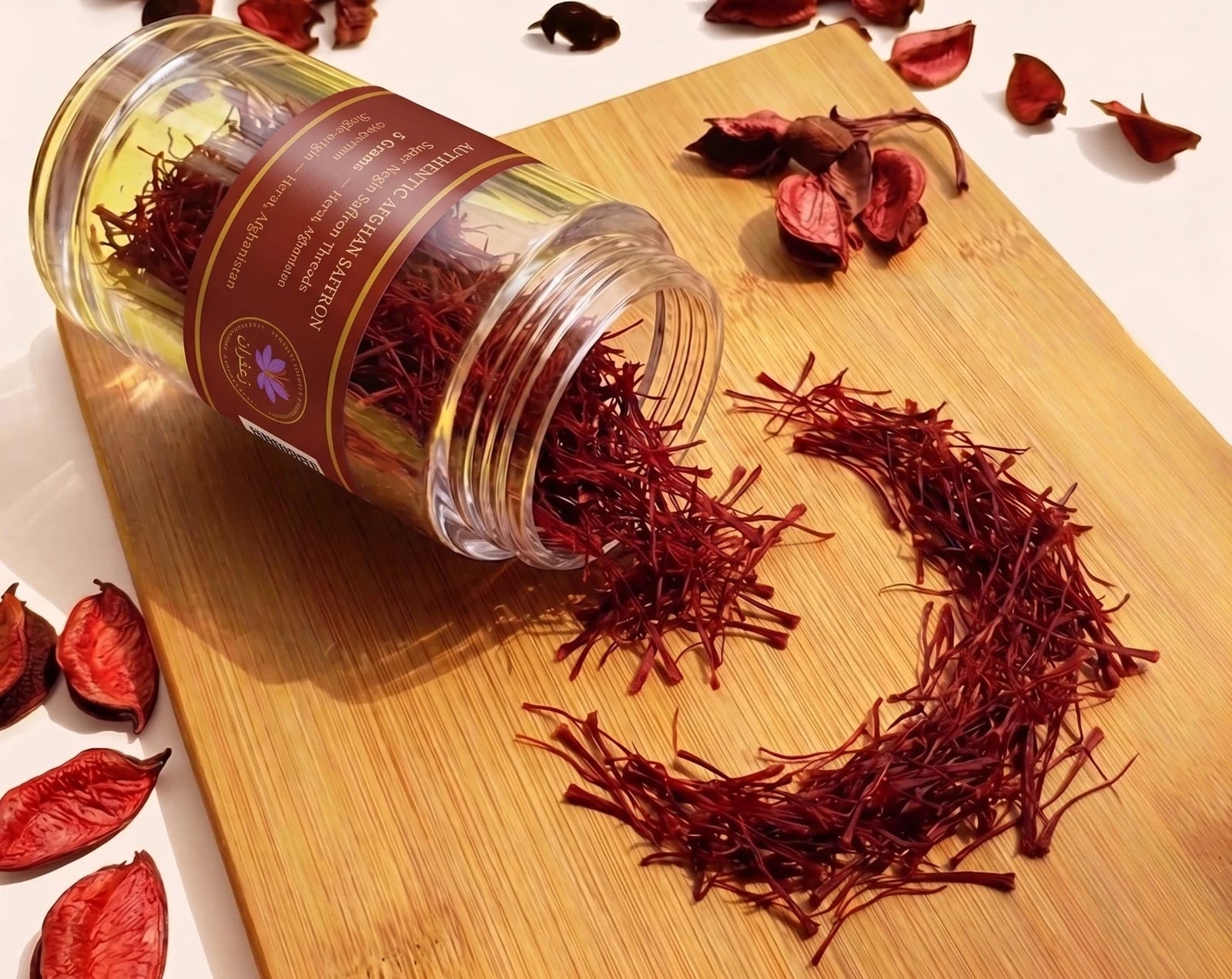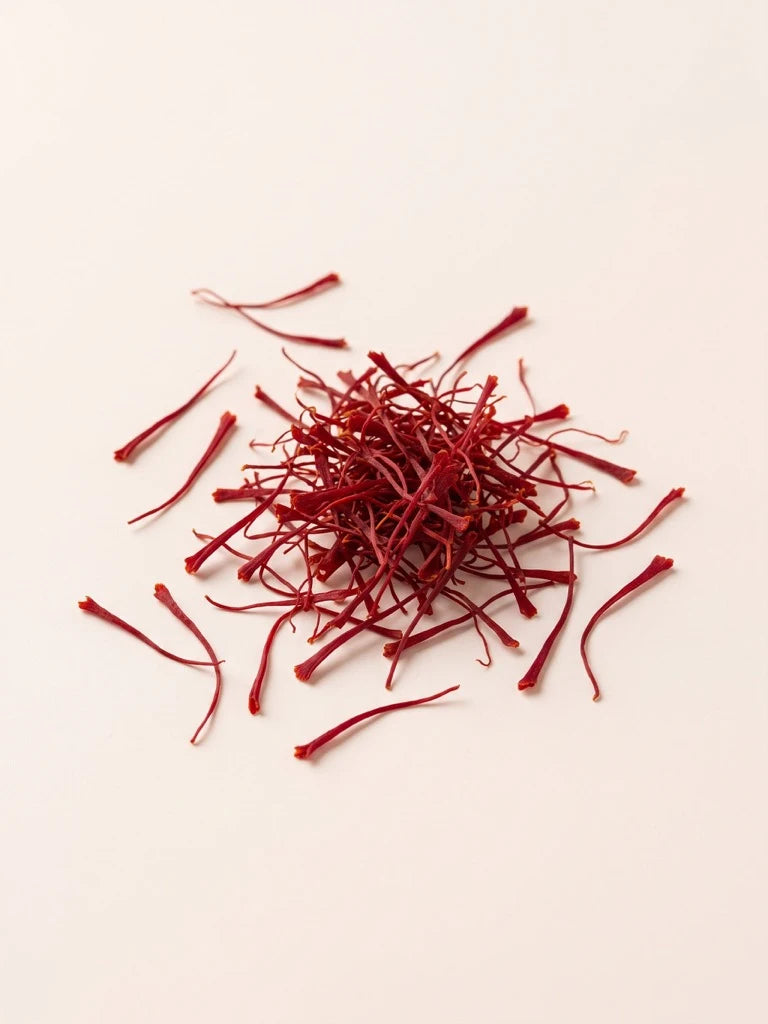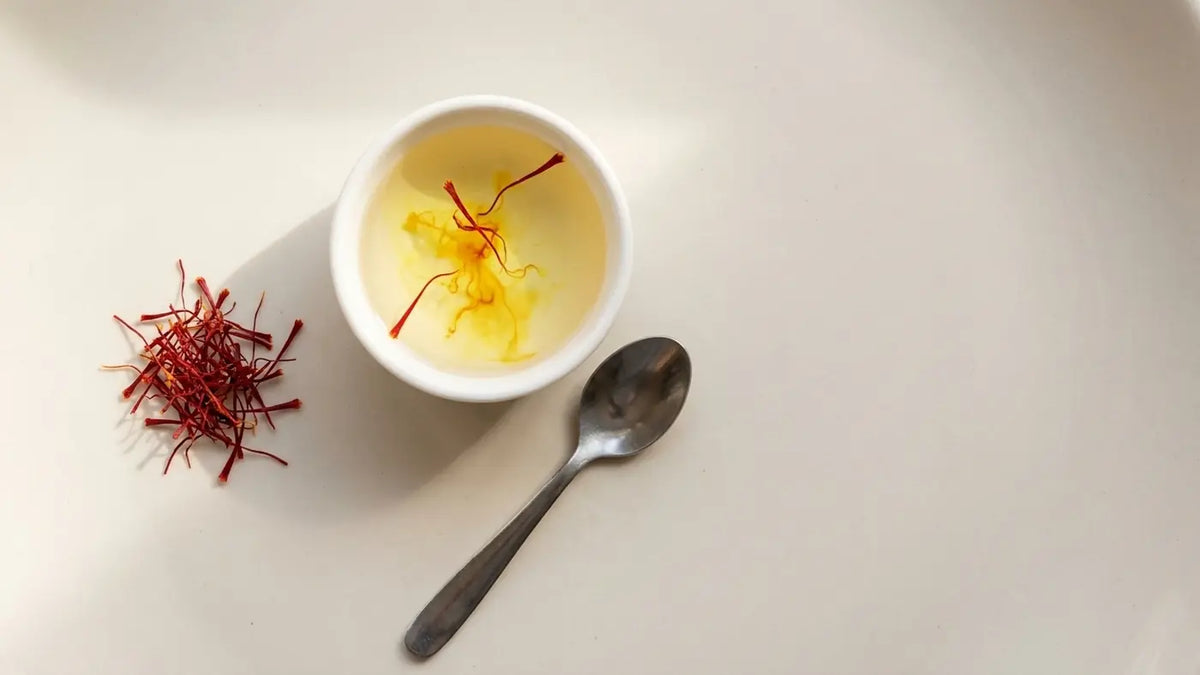
For most savoury dishes, plan on 10 to 15 threads per person, which is roughly 0.02 to 0.03 grams. That is the working answer to how much saffron per person for rice, stews and braises. Desserts and drinks usually need less. Weigh it if you own a scale that reads to hundredths of a gram; count threads if you do not.
How many threads are in a gram of saffron?
Around 450, give or take. The arithmetic is simple and worth knowing, because it turns a vague pinch into a number you can repeat. It takes roughly 150 flowers to make one gram of dried saffron, and each flower carries three red stigmas. Three times 150 is 450 threads in that gram, so a single thread weighs about 0.002 grams.
Thread size varies with grade and with how the stigmas were cut. All-red Super Negin threads are longer and heavier than a cheaper cut that includes pale style, so the same 450 count can be optimistic or conservative depending on what is in the jar. Treat it as an estimate that gets you close, not a measurement. If you want the flower maths in more depth, see how many flowers it takes to make a gram.
How much saffron per person by dish?
Saffron is a seasoning, not a bulk ingredient, and the right amount depends more on the liquid it has to colour than on the person eating it. These are the amounts we cook with.
| Dish | Threads per person | Approx. grams per person | Notes |
|---|---|---|---|
| Rice pilaf or chalow | 12–15 | 0.025–0.03 | Colour is the point; bloom and drizzle over the finished rice |
| Risotto or paella | 10–12 | 0.02–0.025 | Stock carries it; add the bloom with the first ladle |
| Brothy soup | 6–8 | 0.012–0.018 | Thin liquid shows colour easily |
| Braise or stew | 8–10 | 0.018–0.02 | Competing spices need a slightly firmer hand |
| Custard, firni or ice cream | 8–10 | 0.018–0.02 | Dairy softens the perfume; bloom in warm milk |
| Tea or saffron milk | 4–6 | 0.008–0.012 | Nothing to hide behind; too much turns medicinal |
| Bread or bun dough | 6–8 | 0.012–0.018 | Bake heat costs aroma, so colour is the realistic goal |
Note what this means for a gram. At 12 threads a head, one gram of saffron seasons around 35 servings of rice. People who think of saffron as ruinously expensive are usually pricing it per gram rather than per plate.
What does a pinch of saffron actually weigh?
A pinch is whatever your fingers pick up, which is why recipes that use the word are so inconsistent. In practice a firm pinch of loose threads lands somewhere near 20 threads, or about 0.045 grams — nearly double what one person needs in rice. A light pinch might be 8.
If you cook with saffron more than occasionally, a 0.001 gram jeweller’s scale removes the guesswork for the price of one small tin. Failing that, count. Counting 30 threads for a family of four takes fifteen seconds and it makes the dish repeatable, which is the real gain.
Does the amount scale with the number of eaters?
Not linearly. Saffron perception flattens out as you add more of it, so a pot for eight rarely needs twice what a pot for four needed. Two things actually drive the amount:
- Volume of liquid. A wide paella pan with a lot of stock needs more than a tight covered rice pot of the same headcount, because the colour has more to spread through.
- What else is in the dish. Tomato, chilli, heavy garlic and browned meat all crowd saffron out. Rice, dairy, chicken, fish and eggs let it lead.
- Grade and freshness. A high-crocin all-red thread from a recent harvest colours harder than a pale, older one. ISO 3632, published by the International Organization for Standardization, is the framework that puts numbers on that difference.
Cooking for a crowd, we scale to about 75 percent: if four people take 50 threads, eight take around 75 rather than 100. Taste the bloomed liquid before it goes in and you will feel whether it is enough.
Can you use too much saffron?
Easily, and it is the more common error in home kitchens once people stop being nervous about the price. Past a certain point saffron stops smelling floral and starts tasting bitter, iodine-like and faintly metallic. A dessert is where it shows first, because there is nothing else in the bowl to absorb it.
The fix is to build up rather than guess down. Bloom the smaller amount, add most of it, taste, and hold back a spoonful of the infusion to stir in at the end if the dish needs more. You cannot take saffron out once it is in.
Are cooking amounts the same as the doses used in research?
No, and the two should not be confused. Studies that look at saffron and mood, eye health or sleep use weighed extracts or measured powder at doses specified in milligrams per day, taken on a schedule. Cooking amounts are incidental by comparison, and they vary from meal to meal. You can browse the published literature yourself at PubMed, and we summarise the methods separately in saffron dosage in studies.
This is research, not medical advice. Speak to a doctor before using saffron therapeutically.
Frequently asked questions
How many threads of saffron are in a gram?
Roughly 450. It takes about 150 flowers to produce a gram of dried saffron and each flower carries three stigmas, so one thread weighs approximately 0.002 grams. Thread size varies by grade, so treat the figure as a close estimate rather than a measurement.
How much saffron do I need for rice for four people?
About 50 threads, or roughly 0.1 grams. Bloom them in two tablespoons of warm water at around 150°F (65°C) for 15 minutes, then stir the liquid through the rice or drizzle it over the top before serving.
Is a pinch of saffron enough for one person?
Usually it is more than enough. A firm pinch is around 20 threads, close to double what one serving of rice needs. Counting threads or weighing on a fine scale gives a far more repeatable result than pinching.
Does more saffron always mean more flavour?
No. Beyond a modest amount saffron turns bitter, iodine-like and metallic rather than more floral, and desserts show it first. Add most of the bloomed liquid, taste, then stir in the rest only if the dish needs it.