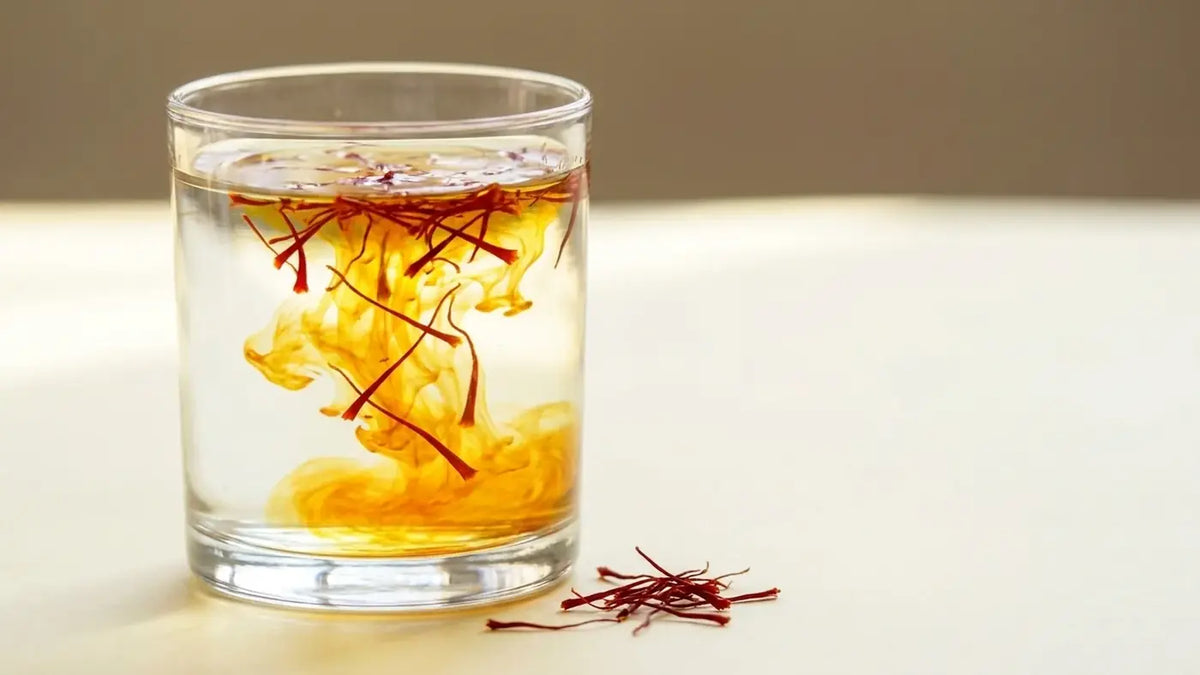
Most human trials of saffron use a saffron dosage of about 30 mg a day, usually a standardised extract taken as one or two capsules, for four to twelve weeks. That is far more than a pinch in a pilaf and far less than the grams people buy as spice.
How much saffron do studies actually use?
The number that appears again and again in published human research is 30 mg a day. Most of those studies use a standardised extract rather than loose threads, because an extract can be made to a fixed compound content and a capsule can be matched with an identical placebo. Neither is possible with a pinch of threads in a spoon.
Trials looking at mood, appetite and vision tend to cluster around the same amount. Some use a little less, some a little more. Nobody arrived at 30 mg because it is a proven threshold. It became the convention because early trials used it and later ones followed, so that results could be compared with each other.
We keep a plain summary of that literature on our saffron research page, with a closer look at the mood work in saffron and mood research.
Extract, powder or threads — does the form matter?
It matters a great deal, and product pages tend to blur it. Three forms turn up in the literature, and they are not interchangeable.
- Standardised extract. The default in modern trials. The manufacturer fixes the content of the marker compounds, so every capsule is the same. This is what a 30 mg figure almost always refers to.
- Dried stigma powder. Used in some earlier work. Closer to the spice itself, but the compound content is whatever that batch happened to contain, which makes trials harder to compare.
- Whole threads. Rare in research, because you cannot blind a participant to a spoonful of red threads and you cannot easily guarantee the strength of the batch.
When a supplement label says “30 mg saffron” without saying which of these it means, the number tells you less than it looks like it does.
How does a research dose compare with cooking?
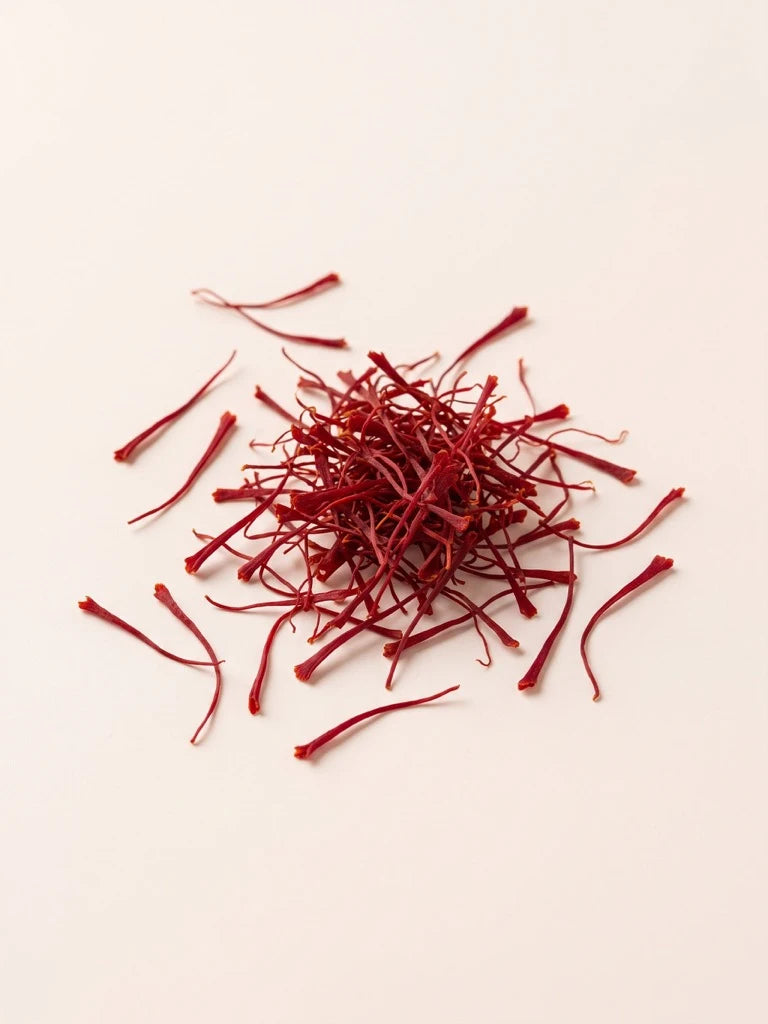
A gram of saffron is roughly 150 flowers, and each flower carries three stigmas, so a gram holds somewhere near 450 threads. That puts one thread at about two milligrams, give or take, because thread length and thickness vary between harvests and grades. Work it through and a 30 mg dose is around 13 to 15 threads.
| Context | Typical amount | Form | Purpose |
|---|---|---|---|
| A generous pinch for four servings | About 20 threads, near 40–45 mg | Whole threads, bloomed | Colour, aroma and taste in a dish |
| One portion of that dish | About 5 threads, near 10 mg | Whole threads | Culinary only |
| Common daily dose in trials | 30 mg a day | Standardised extract | Research on mood, appetite, vision, sleep |
| Split dosing in trials | 15 mg twice a day | Standardised extract | Steadier exposure across the day |
| Stigma powder studies | Usually tens of milligrams; the range varies by trial | Dried, ground stigma | Older or smaller studies |
So the research dose is not exotic. By weight it is close to what a confident cook puts into rice for four. The difference is that a trial participant takes that amount every day, in a fixed and measured form, and a cook does not.
If you want to work backwards from a recipe rather than from a study, our saffron dosage calculator and the guide on how much saffron you need are the practical versions of this arithmetic.
Why is the dose usually split into two?
Two 15 mg capsules a day is the most common schedule. The reasoning given is steadier exposure and easier tolerance, not a demonstrated requirement. There is no published evidence that splitting the dose changes an outcome compared with taking it once.
It is also a practical matter. Twice-daily dosing is easier to build a compliance check around, because participants can be asked about morning and evening capsules separately.
How long do the trials run?
Four to twelve weeks covers most of them. Eight weeks is a common choice. That is long enough to see a change on a questionnaire and short enough to keep people enrolled and funded.
It also means the honest answer about long-term daily use is that nobody has studied it properly. Saffron has been eaten as a food for a very long time; taking a concentrated extract every day for a year is a different question, and it is an open one.
What do these numbers not tell you?
Quite a lot. Many saffron trials are small, running to a few dozen participants. Several were run by groups with an interest in the outcome. Outcomes are often self-reported scores rather than hard measurements, and negative results are less likely to be published than positive ones.
The other gap is between the extract and the spice. A standardised extract is a defined preparation. Threads in a pan are food, eaten with other food, in an amount that changes every time you cook. Reading a trial result across to your dinner is a bigger leap than it looks. For the background on how trials are indexed and searched, PubMed is where most of this literature sits.
This is research, not medical advice. Speak to a doctor before using saffron therapeutically.
Frequently asked questions
How many threads is 30 mg of saffron?
Roughly 13 to 15 threads, using the rough arithmetic that a gram of saffron holds about 450 threads. Thread weight varies with grade and harvest, so treat that as an estimate rather than a measurement. If you need precision, weigh it.
Is a bigger saffron dose better?
There is no evidence for that. Trials settled on small amounts and stayed there, and the studies that exist do not show a dose ladder where more produces more. Larger amounts mainly raise the chance of side effects.
Can I get a research dose from cooking?
You can match the weight fairly easily, but that is not the same thing. Trial participants take a standardised extract every day for weeks. A dish is eaten occasionally, the saffron is spread across several servings, and the extract content is unknown.
How long do saffron trials usually run?
Most run between four and twelve weeks, with measurements taken at fixed points such as four, six or eight weeks. Long-term follow-up is rare, so what happens after a few months of daily use has not really been studied.
Read next
- Saffron safety and sensible limits — where the upper bounds sit.
- Saffron and sleep research — the same doses, a different outcome measure.
- Our summary of saffron research — what has been studied, and how well.