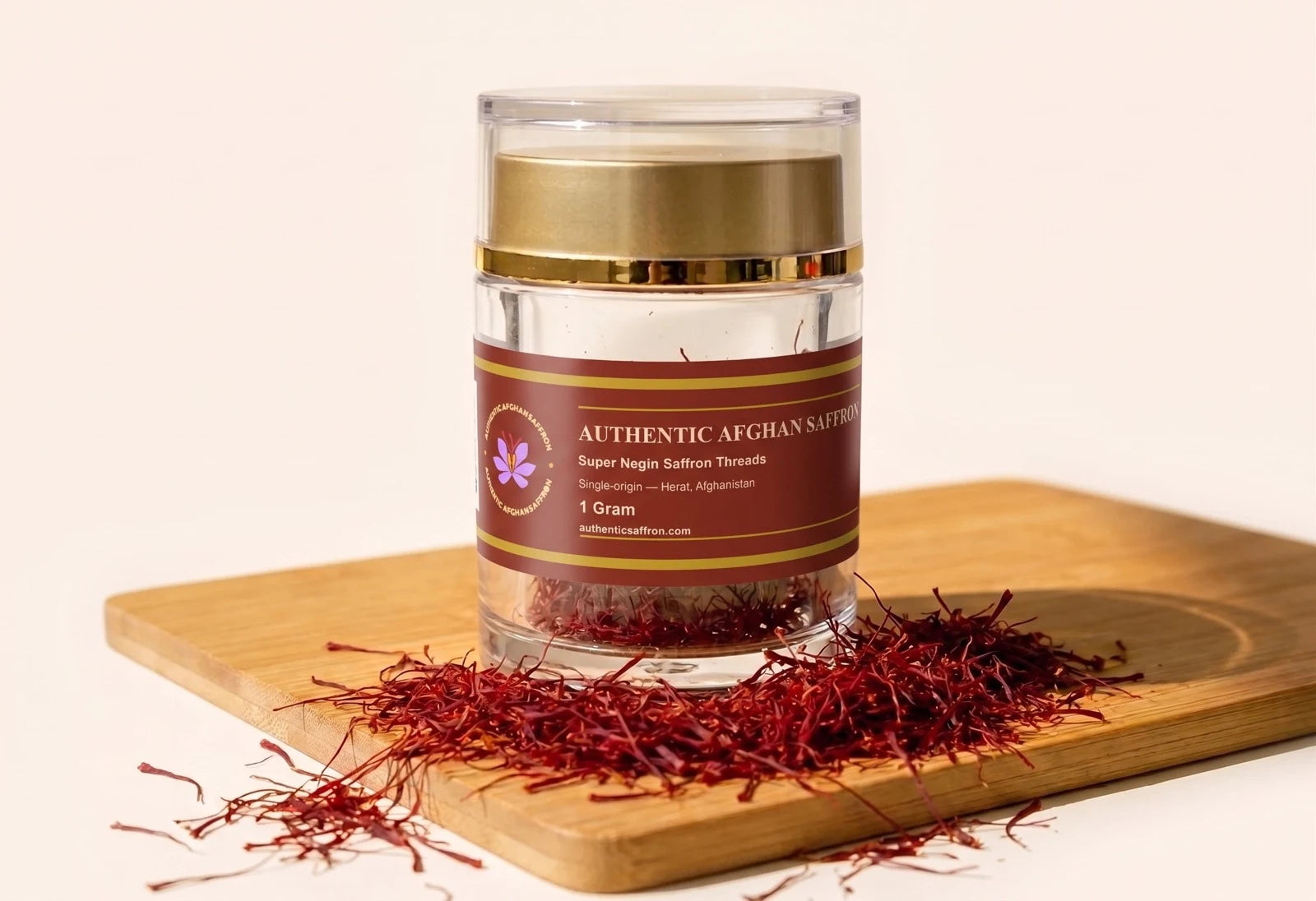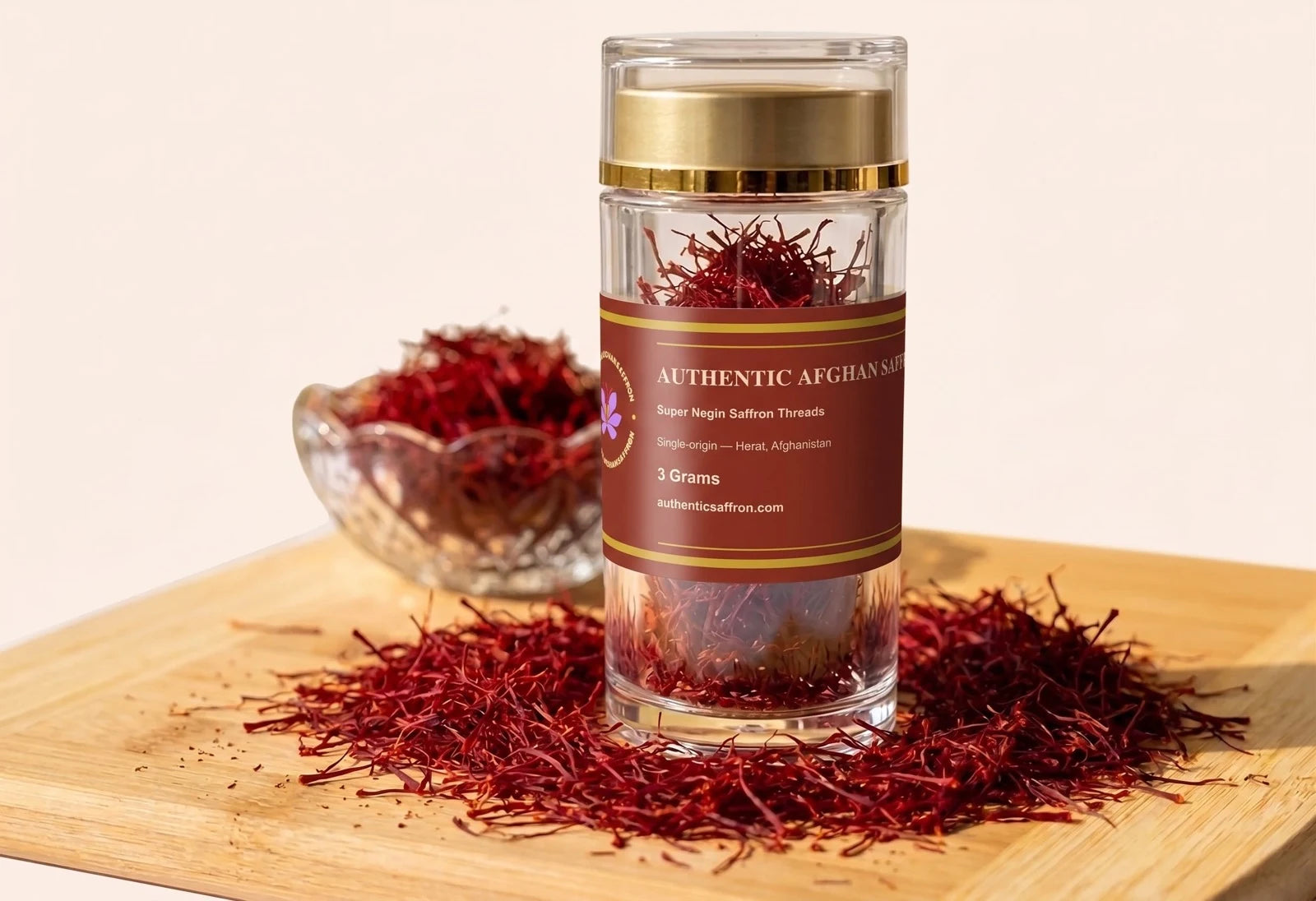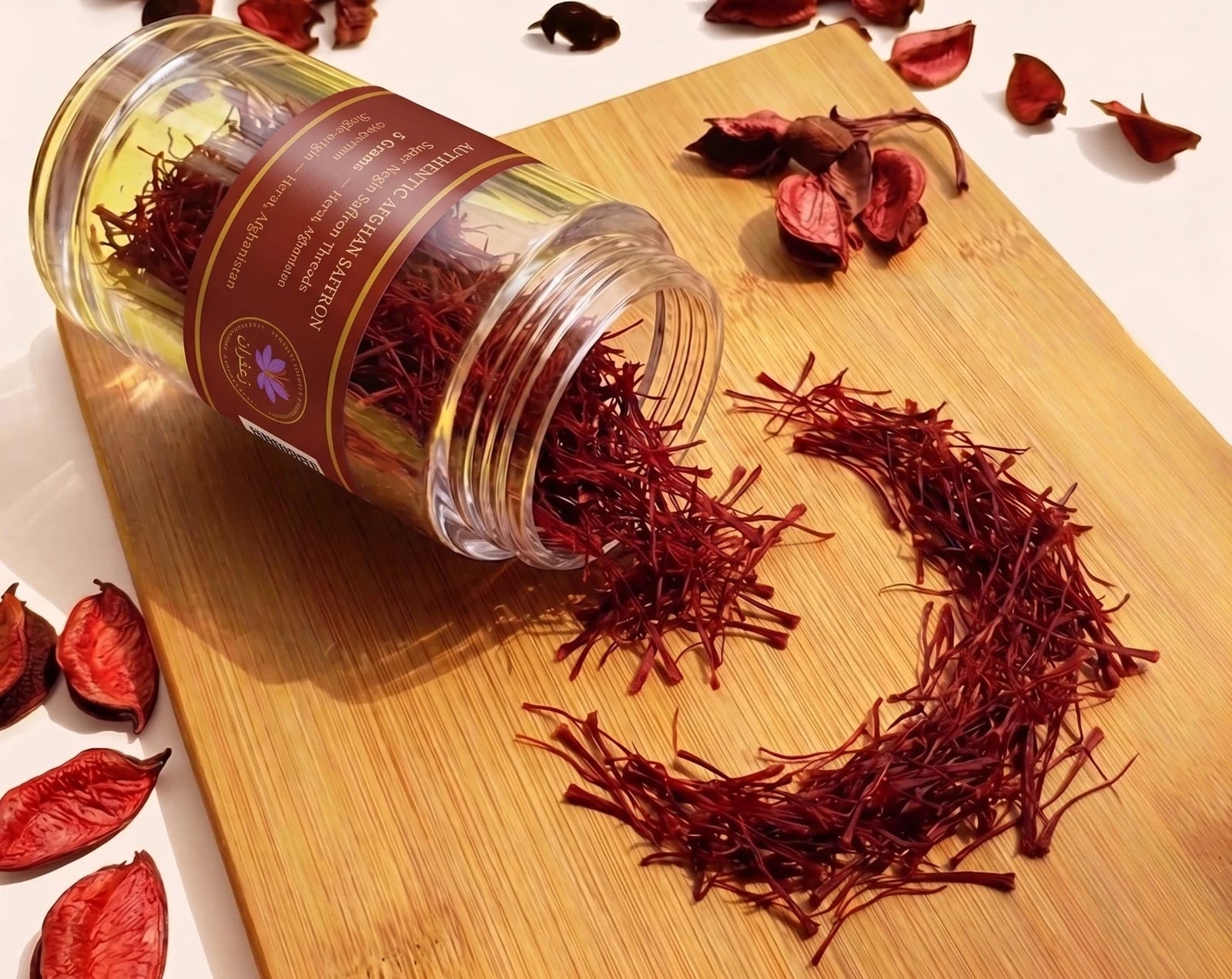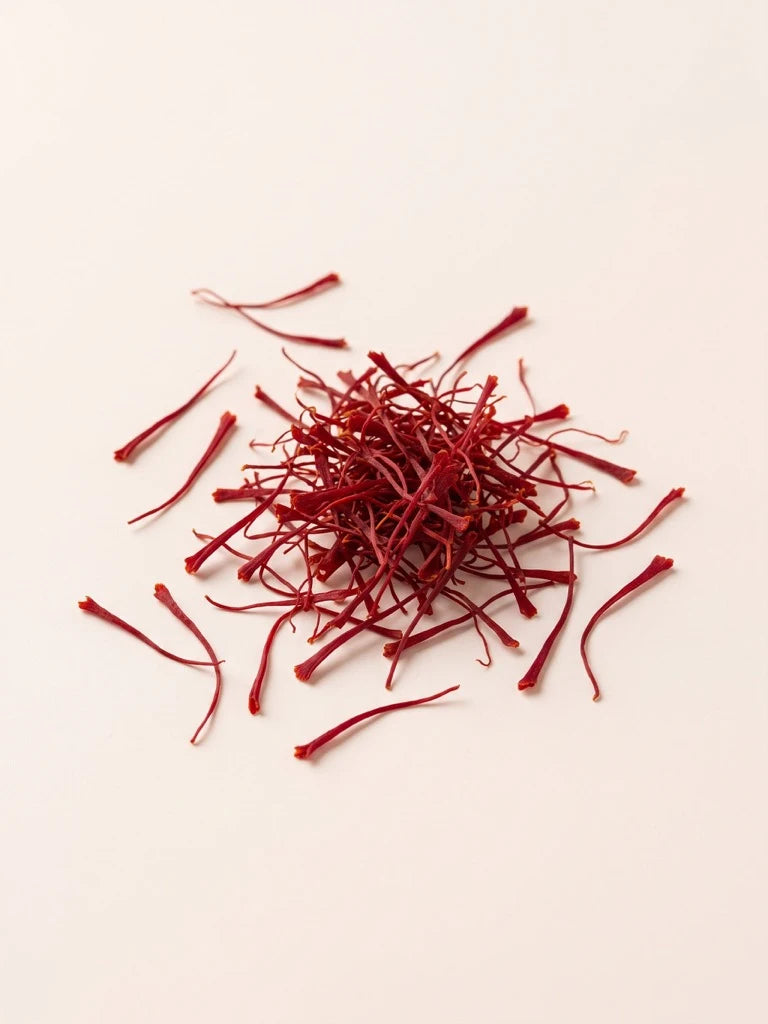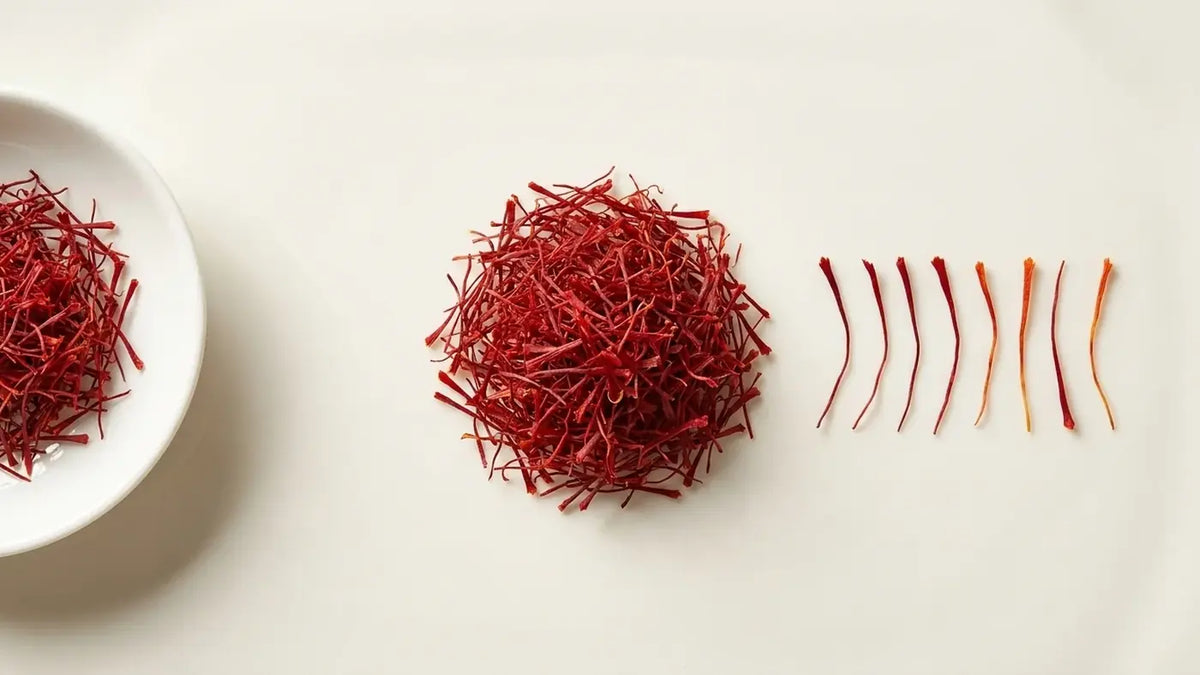
Super Negin, Negin, Sargol and Pushal are trade sorting names, not laboratory grades. They describe how much red stigma is in a thread, how long and unbroken that thread is, and how much pale style was left attached. Super Negin is the most selective sort, Pushal the least. None of the four is defined by ISO 3632.
Put super negin vs negin side by side and the difference is real but narrow: both are all-red, and the distinction is length, thickness and how little breakage the sorter tolerated. Compare either against Pushal and the gap is obvious even to an untrained eye, because Pushal still carries a visible yellow tail.
What actually separates these four grades?
One thing, mostly: which parts of the flower ended up in the tin, and how carefully they were sorted afterwards.
Each crocus flower gives three red stigmas joined at the base to a pale yellow style. The red carries almost all of the colour, bitterness and aroma compounds. The style carries almost none. Every trade grade is a decision about where to cut and how strictly to sort what is left.
- Cut high, discarding all the pale material, and you get all-red threads.
- Cut low, leaving a few millimetres of style, and you get a longer thread with dead weight on the end.
- Sort hard after cutting, removing short, broken and paler pieces, and you get the premium sorts.
- Skip the sort and you get a mixed bag that may still be honest saffron, priced accordingly.
How do the four grades compare?
| Grade | What is in the thread | Typical look | Style attached | What it implies |
|---|---|---|---|---|
| Super Negin | Stigma only, from the most selective sort | Long, thick, deep red, trumpet-shaped tips, very few broken pieces | None | Highest thread-for-thread strength and the most uniform pinch |
| Negin | Stigma only | Long and largely unbroken, slightly more variation in length | None | Very close to Super Negin in practice; cosmetically less uniform |
| Sargol | Stigma only, cut from the bunch | Shorter pieces, more fragments and dust at the bottom of the tin | None | All-red but broken; fragments lose strength faster once exposed |
| Pushal | Stigma plus part of the style | Red tips with a visible pale yellow tail | Yes, a few millimetres | Lower strength per gram because part of the weight is inert |
Read the last column carefully. Three of these grades are all-red, so the differences between them are about breakage and uniformity rather than composition. Only Pushal changes what is actually in the gram. We go further into that distinction in what all-red saffron actually means.
Is Super Negin the same everywhere?
No, and this is the part that catches buyers out. There is no registry, no inspection body and no published threshold for the word Negin. A packer decides how strictly to sort, then chooses the name.
Two tins labelled Super Negin from two different sellers can differ in thread length, in the amount of dust at the bottom, and in colouring strength. Neither seller has broken a rule, because there is no rule to break. The only external framework that does carry defined thresholds is ISO 3632, and it never mentions these trade names at all. The current text is published as ISO 3632-1.
What ISO measures is the extract itself: colouring strength read at 440nm, bitterness at 257nm and safranal at 330nm, which together place a batch in Category I, II or III. A batch of Pushal can pass Category I. A batch of tired, badly stored Super Negin can fail it. Grade name and category are answering different questions.
Which grade should you actually buy?
For cooking, the honest answer is that Super Negin and Negin will behave almost identically in a pot. The premium you pay for the top sort buys uniformity and appearance more than flavour. If you are dosing by thread count rather than by weight, uniformity has real value, because your pinch is consistent from one dish to the next.
Sargol is worth buying if the price reflects the breakage. Short pieces bloom quickly, which some cooks prefer, but they also stale faster once the tin is opened. Pushal is defensible at a genuinely lower price per gram, since you are knowingly buying some inert weight, and it is often the freshest option at a local market.
What is not defensible is paying a Super Negin price for anything else. That is a pricing question more than a grading one, and we set out the arithmetic in the saffron price guide.
Why do sellers stretch these names?
Because the names are free. Adding the word Super to a listing costs nothing and moves the price. Absent any verification, the label drifts upward over time until almost everything on a marketplace claims the top sort and the word stops carrying information.
Three habits protect you:
- Look at photographs of the actual threads, not stock imagery. Length, breakage and the presence of pale tails are all visible.
- Ask what the harvest year is. Sorting grade is fixed at harvest; strength is not.
- Ask for a dated laboratory report rather than a grade name. A number with a date behind it beats an adjective.
Our own batches are sorted to the Super Negin standard, and we describe them that way while being clear that the term is a sorting description rather than an accredited grade. Testing on the current harvest is underway and we will publish the report in full when it is complete. Until then we would rather you judged the threads than the word.
Frequently asked questions
Is Super Negin an official saffron grade?
No. It is a trade sorting description used by packers to mean the longest, thickest, all-red threads with minimal breakage. No standards body defines it and no inspection is required to use the word.
Is Negin weaker than Super Negin?
Not necessarily. Both are all-red stigma with no style attached, so the compounds present are the same. Super Negin is sorted more strictly for length and uniformity, which affects appearance and consistency more than it affects strength per gram.
What is the difference between Sargol and Negin?
Both are all-red. Sargol threads are cut and tend to be shorter and more broken, with fragments and dust in the tin. Negin threads are longer and largely intact, which is why they command a higher price.
Should I avoid Pushal saffron?
Not if the price reflects what it is. Pushal includes part of the pale style, which adds weight without adding colour or aroma, so you need a slightly larger pinch. It becomes a bad deal only when it is sold at an all-red price.