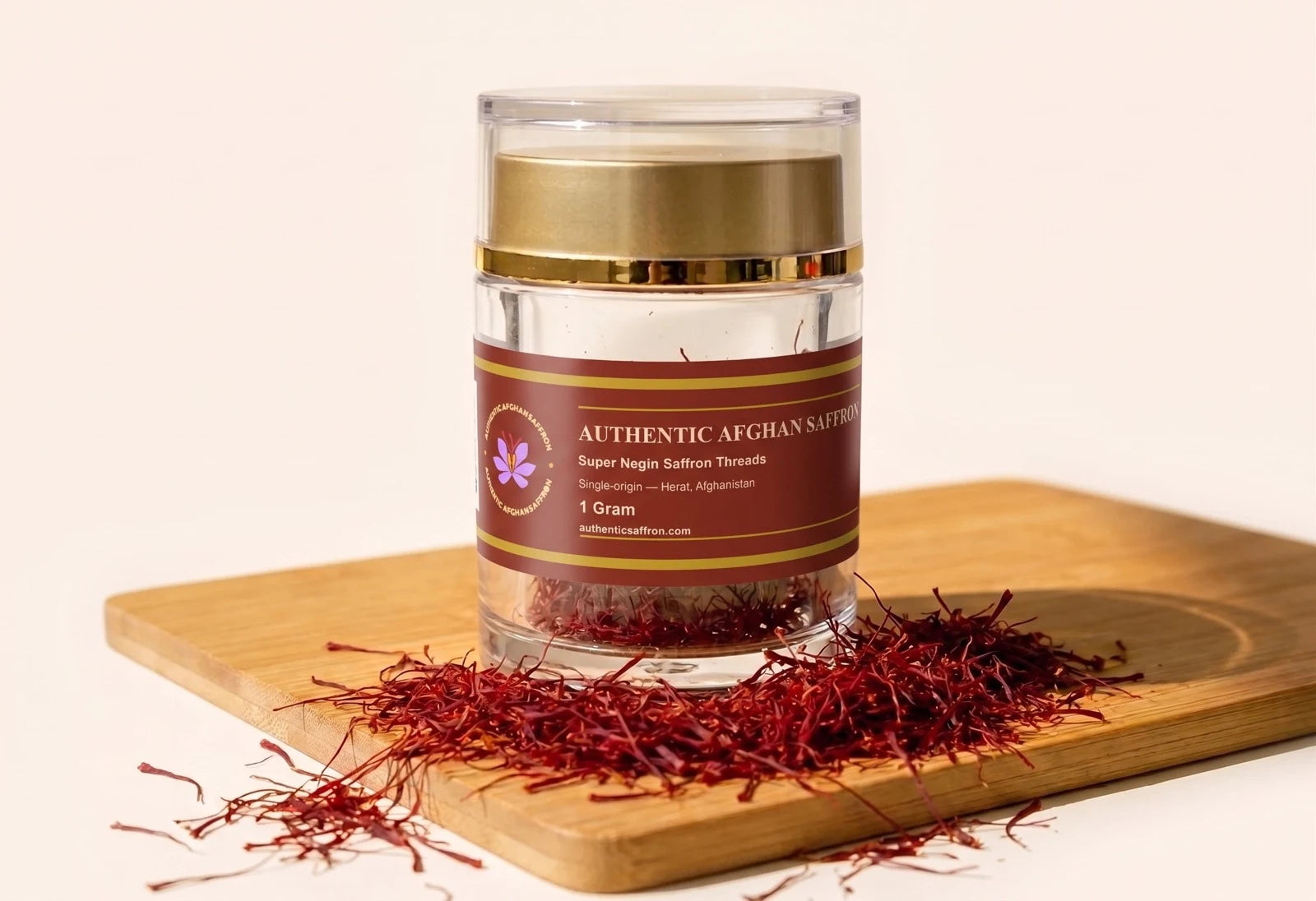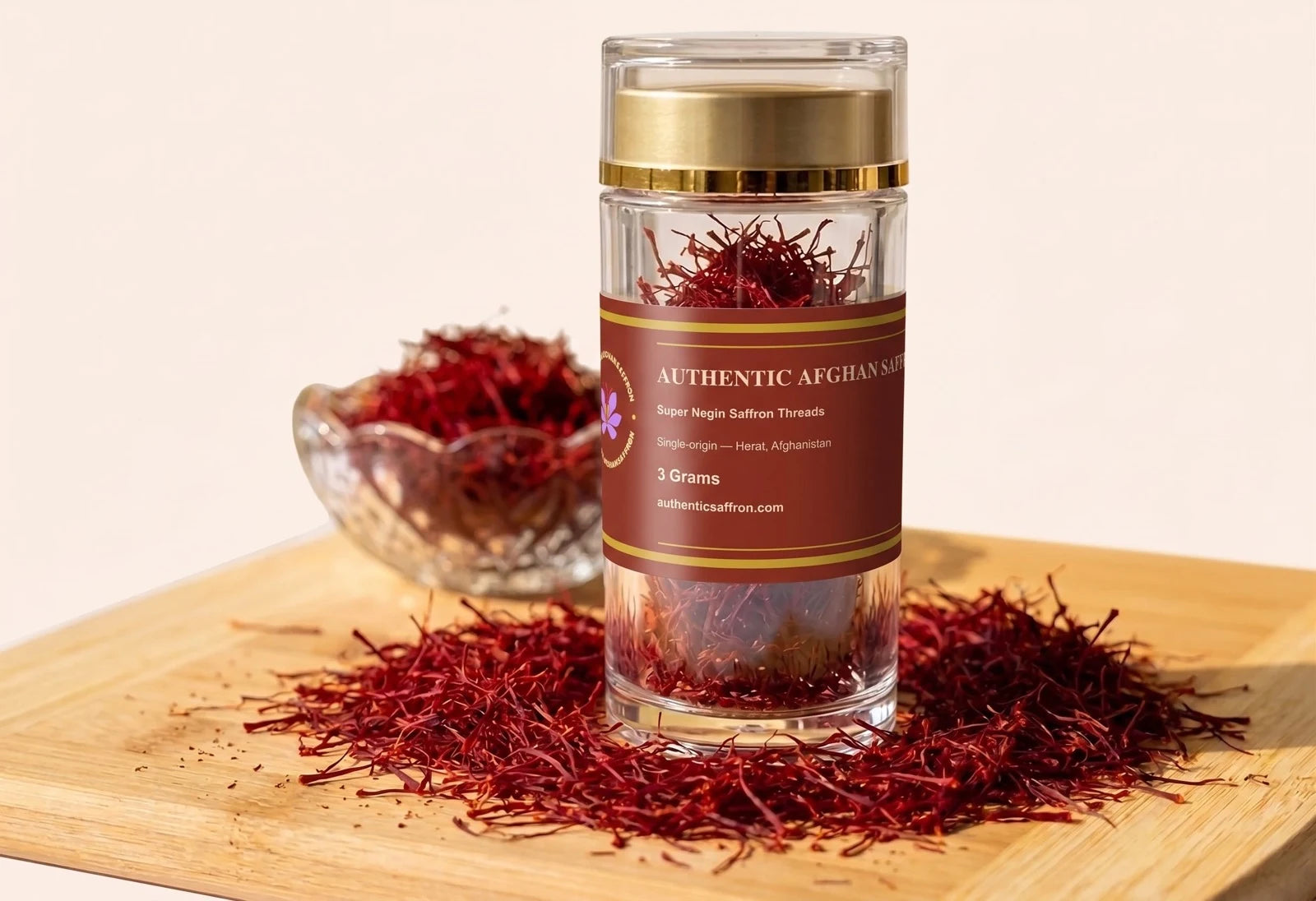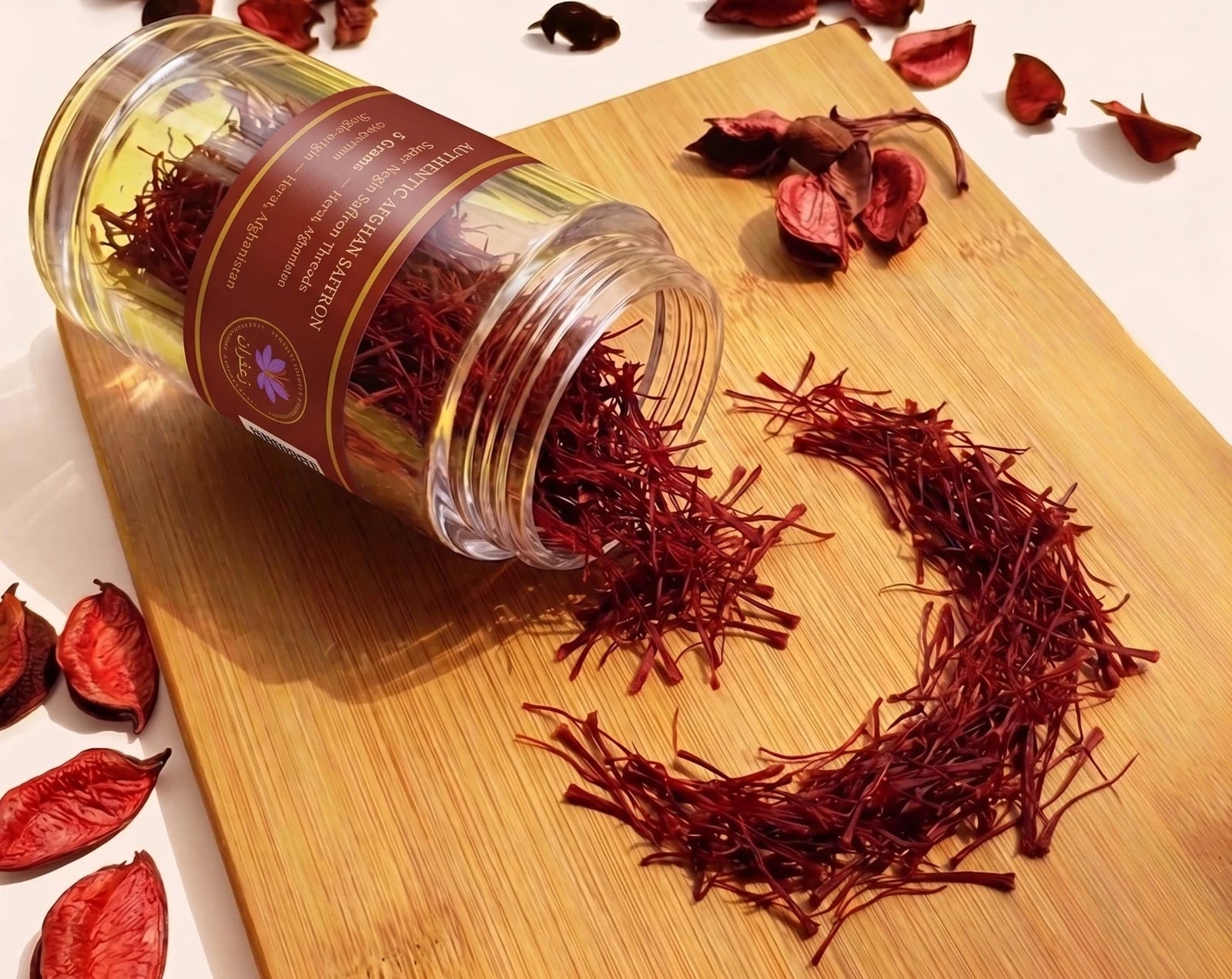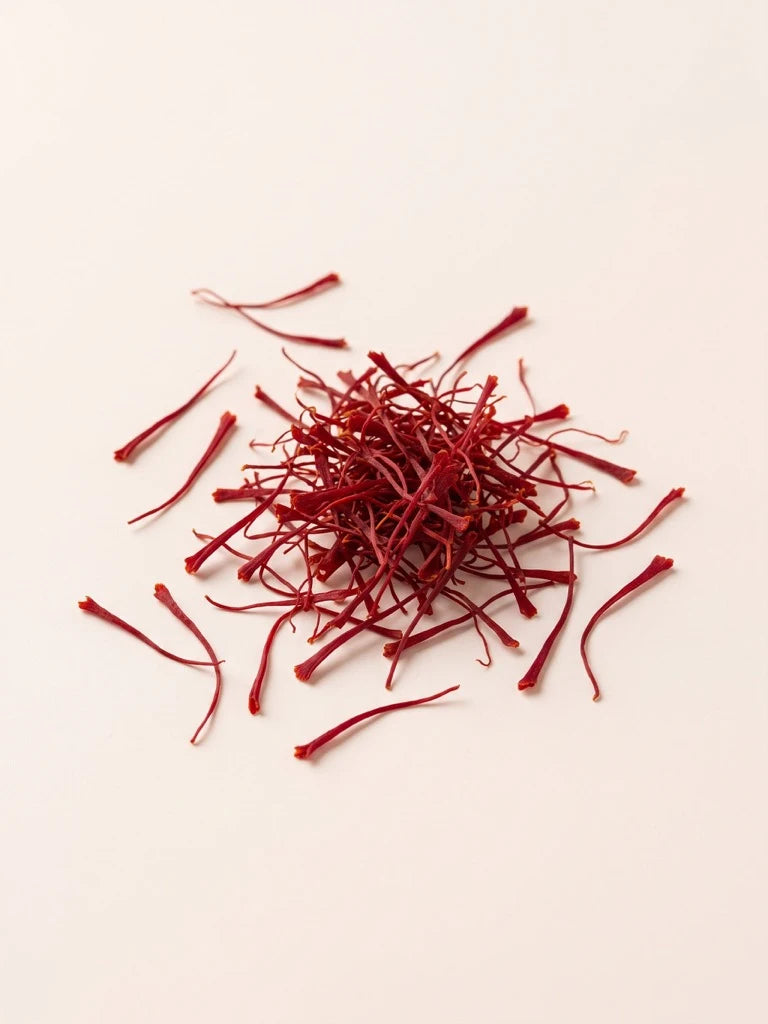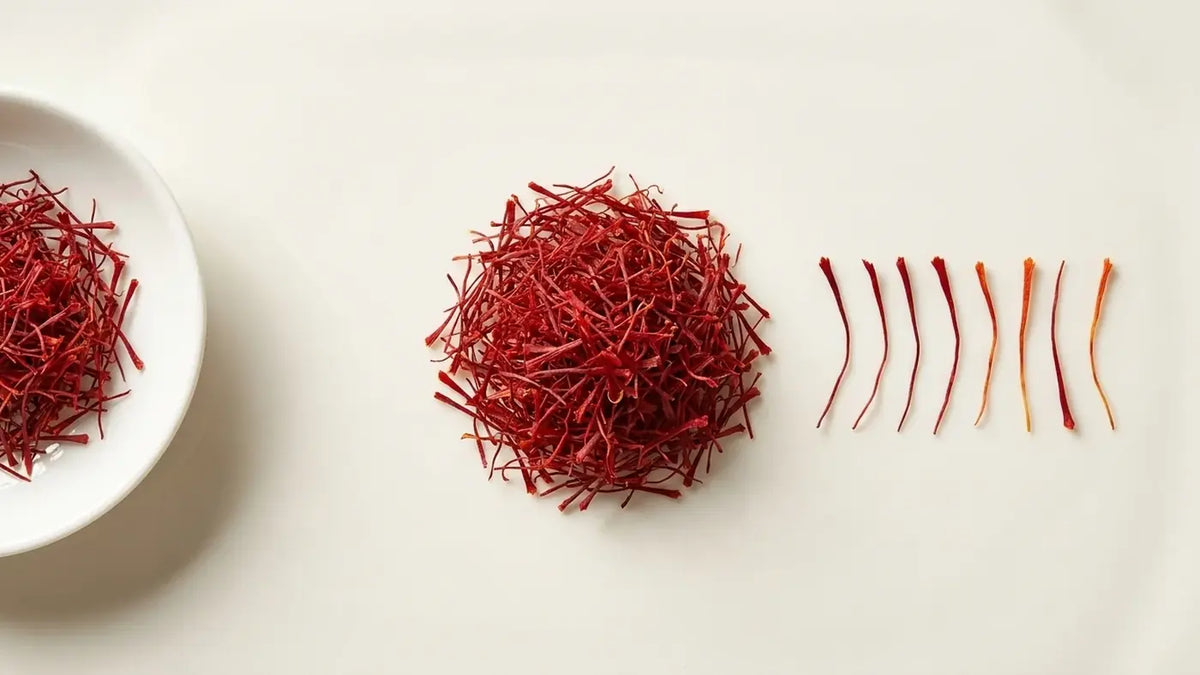
Coupe saffron is the top grade in the Spanish naming system. The word means cut: the pale style has been cut off, leaving only red stigma. It is the Spanish equivalent of an all-red sort, and like every trade grade it describes how the threads were trimmed rather than how strong they turned out.
Spanish grade names travel further than Spanish saffron does. You will see coupe on tins packed in the United States, in Morocco and across the Gulf, often alongside grade names from other traditions on the same shelf. Knowing what the word originally meant makes those labels much easier to read.
What does coupe mean on a saffron label?
Coupe — properly coupé — is the trimming instruction turned into a product name. In the Spanish trade the stigmas are cut at the point where the red tissue ends, and everything below that line is discarded.
What survives is the part of the flower that carries the working compounds: crocin for colour, picrocrocin for bitterness, safranal for aroma. What is discarded is the style, which adds weight and very little else. That is the entire proposition, and it is a sound one.
Two things the word does not mean. It does not mean the saffron was grown in Spain. And it does not mean the saffron carries a protected designation — Azafrán de La Mancha is a geographic designation with its own rules, while Mancha as a grade name is just the next rung down the trimming ladder. The two uses of the word are unrelated.
How does coupe fit the Spanish grading ladder?
The traditional ladder runs from most trimmed to least. Each step down leaves more pale style attached, which dilutes the gram.
| Grade | Style left attached | Relative colour per gram | Where you usually see it |
|---|---|---|---|
| Coupe | None — red stigma only | Highest of the Spanish grades | Premium retail tins and food service |
| Mancha | A small amount | High, slightly below coupe | The common commercial grade |
| Rio | More style, thinner threads | Moderate | Bulk and catering supply |
| Standard | More again | Lower | Volume buyers and blends |
| Sierra | The most — often whole style | Lowest of the five | Industrial use and colouring |
The column to watch is the second one. Every difference in the table comes from a single decision made with scissors. Nothing in the ladder describes freshness, drying quality or how long the tin sat under shop lights.
Does coupe grade saffron test stronger?
On average, yes, and for a reason that is close to arithmetic rather than agronomy. Remove inert material and the compounds that remain are concentrated into fewer grams. A coupe sample from a given harvest will normally read higher for colouring strength than a Sierra sample from the same field.
That is a comparison within one harvest, though. Across harvests it collapses quickly. Coupe threads that are three years old, or that were dried too hot, can read below fresh Mancha. Grade sets the ceiling; handling decides where under that ceiling the batch actually lands.
The measurement itself is not a grade at all. Under ISO 3632, a prepared extract is read for colouring strength at 440nm, bitterness at 257nm and safranal at 330nm, and those readings place a batch in Category I, II or III. The standard is published as ISO 3632-1 and it does not contain the word coupe anywhere. We unpack the bands in Category I, II and III explained.
Is coupe the same as Sargol or Super Negin?
Functionally close, commercially different. All three describe all-red threads with the style removed. Where they diverge is in what else the sorter cared about.
- Coupe is defined by the cut. Thread length and breakage are not part of the definition.
- Sargol is also defined by the cut, and tends to arrive shorter and more fragmented.
- Super Negin adds a second filter on top of the cut: length, thickness and minimal breakage.
So a tin of coupe can be all-red and still be full of short pieces and dust. That is not a defect against the grade, because the grade never promised otherwise. The comparison is drawn out further in Super Negin, Negin, Sargol and Pushal compared, and by region in Afghan, Spanish and Kashmiri saffron side by side.
Where does a coupe claim fall short?
Two places, and both are worth knowing before you pay a premium for the word.
First, provenance. Spain has for a long time imported far more saffron than its own fields produce, cleaning, grading and repacking it for export. A Spanish grade name on a tin therefore says something about the sorting convention used, not about the soil the crocus grew in. That is legal and long-established, but it does mean the word coupe cannot be read as a country of origin.
Second, verification. No one audits the use of the term. A packer applies it because the threads look trimmed, and there is no body to appeal to if you disagree. The only claim that can be checked is a dated laboratory report with the batch identified on it, which is the argument we make in why a grade claim without a certificate means nothing.
Frequently asked questions
Is coupe the best grade of saffron?
It is the most trimmed grade in the Spanish system, so within that system it delivers the most red tissue per gram. Best is a stretch, because the term says nothing about freshness, drying or storage, all of which change how the saffron performs.
Does coupe saffron come from Spain?
Not necessarily. Coupe is a grading convention, not a geographic label. Saffron grown elsewhere is routinely graded and packed under Spanish trade names, so the word describes the cut rather than the origin.
Is coupe the same as Category I?
No. Coupe is a trimming grade applied by eye. Category I is a laboratory outcome under ISO 3632, based on absorbance readings. Coupe threads can test into any of the three categories depending on their condition.
Should I pay more for coupe than for Mancha?
Only in proportion to the extra red tissue you receive. Mancha carries some pale style, so you need a slightly larger pinch. If coupe costs far more per gram than that difference justifies, Mancha is the better value.