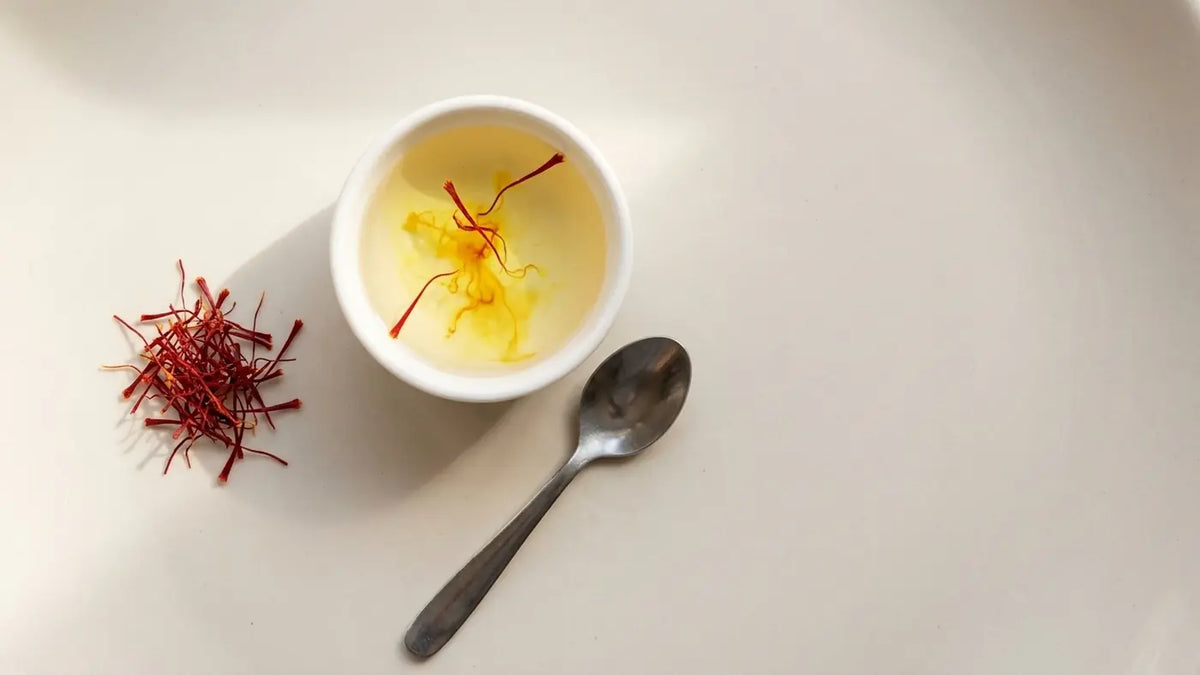
Saffron pairings work best when the partner ingredient is quiet. Saffron sits happily with dairy, rice, potato, almond, citrus zest, fennel and delicate seafood. It fights loud aromatics — smoked chilli, heavy cumin, woody herbs, dark chocolate — because those cover the honeyed, hay-like notes you actually paid for.
Saffron is not a strong spice. It is a persistent one. A pinch colours a whole pot of rice and scents a kitchen, but its own flavour occupies a narrow band, and that band is easy to bury. Most pairing failures are not clashes of taste. They are cases of one ingredient simply shouting louder.
What does saffron actually taste like?
Three compounds carry the load. Crocin is the colour, read in a laboratory at 440nm. Picrocrocin is the bitterness, read at 257nm. Safranal is the aroma, read at 330nm — floral, faintly medicinal, and volatile enough to leave the pan if you are careless. The ISO 3632 scheme measures all three, and the current text is published as ISO 3632-1.
The useful translation for a cook is this. Colour is robust and survives almost anything. Bitterness is moderate and grows if you overdose. Aroma is fragile, and aroma is what people mean when they say a dish tastes of saffron.
Pairing, then, is mostly a question of protecting the aroma. Everything below follows from that one idea.
Which ingredients does saffron love?
Good partners share a trait: they carry flavour without competing for the same space. In practice that means fat, starch, mild sweetness and gentle acidity.
- Dairy and fat. Butter, cream, whole milk, yoghurt, olive oil. Crocin dissolves in water and the aromatic fraction travels well in fat, so a dish with both gets more out of the same pinch.
- Quiet starches. Rice, potato, bread dough, pasta, couscous. They give the colour somewhere to land and add almost no flavour of their own.
- Almond and pistachio. Sweet, oily, low in aromatics. A classic partnership in both sweet and savoury cooking.
- Citrus zest. Orange especially, lemon at a lighter hand. Zest lifts saffron without the flattening effect of straight acid.
- Alliums cooked slowly. Onion, leek, shallot and fennel taken to sweetness rather than colour.
- Delicate seafood. Mussels, clams, white fish, shellfish stock. Saffron and shellfish share a faint iodine edge that reads as one flavour rather than two.
- Cardamom, rose and vanilla, used sparingly. All three are aromatic, so they are allies at a quarter of the quantity you would normally use and rivals at full strength.
What does saffron fight with?
The opponents are not bad flavours. They are simply bigger ones, and they sit in the same aromatic register. Put saffron next to them and you have paid for a colour.
Smoke is the worst offender. Smoked paprika, chipotle and anything grilled over hardwood will erase saffron entirely. Woody herbs come next: rosemary, thyme and oregano in quantity all carry pine and camphor notes that read as noise against a floral spice.
Then there are the deep, roasted flavours — dark chocolate, coffee, browned butter taken past nutty into burnt. They are not enemies of saffron so much as replacements for it. Heavy toasted cumin, brown mustard seed and a raw garlic hit belong in the same group.
Sharp vinegar deserves a note of its own. Acid does not destroy saffron, but a vinegar-forward dressing flattens the aroma and leaves the bitterness exposed, which is the least attractive part of the spice on its own.
Which pairings are safe and which need care?
The table below sorts the common partners into three relationships. Treat it as a starting point rather than a rule, and taste as you go.
| Partner | Relationship | Why it behaves that way | How to use it |
|---|---|---|---|
| Butter, cream, milk | Ally | Fat carries the aromatic fraction and softens bitterness | Bloom directly in warm milk or finish with saffron butter |
| Rice and potato | Ally | Neutral starch, high surface area for colour | Add the bloom with the cooking liquid, not at the end |
| Orange zest | Ally | Shares floral terpenes without masking them | Zest at the end; avoid boiling the zest |
| Cardamom, rose | Handle with care | Equally aromatic, so they compete directly | Use a quarter of your usual quantity |
| Tomato | Handle with care | Acidity and sweetness can swamp a small pinch | Increase the saffron slightly, or add it late |
| Garlic | Handle with care | Fine when softened, dominant when raw or browned | Sweat it first; keep it off the heat colour |
| Smoked paprika, chipotle | Fights | Smoke sits on top of every other aroma | Choose one or the other in a dish |
| Rosemary, thyme, oregano | Fights | Resinous notes clash with a floral spice | Swap for parsley, chervil or dill |
| Dark chocolate, coffee | Fights | Roasted bitterness replaces saffron bitterness | Keep saffron for lighter desserts instead |
Does the way you bloom it change the pairing?
It does, more than most people expect. Dry threads dropped into a pan give you a fraction of what you bought, because the colour and much of the aroma need a liquid to move into first.
Bloom in warm liquid at around 150°F (65°C) for ten to twenty minutes. Never boiling — hard heat drives off the safranal you are trying to keep. Then choose the liquid to match the dish: water for the cleanest, most neutral result; milk or cream for desserts and rice; a ladle of warm stock for stews and seafood.
The choice of liquid is itself a pairing decision, and we compare the options side by side in blooming liquids compared. The basic technique is set out step by step in our guide to how to bloom saffron.
One more practical point. Add the bloom early enough to distribute and late enough to survive. In a risotto or a pilaf that means with the last of the liquid, not at the first sizzle. Our page on cooking with saffron covers the timing for each dish type.
Frequently asked questions
Do saffron and garlic go together?
Yes, if the garlic is softened rather than browned. Slow-cooked garlic turns sweet and sits underneath saffron without competing. Raw or deeply caramelised garlic takes over, and the saffron becomes colour alone.
Can I use saffron and turmeric in the same dish?
You can, but there is little reason to. Turmeric is earthier and much stronger by weight, so it dominates the aroma while adding colour saffron was already providing. If a recipe calls for both, add the turmeric with a light hand.
What herb goes best with saffron?
Soft green herbs. Parsley, chervil, chive, dill and a small amount of tarragon all sit alongside saffron without crowding it. Woody herbs such as rosemary and thyme are the ones to avoid in quantity.
Does saffron work with chilli?
Fresh chilli heat is fine, because heat is a sensation rather than an aroma. Smoked and dried chillies are the problem, since smoke covers the floral notes completely.
Where should you go from here?
- Saffron in sweet dishes versus savoury — how the same pinch behaves differently on each side of the menu.
- Common saffron mistakes — the handling errors that waste more saffron than bad pairings do.
- How much saffron per person — getting the quantity right before you worry about partners.
- Saffron risotto Milanese — the classic case of dairy, starch and saffron doing very little else.