Saffron harvesting by hand survives because the crop breaks every rule automation depends on. The flowers open at dawn and must be picked that morning, they do not all open at once, and the harvest is three fragile threads hidden inside each bloom. Machines can dry and sort saffron. Nobody has replaced the picking or the plucking.
Why is saffron still harvested by hand?
Mechanisation usually needs three things: a crop that ripens more or less together, a harvestable part that is tough enough to survive rough handling, and a low enough value per unit that a little waste does not matter. Wheat has all three. Saffron has none.
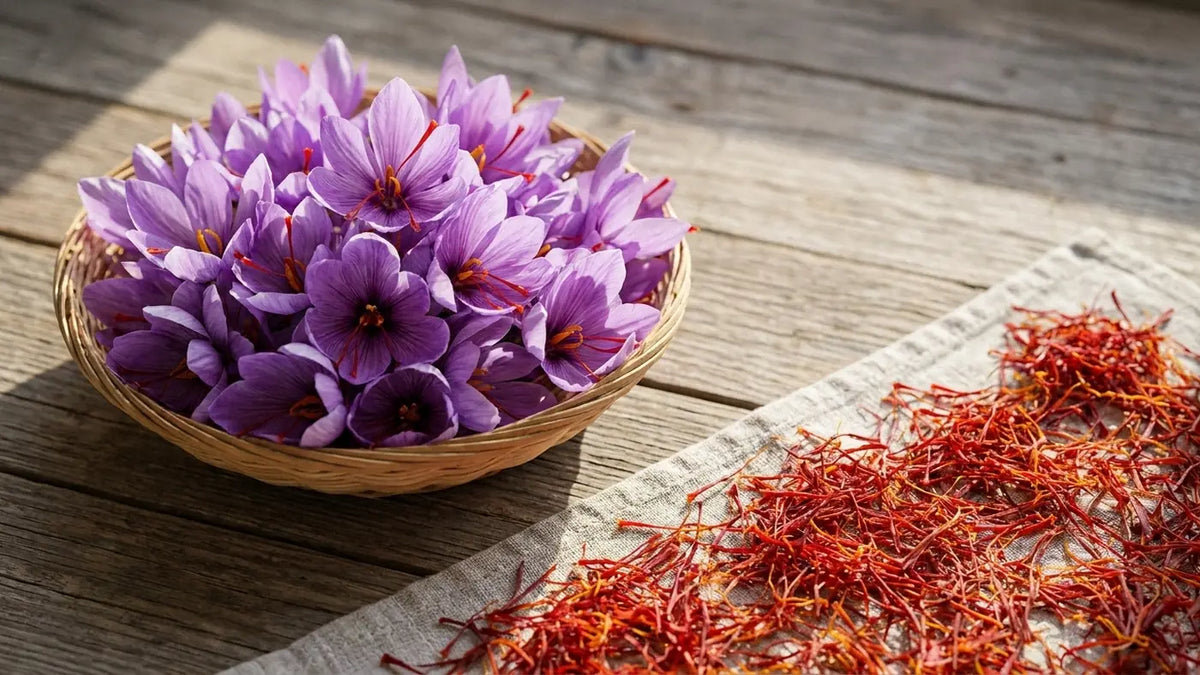
A saffron field flowers in waves over two to four weeks. On a peak day thousands of blooms open; the next morning a different set opens beside them. Any machine would have to go back through the same rows day after day, taking only the flowers that opened that night and leaving buds and spent stalks untouched. That is a selective-harvest problem, and selective harvesting is the hardest kind to automate.
What exactly has to happen in one morning?
The window is short. Flowers open around first light, and by the middle of the day sun and wind have started to degrade the stigmas inside. Left standing overnight, a bloom wilts and the threads lose quality. So the whole day’s crop has to come off the plant in a few hours.
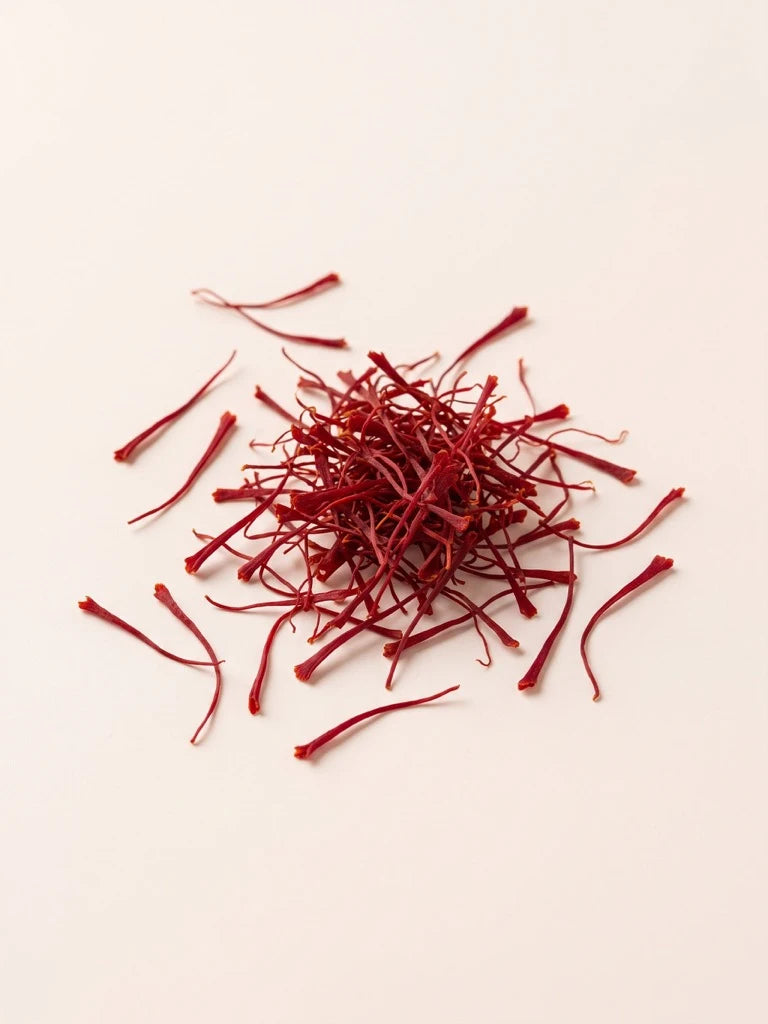
What follows is the slower half. The picked flowers go indoors and someone opens each one, finds the pale style running up the centre, and pulls the three red stigmas clear of the yellow stamens around them. For the highest grades the thread is separated right at the point where red becomes yellow, so no pale style stays attached. That is a decision made by eye and finger, several hundred times an hour.
Then multiply. It takes around 150 flowers to make one gram of dried saffron, which we set out in detail in the flowers-per-gram breakdown. Every gram is 150 flowers picked and 150 flowers opened.
Which steps have machines tried to take over?
Not all of the harvest resists automation equally. Drying and cleaning have been mechanised for decades in professional operations. It is the first two steps that hold out.
| Stage | What it demands | Why machines struggle | State of automation |
|---|---|---|---|
| Picking flowers | Select only blooms opened that morning, low to the ground, without crushing | Staggered flowering, fragile petals, mixed foliage | Prototypes only; hand picking dominates |
| Separating stigmas | Pull three joined red threads intact and cut at the red line | Sub-millimetre judgement inside a soft flower | Bench devices exist; hand work still standard for top grades |
| Drying | Rapid, gentle, even moisture loss | Nothing — this suits controlled equipment | Widely mechanised: airflow and temperature control |
| Cleaning and grading | Remove dust, broken threads and stray style | Manageable with sieves, air and inspection | Partly mechanised, finished by hand |
| Weighing and packing | Accuracy at fractions of a gram | Nothing | Fully mechanised |
Research groups and equipment makers have built flower harvesters and stigma separators over the years, and some processors use them for parts of the job. What has not happened is displacement: no machine has yet done the picking and the plucking well enough, cheaply enough and gently enough to push hand labour out of the field.
Would a machine make saffron cheaper?
Less than people assume, and only if the quality held. Saffron’s value is concentrated in an extremely small mass, so damage is expensive in a way it is not for most crops. A harvester that broke a fifth of the threads or left yellow style attached would cut the market value of the output by more than it saved in wages.
Grading makes that concrete. ISO 3632, the international standard for saffron, measures colouring strength by absorbance at 440 nm and sorts the result into Categories I to III. Pale style attached to the thread adds weight without adding colour, so it drags the measured value down. A machine that is slightly imprecise at the red line does not just look untidy; it moves the batch down a category. The reasoning behind all-red cutting is covered in our guide to Super Negin.
- Broken threads lose value and are sold as lower grades or dust.
- Attached style adds inert weight and lowers measured colouring strength.
- Bruised stigmas dry unevenly and lose aroma.
- Delayed picking costs quality within hours, not days.
What does hand harvesting mean for the buyer?
First, it fixes the floor under the price. Labour is the largest input in saffron and it scales one-for-one with volume — there is no economy of scale in opening flowers. When a price sits far below the going rate, something has usually been done to reduce the labour inside the jar: style left on, short broken threads swept in, old stock repackaged, or filler that never grew on a crocus. We work through the mechanics in why cheap saffron is cheap.
Second, it makes the harvest a human event rather than an industrial one. Whole families and hired crews work the same fortnight every autumn, and the quality of a season depends on how well that fortnight is organised: who picks at dawn, how quickly the flowers get indoors, how soon the threads reach the dryer. Our notes from the Herat harvest describe those weeks.
Third, it explains why saffron is sold by the gram and why a gram lasts a long time. You are buying concentrated hand labour. Use it accordingly — bloom it properly, store it dark and cool, and do not treat it as a garnish.
Frequently asked questions
Is any saffron machine harvested?
Some processing steps are mechanised, particularly drying, cleaning and packing. The two labour-heavy steps, picking the flowers and separating the stigmas, are still done by hand almost everywhere saffron is grown commercially.
Why must saffron be picked in the morning?
Flowers open at first light and begin to deteriorate once the sun and wind reach them. Picking early keeps the stigmas intact and lets the separation and drying happen the same day, which is what preserves aroma.
How many people does a saffron harvest need?
Far more than the field size suggests, because the work is concentrated into a few weeks of overlapping flowering waves. Growing regions rely on family labour and seasonal crews, and the number needed rises directly with the area planted.
Would machine harvesting lower the price of saffron?
Only if it preserved quality, which no machine has yet managed at scale. Damaged or imprecisely cut threads lose more value than the labour saved, so hand work remains the cheaper option in real terms.