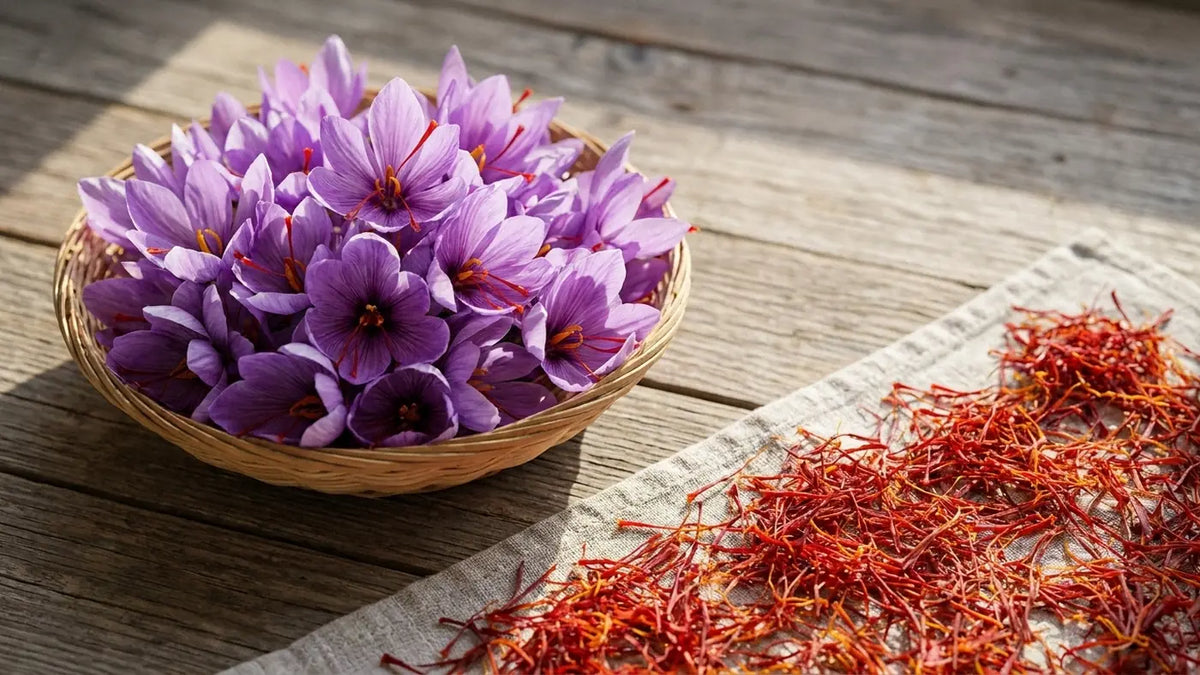
Herat saffron grows on a dry, high plain in western Afghanistan where the summers are long and rainless, the winters are properly cold and the soil drains fast. That combination happens to be exactly what a saffron crocus wants: a baked, dormant summer, a cool damp autumn to trigger flowering, and no standing water at any point.
Where is the Herat valley?
Herat sits in the far west of Afghanistan, on a plain of around 900 metres threaded by the Hari river. The city is old and the farmland around it is older, worked with a mix of river irrigation, wells and underground channels. Saffron is a relatively recent arrival at scale, spreading through the province from the early 2000s and becoming a serious smallholder crop.
The geography reads as unpromising at first glance. Very little rain falls, the summer is punishing and the wind is relentless. For most crops that is a list of problems. For Crocus sativus, most of it is an advantage.
What kind of climate does Herat have?
Cold semi-arid, with a sharp seasonal swing. Winters bring frost and occasional snow. Summers are hot, cloudless and effectively rainless for months. What precipitation there is arrives in winter and early spring, then stops.
The saffron crocus spends summer as a dormant corm underground, and dormancy is when it is most vulnerable to rot. A wet, humid summer is the fastest way to lose a field. Herat delivers the opposite: months of dry heat that leave the corms hard and intact, followed by a rapid autumn cooling that signals the plant to send up flowers.
Flowering itself lands in late October and November. Rain during those weeks bruises petals and spoils stigmas, so a dry autumn with cold nights is the ideal, and it is roughly what the valley provides most years. That is not a guarantee — a bad season is a bad season anywhere — but the odds sit in the grower’s favour.
What does the crocus need, and what does Herat supply?
It is easier to see the fit as a checklist. The left column is what horticulture says the plant wants; the right is what the valley actually offers.
| Requirement | Why the plant wants it | What Herat provides |
|---|---|---|
| Dry, hot summer dormancy | Wet corms rot underground | Months of rainless heat, very low humidity |
| Cold winter | Leaf growth and next season’s corm development | Frost, occasional snow, sustained cold |
| Free-draining soil | No standing water around the corm | Light, silty, calcareous alluvial loam |
| Neutral to alkaline pH | Tolerates lime; dislikes acidity | Naturally calcareous, mildly alkaline ground |
| Dry autumn flowering | Rain damages open blooms and stigmas | Clear, cool, dry late October and November |
| Controlled water | Irrigation timed to the growth cycle, not the weather | River, well and channel irrigation |
Gardening references generally list saffron crocus as hardy across roughly zones 6 to 8 on the US Department of Agriculture hardiness scale, which describes winter cold tolerance. Herat sits comfortably inside that band, but hardiness alone is not the story. Plenty of US gardens are zone 7 and cannot grow saffron well, because the missing ingredient is the dry summer, not the cold winter.
What is the soil actually like?
Arid alluvial plains tend to produce light, pale, calcareous soils that are low in organic matter and high in mineral content. Herat is broadly that: silty loam over gravel in many places, alkaline, and quick to drain after irrigation.
Low organic matter sounds like a defect. For a corm crop that hates sitting wet, it is close to ideal. Growers build fertility deliberately with manure and compost before planting, then rely on the soil’s natural structure to move water through rather than hold it. Heavy clay would do the opposite and take the field with it.
- Texture: light silty loam, often over gravel — water passes through.
- Chemistry: calcareous and mildly alkaline, which the crocus tolerates well.
- Organic matter: naturally low, so growers add it before planting corms.
- Depth: deep enough to plant corms well below the surface, out of reach of frost heave and surface heat.
Does the wind of 120 days matter?
Herat is known for a strong summer wind that blows from the northwest for much of the hottest part of the year — locally the wind of 120 days. It dries everything it touches, which is hard on people and hard on most crops.
For saffron the timing is fortunate. The wind blows through the dormant season, when there is nothing above ground to damage, and its main effect is to keep humidity low and the soil surface dry. By the time the flowers appear the wind has usually eased. A crop whose worst enemy is moisture during dormancy is not badly served by a summer gale.
It also shapes the working day at harvest. Flowers open at dawn and are picked in the first hours of light, partly for the cool and partly because still air keeps the stigmas in better condition. Our account of the harvest follows those mornings.
What geography cannot do
Climate and soil set a ceiling. They do not decide what ends up in your jar.
Two fields a mile apart in the same valley can produce very different saffron, because the decisions that matter most come after the flower is picked: how quickly the stigmas are separated, how much of the pale style is left attached, how gently and how fast the threads are dried, and how they are stored through the year that follows. Slow drying at too high a temperature will flatten the aroma of a perfect crop. Leaving yellow style on the thread will dilute a perfect cut.
So the honest version of the Herat story is this: the valley gives the plant unusually good conditions, and the rest is craft and discipline. That is also why we talk about a specific valley and a specific season rather than a country. Our sourcing is set out on the Herat page, and how it compares with other origins on the growing regions guide.
Frequently asked questions
What altitude is the Herat saffron region?
The Herat plain sits at roughly 900 metres. Individual growing districts around the valley vary by a few hundred metres either way, which affects how early or late the flowering starts.
How much rain does Herat get?
Little, and almost all of it in winter and early spring. Summer is effectively dry. That is why irrigation matters so much and why the corms come through dormancy in good condition.
Can I grow saffron in a similar climate at home?
Possibly. The plant is hardy across a fair range of winter cold, and the harder requirement to reproduce is a hot, dry, rainless summer with sharp drainage. Gardeners in wet-summer climates usually lift the corms or grow them in raised beds and containers.
Does soil change how saffron tastes?
Indirectly. Soil affects plant vigour and corm size, which affects thread size. Aroma and colour are shaped far more by the harvest timing and the drying method than by the ground itself.