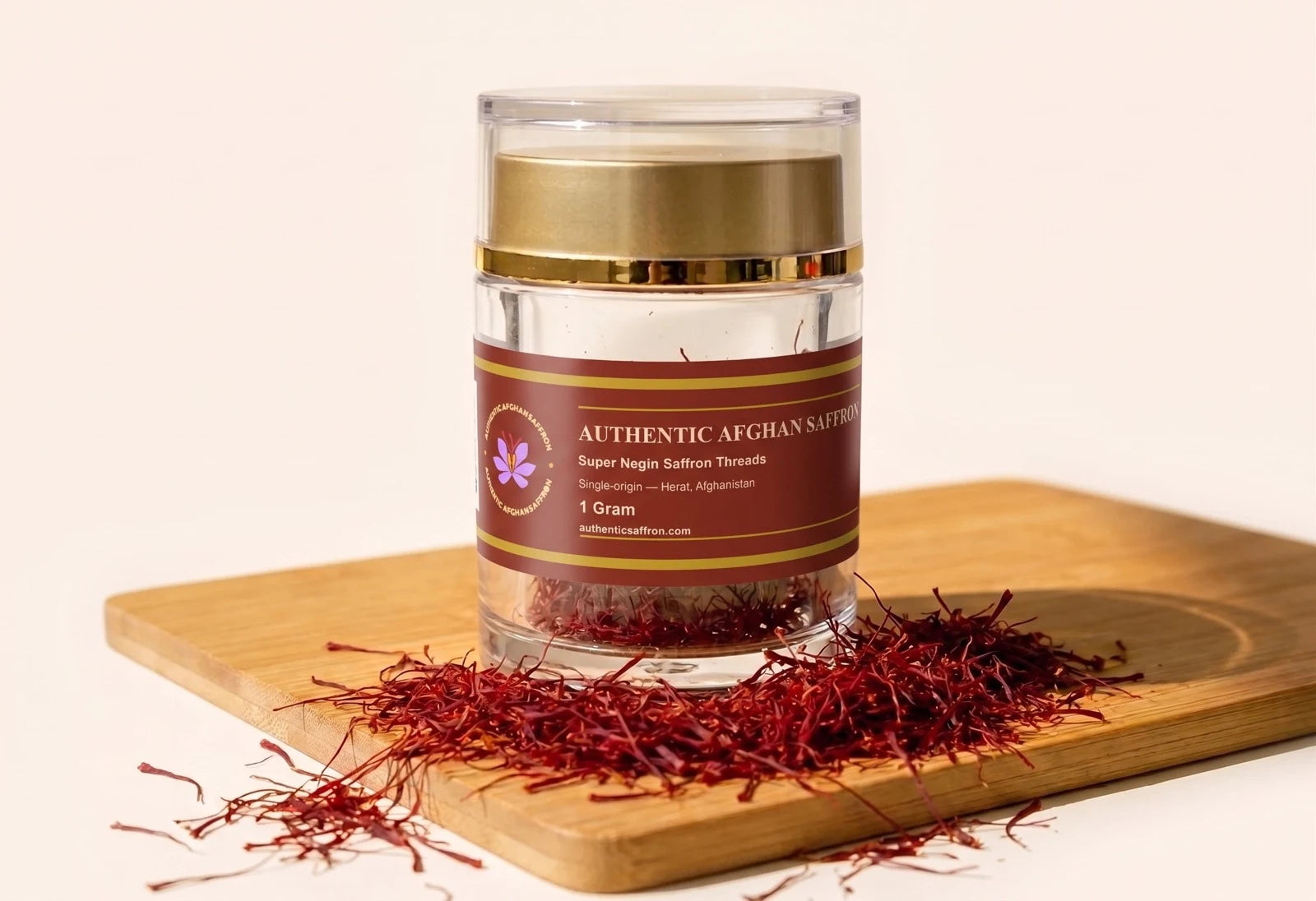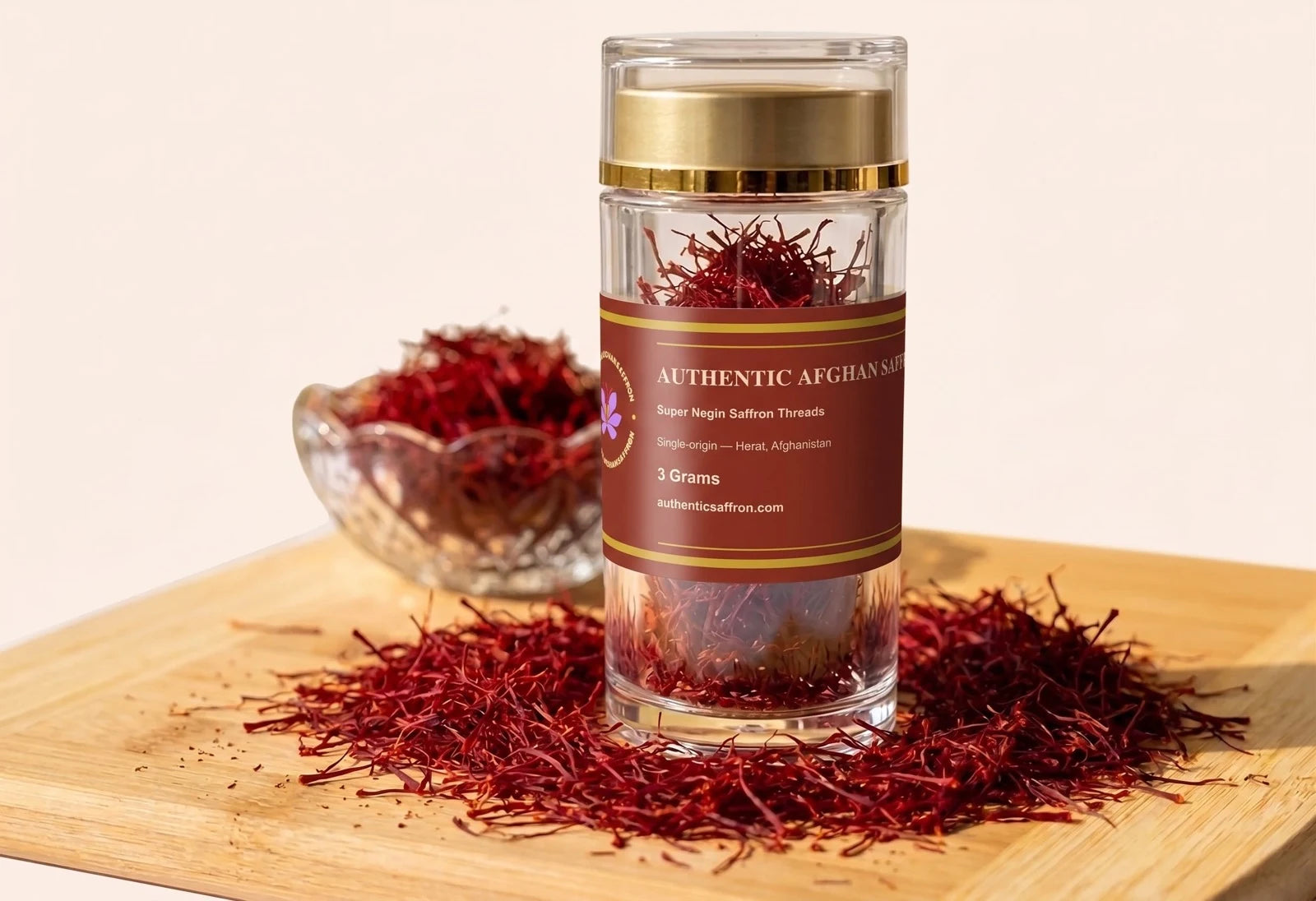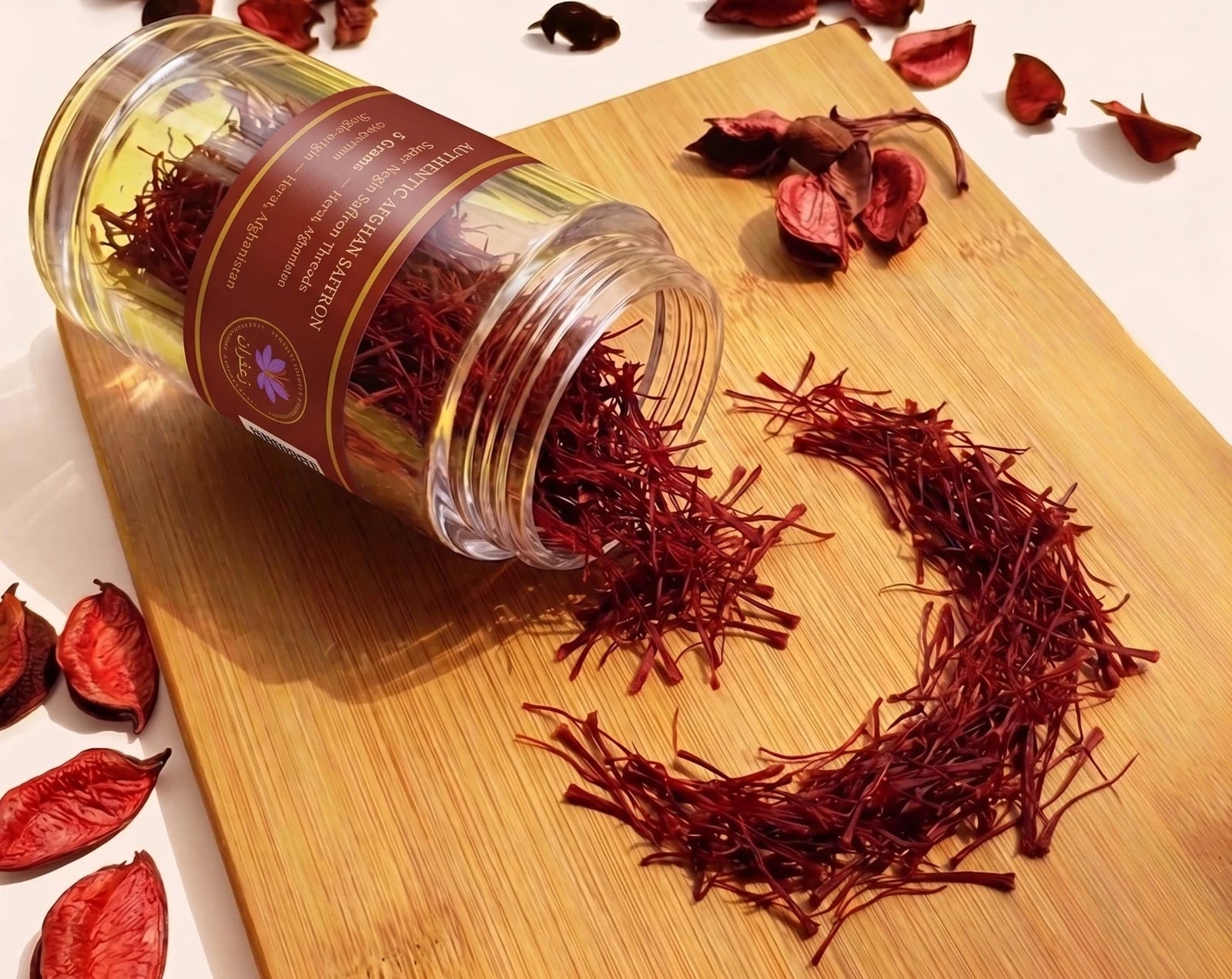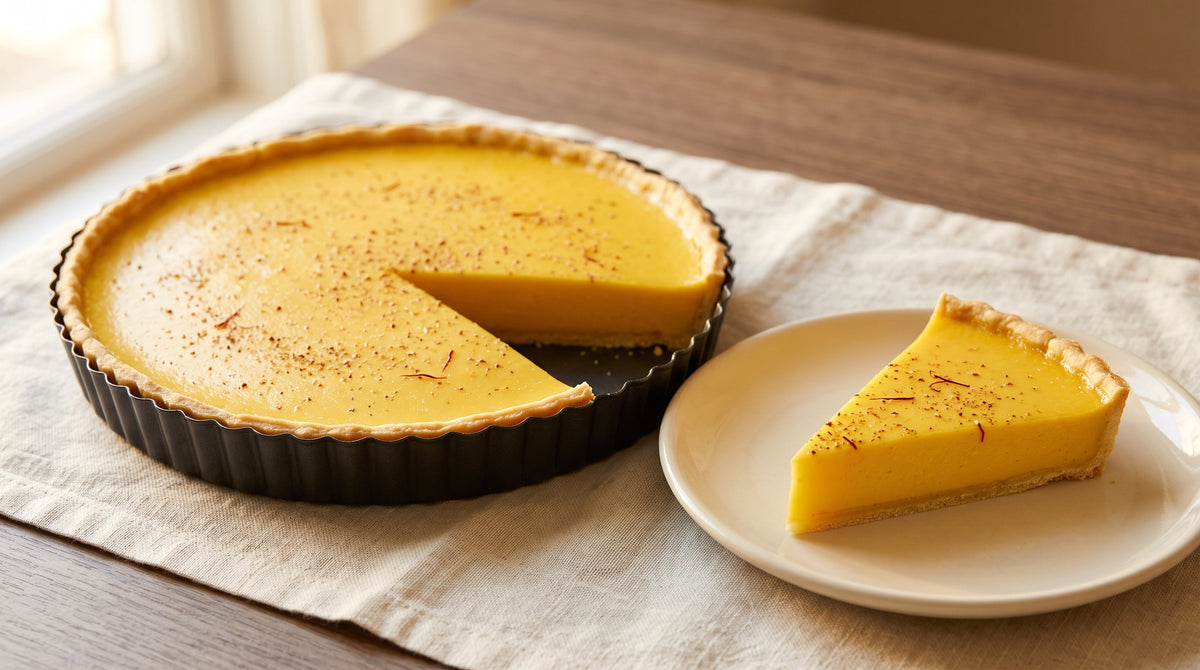
A saffron custard tart is the plain British custard tart with 30 threads, about 0.12 g, steeped in cream held at 150°F. That is enough to turn the set custard the colour of a duck egg yolk and give the nutmeg something to sit against. The shell is blind-baked and sealed; the custard bakes at 300°F until the centre still trembles.
Two steps decide this: sealing the pastry, and taking the tart out while the middle still moves.
Why saffron in a custard tart?
The English custard tart — egg yolk, cream, sugar, nutmeg — survives because the plainness is the point. Most additions to it taste like a worse version of something else.
Saffron is the exception, and the reason is nutmeg. Grated nutmeg is warm, resinous and slightly bitter, and saffron shares that last quality without the sweetness of vanilla. Together, the nutmeg stops sitting on top of the custard and starts running through it. Thirty threads also take an already-yellow custard to a deep, even gold.
This is not a traditional British combination — saffron baking there means Cornish cake and buns, not custard. What saffron adds is depth in a dessert with very little to hide behind.
How many saffron threads, and bloomed in what?
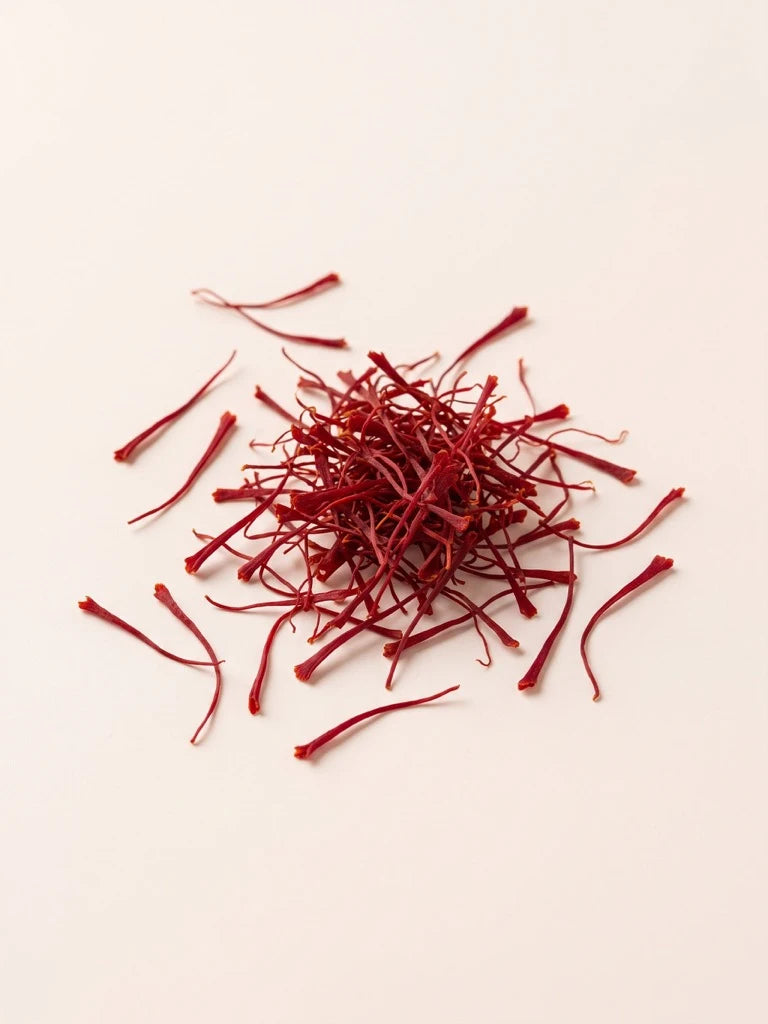
Thirty threads, about 0.12 g, for a 9-inch tart of eight slices. Custard is mild and served cool, and cool flattens aroma, so this sits high for a dairy dessert. Below twenty threads you get colour and little else.
Heat the cream and milk to about 150°F (65°C) — steam rising, the surface still — then take the pan off the heat, crumble the threads in, cover, and leave it 20 minutes. Do not scald or boil it. Boiling costs you the volatile aroma compounds, which are the whole reason for using saffron rather than food colouring.
After twenty minutes the cream sits near 110°F, exactly right for whisking into the yolks: no reheating, no scrambling. Blooming and tempering do each other’s work here — the temperature reasoning is in why you bloom in warm liquid, not hot.
Strain the custard before it fills the shell, then decide about the threads: returned to the jug they show as red flecks in the slice, left out they give a cleaner surface. For the chemistry behind red thread turning gold custard, see why saffron turns food golden.
What is in it?
For a 9-inch loose-bottomed tart tin, eight slices. The pastry can be made a day ahead.
For the pastry
- 200 g (1 2/3 cups) all-purpose flour
- 100 g (7 tbsp) cold unsalted butter, cubed
- 40 g (1/3 cup) confectioners’ sugar
- 1/4 tsp fine salt
- 1 large egg yolk
- 2 to 3 tbsp ice water
For the custard
- About 30 saffron threads (0.12 g)
- 480 ml (2 cups) heavy cream
- 120 ml (1/2 cup) whole milk
- 6 large egg yolks
- 75 g (6 tbsp) granulated sugar
- 1 tsp vanilla extract
- Pinch of fine salt
- 1 egg white, lightly beaten, for sealing the shell
- Whole nutmeg, for grating
How is it assembled?
- Make the pastry. Rub or pulse the butter into the flour, sugar and salt until it looks like coarse meal with a few pea-sized pieces left. Add the yolk and 2 tbsp of ice water and bring it together with a fork, adding the last spoonful only if it will not hold. Do not knead. Flatten to a disc, wrap, chill an hour.
- Line the tin. Roll the pastry to about 1/8 inch (3 mm) and lift it into a 9-inch loose-bottomed tin, leaving an inch hanging over the rim. Press it into the corner of the tin without stretching it, since stretched pastry shrinks back down the sides as it bakes. Freeze it for 20 minutes. Heat the oven to 375°F (190°C).
- Blind bake. Line the shell with parchment and fill it right to the rim with baking beans or rice — a half-filled shell slumps at the top edge. Bake 20 minutes, lift out the paper and beans, and bake 8 to 10 minutes more until the base looks dry and sandy rather than damp.
- Seal the shell. Brush the inside of the hot shell all over with beaten egg white and return it to the oven for 2 minutes to set into a film. This is the step that keeps the base crisp under a wet custard. Trim the overhang flush with a serrated knife, sawing outwards. Drop the oven to 300°F (150°C).
- Steep the saffron. Heat the cream and milk to about 150°F (65°C), until steaming but with no bubbles. Off the heat, crumble in the threads, cover, and leave 20 minutes.
- Mix the custard. Whisk the yolks, sugar and salt together just until combined, with no foam on top — foam turns into bubbles baked into the surface. Pour the warm saffron cream in slowly, whisking, then add the vanilla. Strain through a fine sieve into a jug, and drop the threads back in if you want them visible.
- Fill at the oven door. Put the shell on a baking sheet and slide the oven rack half out. Pour the custard in while it sits there, stopping about 1/8 inch below the rim — carrying a full tart across a kitchen is how custard ends up under the pastry. Grate nutmeg generously over the surface.
- Bake low and slow. Bake 45 to 55 minutes at 300°F. It is ready when the outer edge is set and a circle about two inches across in the centre sways gently when you nudge the sheet. A knife test tells you nothing useful here; go by the wobble, and take it out on the early side.
- Cool completely. Cool on a rack for 2 to 3 hours, until barely warm; the centre finishes setting as it goes. Do not refrigerate it while warm — trapped steam makes the custard weep and softens the pastry. Serve the day it is made.
Why do custard tarts weep or curdle?
Both faults have one cause: the eggs got too hot. Above roughly 185°F the proteins tighten and squeeze water out, showing as grain and a puddle in the slice. A 300°F oven and an early exit are the defence.
The other common problem is a soggy base, with three separable causes.
- An under-baked shell. The base has to be dry and sandy before custard goes near it, not merely pale. Eight to ten minutes uncovered after the beans come out.
- A skipped egg-white seal. Two minutes of work, and the difference between crisp pastry and pastry that has given up by the evening.
- A crack in the shell. Custard running underneath steams the base from below. Patch cracks with raw pastry after the blind bake, before the seal.
If the finished custard is pale, the threads were probably old rather than too few. Fresh saffron colours warm cream visibly within five minutes; if nothing much happens in that time the tin has been open too long. See cooking with saffron for how to get more from what you have.
Frequently asked questions
Can I use a store-bought pastry shell?
Yes, and it is a reasonable trade. Blind bake it according to the packet, then still brush it with egg white and give it two minutes back in the oven. Bought shells run thinner than home-made, so watch the base for over-browning.
Why strain the custard?
To catch the chalazae — the white cords attached to the yolk — and any specks of set egg from the warm cream. They do not dissolve, and one is enough to show as a rubbery spot in a smooth slice.
Can I make it the day before?
You can, but it is best on the day. A custard tart peaks between two and six hours after baking, set but with the pastry still crisp. Overnight in the fridge the base softens, though the flavour holds up.
Is saffron strong enough to taste in a custard this rich?
At thirty threads, yes, though it works with the nutmeg rather than announcing itself. Serve the tart at cool room temperature rather than fridge-cold: chilling suppresses volatile aroma, and this is a dessert where the aroma is most of the point.
Read next
- Saffron crème brûlée — the same custard, no pastry, a harder set
- Firni, saffron milk pudding — a stovetop custard thickened with rice flour
- Our saffron — what we sell and where in Herat it comes from