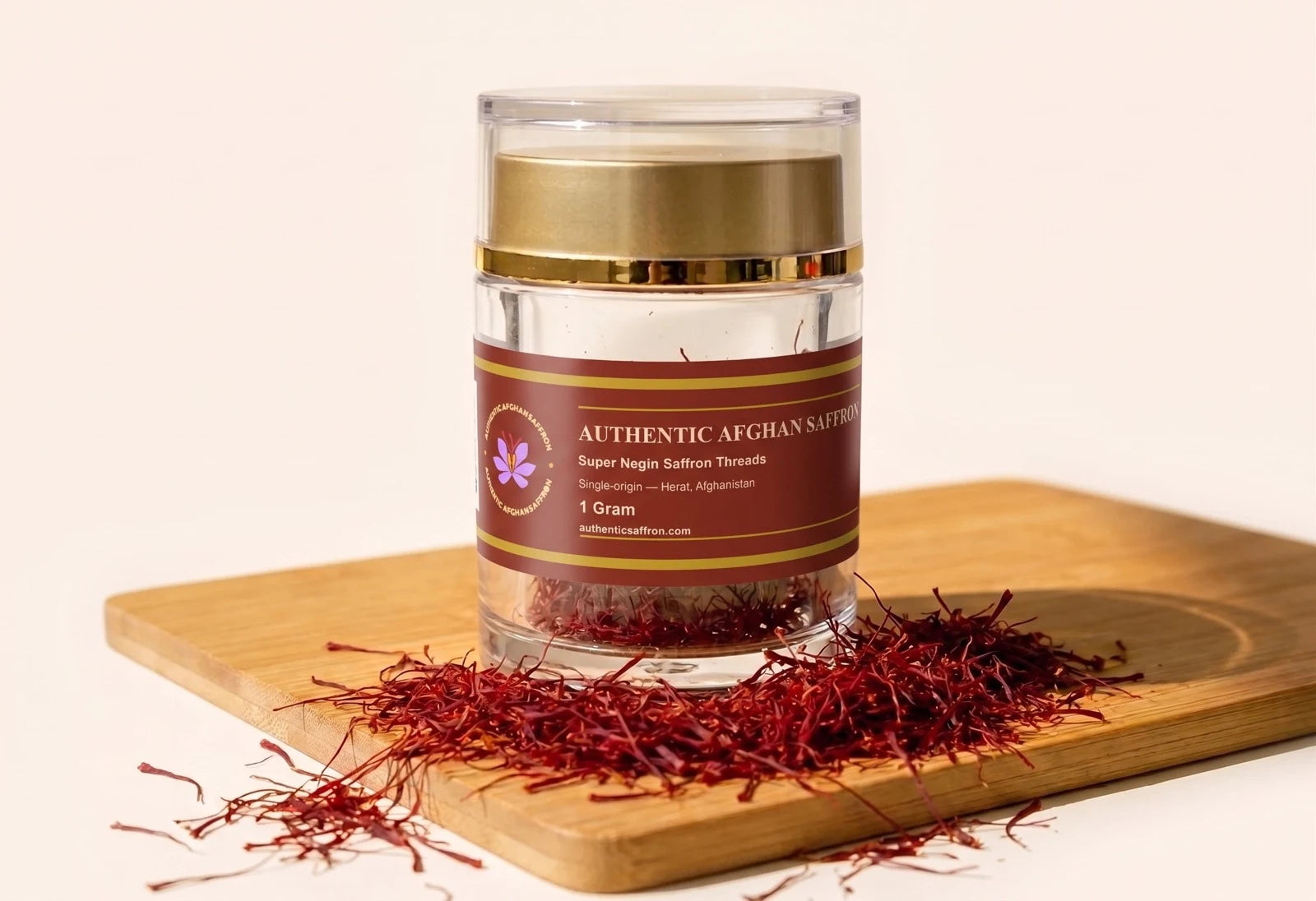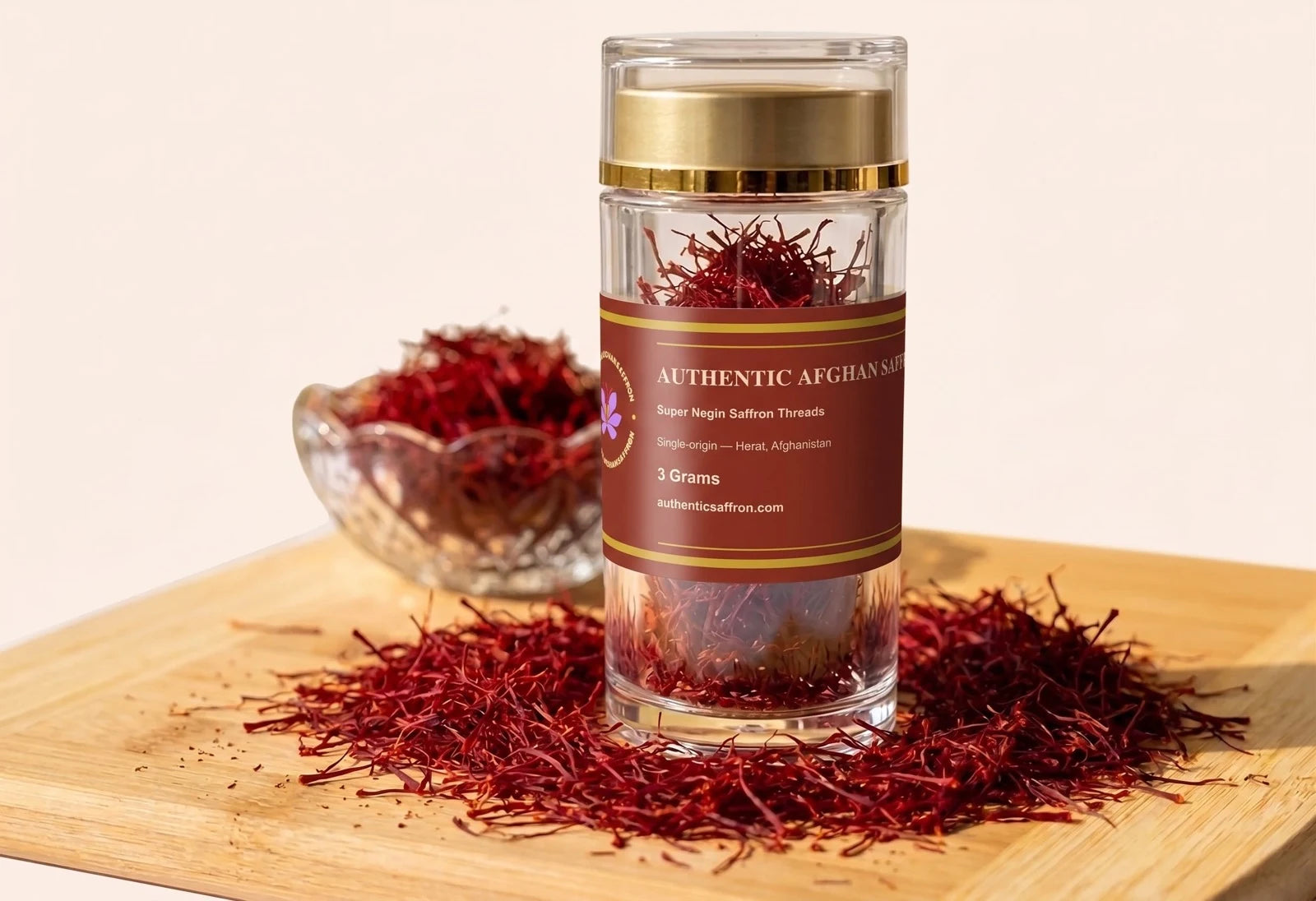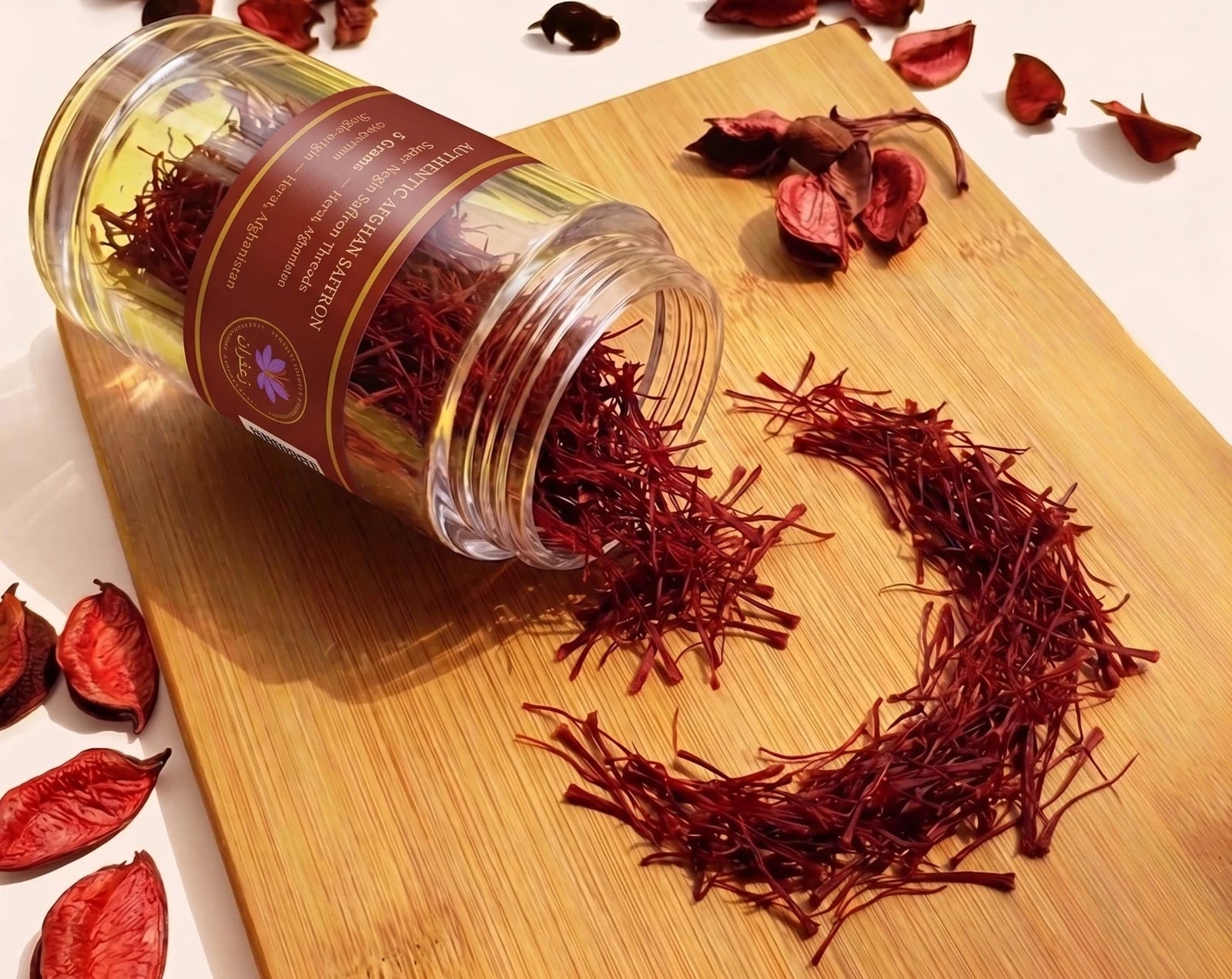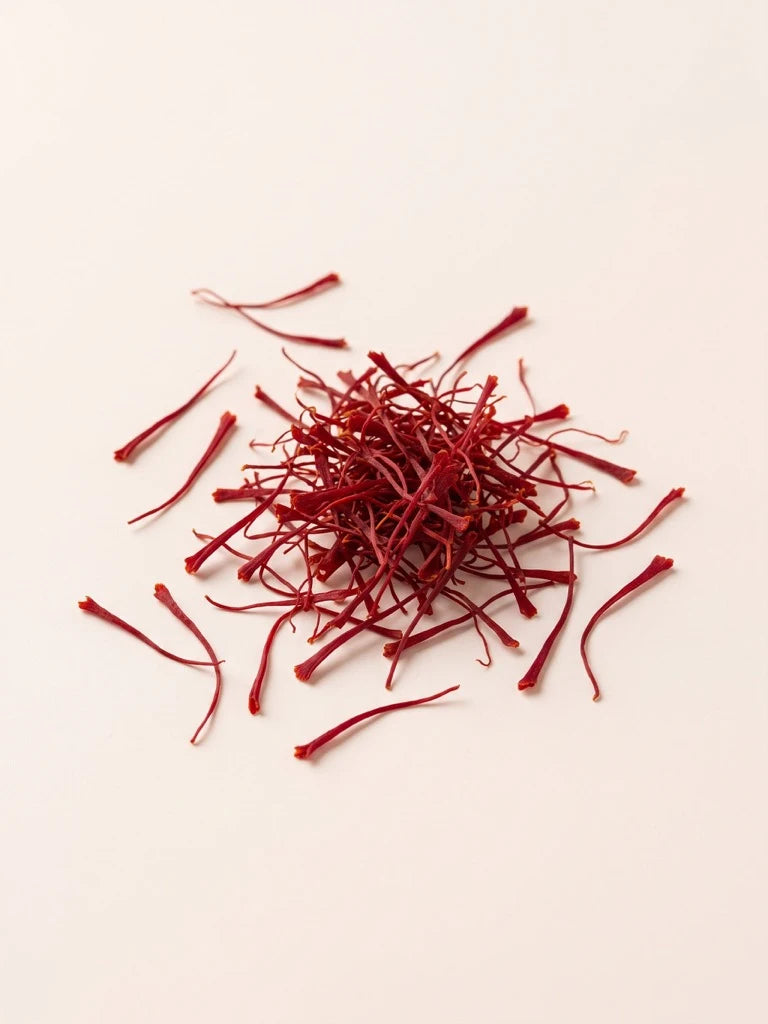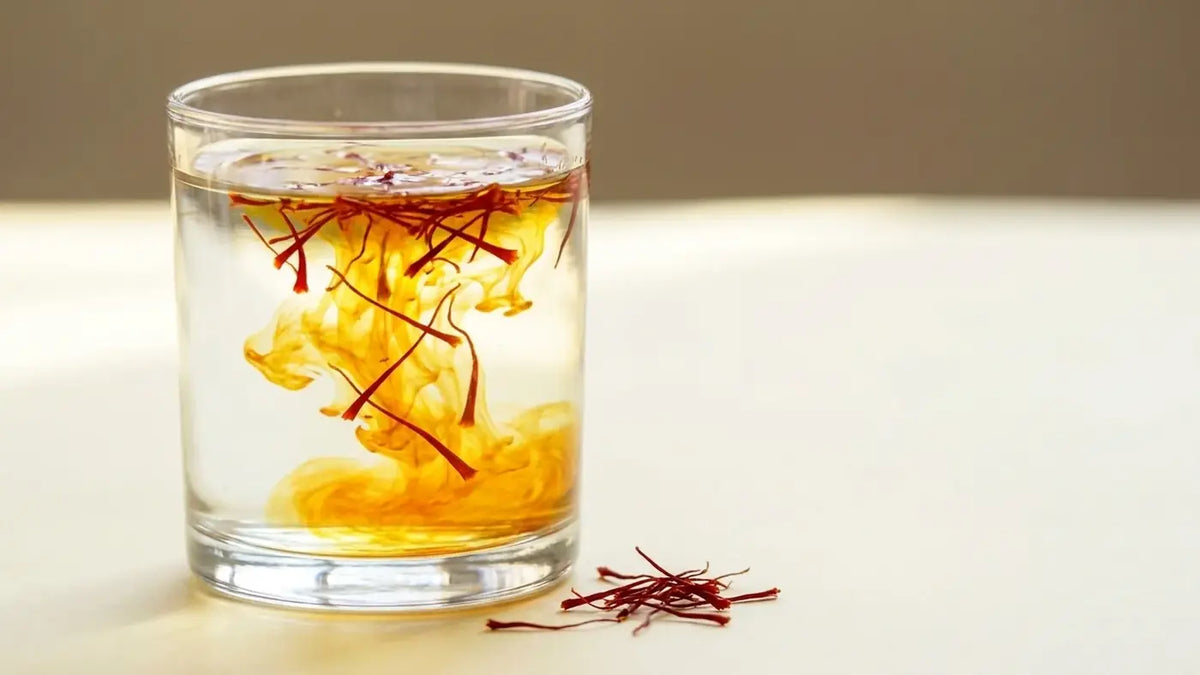
Saffron turns food golden because crocin, its main pigment, dissolves in water and spreads through everything the water touches. In the jar that pigment is packed tight and looks red; in solution it reads yellow-gold. That is the whole of why saffron turns food yellow rather than red, and why blooming matters more than quantity.
Why does red saffron turn food yellow and not red?
It is a question of concentration, not of chemistry changing. A dried stigma is a tiny volume holding an enormous amount of pigment, and at that density crocin looks deep red-brown. Disperse the same pigment through a litre of stock and you are looking at a solution thousands of times more dilute. Dilute crocin is gold.
You can watch the transition in a glass. Drop crushed threads into warm water and the liquid runs pale straw, then amber, then a deep honey colour as more pigment leaves the threads. The threads themselves fade toward a washed-out orange. Nothing has been transformed; it has only been spread out.
What is actually happening in the liquid?
Crocin is a carotenoid pigment with sugar groups attached. Most carotenoids — the ones in carrots, tomatoes, palm oil — are fat-soluble and need oil to move around a dish. The sugars on crocin flip that. They make saffron one of the few natural pigments that dissolves straight into water.
This is why saffron behaves so differently from turmeric in a pan. Turmeric wants fat and will sit in a watery sauce looking cloudy and grainy; saffron wants water and will sit in oil doing very little. It is also why saffron is one of the colour additives the US Food and Drug Administration lists as exempt from batch certification — it is a plant extract, not a synthesised dye.
Once dissolved, the pigment goes wherever the liquid goes. Rice absorbs it as it absorbs the cooking water, which is why the colour ends up inside each grain rather than painted on the outside. There is more on the compound itself in our guide to crocin.
Which liquids pull the colour out best?
Anything with a high water content works. Fat alone does not. The table below is what you can expect from the mediums people actually reach for.
| Blooming liquid | Colour extraction | Resulting shade | Best used for |
|---|---|---|---|
| Warm water, 150°F (65°C) | Excellent | Clear amber gold | Rice, broths, doughs, anything neutral |
| Warm milk or cream | Very good | Soft opaque yellow | Puddings, custards, ice cream, sweet rice |
| Warm stock or broth | Very good | Deep gold, muddied by the stock | Soups, braises, paella and risotto |
| Wine or spirits | Good | Bright, slightly greenish gold | Sauces and syrups where alcohol cooks off |
| Cold water | Slow but complete | Clear gold, after an hour or more | Cold infusions, overnight preparations |
| Oil or melted butter alone | Poor | Patchy, weak | Not recommended — bloom in water first |
Cold water is worth a note. It extracts colour perfectly well; it just takes an hour or more instead of fifteen minutes. That patience is also the basis of the cold water test, where the speed and the colour of the release tell you whether you are holding saffron or a dyed substitute.
Why does saffron sometimes fail to colour a dish?
Four causes account for almost every pale result, and only one of them is the saffron’s fault.
- Threads added dry. The pigment never left the thread, so it coloured one square centimetre of rice and nothing else.
- Not enough liquid contact. A dish that is mostly fat, or one that is stirred once at the end, gives the pigment nowhere to travel.
- Too little saffron for the volume. Ten threads will not colour a stockpot, no matter how well you bloom them.
- Weak saffron. Light, heat and time degrade crocin, and old threads look identical to fresh ones. This is the one you cannot fix in the kitchen.
There is a fifth cause worth naming separately: it was never saffron. Dyed corn silk and safflower both colour water, but the colour arrives instantly and often reads orange or red rather than gold. Our page on how to spot fake saffron covers the tells.
How do you get even colour all the way through?
Bloom first, always. Crush the threads lightly between dry fingers, cover with two or three tablespoons of warm water, put a saucer on top and leave them for ten to twenty minutes. Then add the whole thing — liquid and spent threads together — at a point in the recipe where it can circulate.
For rice, that means into the cooking water before the lid goes on. For a braise, the last half hour. For a custard, into the warm dairy before the eggs. The spent threads are worth including: they look attractive and they still hold a little colour and aroma.
Keep the bloom warm rather than hot. Boiling water extracts colour fast but drives off the aroma compounds, which is a bad trade for a spice you are buying by the gram. The full reasoning is in why you bloom saffron in warm water, not hot, and the general technique in cooking with saffron.
Frequently asked questions
Why is my saffron rice yellow instead of orange?
Because crocin in solution is yellow-gold. The red you see in the jar is pigment packed densely into a dry thread. Once it disperses through water and then through starch, the colour reads as gold. Orange usually means the dish is very concentrated, or that turmeric or annatto is also present.
How long does it take for saffron to release its colour?
Ten to twenty minutes in warm water gets most of it. You can watch it happen: the liquid goes pale straw within a minute, deep amber by ten. If nothing has changed after five minutes in warm water, you are probably not looking at saffron.
Does saffron colour food more if I use more?
Up to a point, then it stops being worth it. Colour deepens with dose but the taste climbs faster than the colour does, so the practical ceiling is set by your palate, not your eyes. Around one thread per person suits most dishes.
Will saffron colour a dish that has no water in it?
Poorly. Crocin is water-soluble and barely soluble in fat, so threads bloomed in oil or butter alone give patchy colour. Bloom in a spoonful of warm water first, then stir that into the fat.