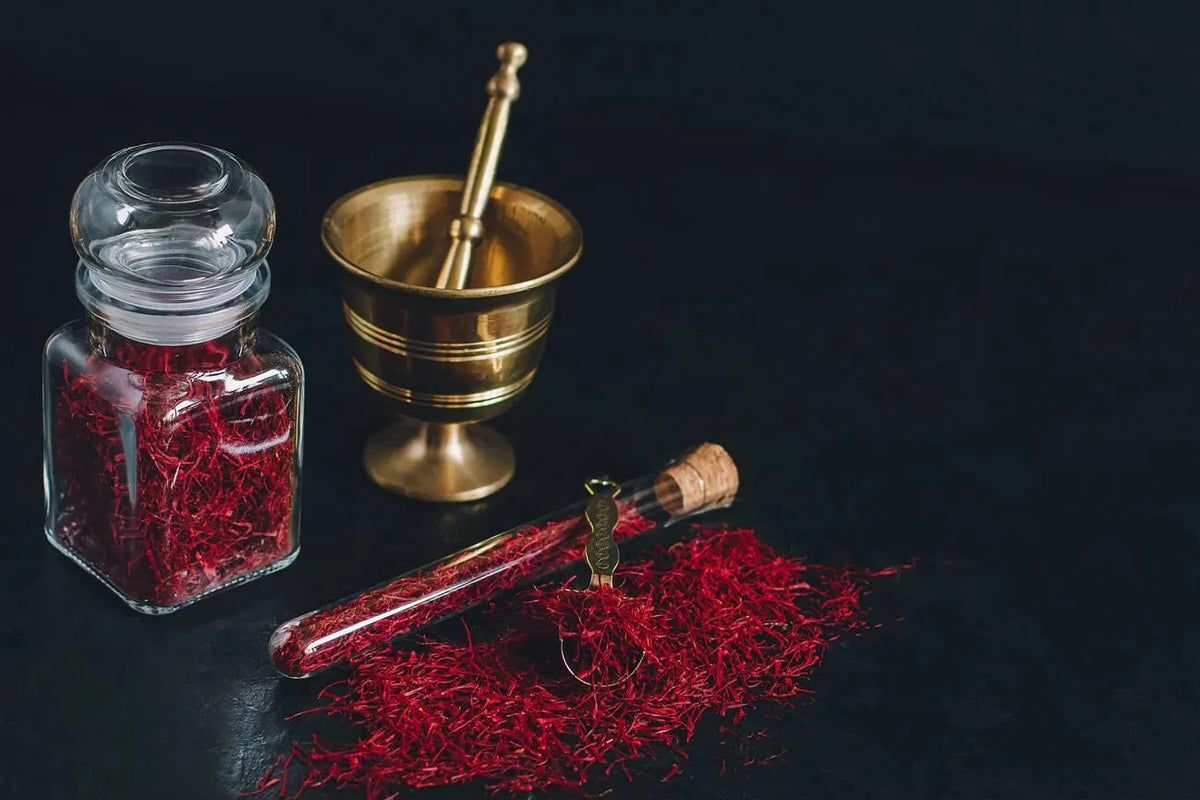
The cold water saffron test is a patience test. Drop a few threads into a glass of cold water and watch for twenty minutes. Real saffron releases a slow golden yellow and the threads stay red. A fake releases red or orange within seconds and the strand goes pale. Speed is the tell, not strength.
Why cold water and not hot?
Because the point of the test is to slow the real thing down.
In warm liquid, genuine saffron gives up its crocin quickly — which is exactly what you want when you are cooking, and why our advice for the kitchen is to bloom threads in liquid at around 150 °F (65 °C) for ten to twenty minutes. But when everything releases colour quickly, you lose the difference between pigment diffusing out of plant tissue and dye washing off a fibre.
Cold water widens that gap. Diffusion slows down; a surface coating does not care. Twenty minutes at room temperature turns a subtle distinction into an obvious one.
How do you run the cold water test?
Use a clear glass, cold tap water and good light. A white surface behind the glass helps more than anything else.
- Half-fill a clear glass with cold water and let it settle so it is still.
- Add five to ten threads. Resist the urge to add more — a heavy pinch floods the glass and hides the timing.
- Do not stir. Stirring accelerates everything and destroys the one variable you are measuring.
- Watch the first thirty seconds closely. This is where fakes announce themselves.
- Come back at five, ten and twenty minutes and look at both the water and the threads.
- At the end, lift one thread out with a spoon and look at it against the white surface.
If you have a jar you trust, run it in a second glass alongside. A side-by-side comparison removes almost all the guesswork about lighting and quantity.
What should happen, minute by minute?
| Elapsed time | Genuine saffron | Dyed fibre or coloured substitute |
|---|---|---|
| 0–30 seconds | Threads float or sink; little visible colour | Red or orange cloud spreads immediately |
| 1–2 minutes | Fine yellow streamers descend from each thread | Water already broadly coloured |
| 5 minutes | Pale, clear yellow throughout | Strong colour; strands visibly paler |
| 10 minutes | Yellow deepening towards gold | No further change; colour has finished |
| 20 minutes | Clear golden liquid, threads still red and swollen | Strands pale gold or near-white, water red or muddy |
| Thread at the end | Soft, still red, splits when pressed | Limp, colourless, tears rather than splits |
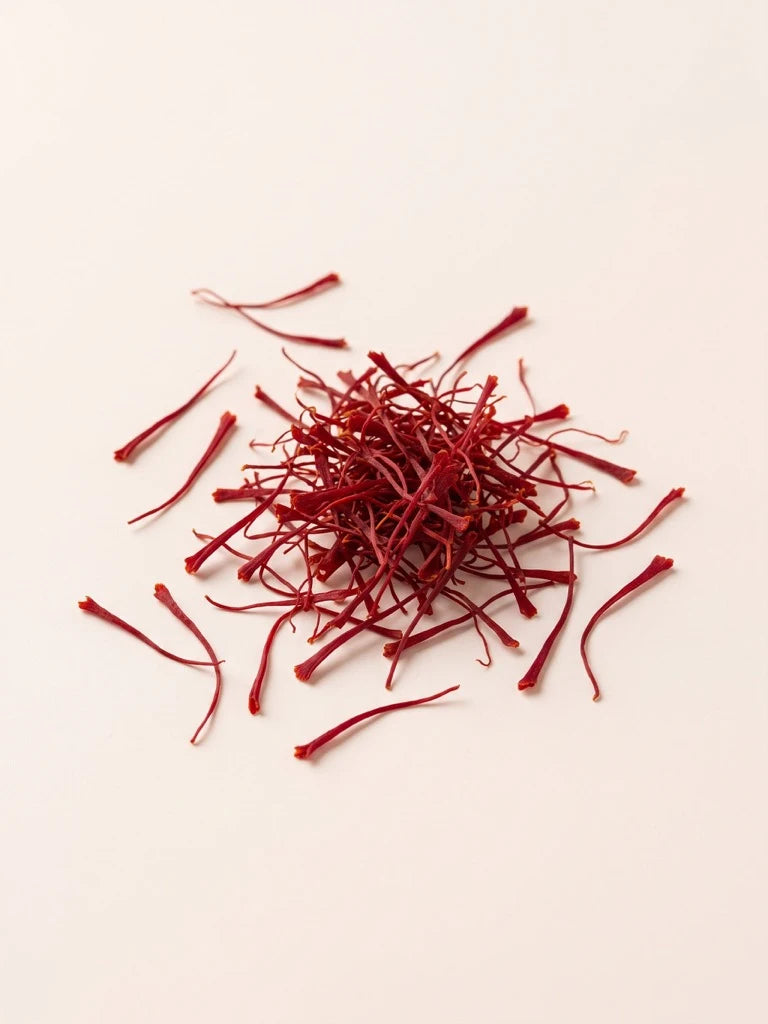
Two details do most of the work in that table. The water should end up yellow-gold, never red. And the threads should still be red when the water is gold, because you have extracted a fraction of what they hold rather than stripped a coating off them.
What does a fake look like in the glass?
Different fakes fail differently, which is useful.
- Dyed corn silk reddens the water almost instantly and leaves behind pale, limp strands. It is the most theatrical failure and the easiest to read. We describe it in full in the note on dyed corn silk.
- Safflower gives an orange rather than golden cast and pales as its own pigment leaves. The florets go translucent and flatten out. More on separating safflower from saffron.
- Turmeric powder clouds the water rather than colouring it cleanly, and settles into a yellow sediment. It is better caught with the baking soda test.
- Coated real saffron is the awkward one. Honey, syrup or oil on the threads makes them clump and shed a slick on the surface, but the underlying colour behaves normally.
Is a fast, strong colour a good sign?
No, and this is the single most common misreading of the test.
The instinct is understandable. A jar that turns water blazing red in ten seconds looks powerful next to one that takes ten minutes to reach a soft gold. But instant release means the colour was sitting on the outside of the material, which is what dye does and what plant tissue does not.
Colour that arrives slowly and keeps deepening is the signature of extraction. Colour that arrives all at once and then stops is the signature of a coating. Genuine saffron is also golden, not scarlet — the red you see in a thread is a concentrated form of a pigment that appears yellow once it is dispersed through water, which is why saffron turns food golden rather than red.
What does the test not tell you?
It tells you whether you are probably holding saffron. It says nothing about how much saffron you are holding per gram.
Two genuine samples can differ by a wide margin in colouring strength, and this glass will not rank them. Nor will it detect the quieter forms of adulteration: extra moisture, a generous amount of pale yellow style left on the thread, or old stock that has faded in a clear jar on a sunny shelf. Those are covered in our overview of saffron adulterants.
Measuring strength requires a laboratory: a weighed sample, a spectrophotometer, and absorbance read at 440 nm for colour, 257 nm for taste and 330 nm for aroma, within the framework of ISO 3632. Our own harvest is going through that process, and we will publish the report in full on the lab report page rather than summarising it.
Frequently asked questions
How long should the cold water test take?
Give it twenty minutes. The first thirty seconds tell you whether something is badly wrong, and the twenty-minute mark tells you whether the colour is a clear gold with the threads still red. Judging it at two minutes is how people talk themselves into the wrong answer.
Should the threads lose their colour in the water?
No. Genuine saffron threads stay red for hours, swelling and softening as they hydrate. A strand that turns pale or white as the water colours has given up a surface dye, which means it was never saffron in the first place.
Can I still use the water afterwards?
Yes. A cold infusion is a slow bloom, and the liquid is perfectly good in rice, broth or a dressing. It will be weaker than a warm bloom, so treat it as a bonus rather than as your measured dose.
Does the test work on saffron powder?
Not well. Powder disperses instantly, so there is no slow release to observe and no thread left to inspect. This is one of several reasons to buy whole threads and grind them yourself only when a recipe needs it.