Corn silk is the oldest substitute in the saffron trade. The pale threads inside a corn husk are dried, cut short, dyed red and sold by weight. They are the right shape and roughly the right colour, and they cost almost nothing. Two minutes of looking and one glass of water will expose them.
How is fake saffron corn silk made?
Corn silk is the mass of fine strands that grows under the husk of an ear of corn. Each strand is a style leading to one kernel. It is a by-product, available in enormous quantity, and in its dried state it is already thread-like, slightly wavy and pale gold.
Making it into a fake takes three steps. Dry it. Cut it into short lengths so it matches the size of a stigma. Soak it in dye — historically anything from beetroot juice to industrial textile colourant, which is why the practice attracts the attention of food safety regulators such as the FDA, who control which colour additives may legally be used in food.
The result is convincing at arm’s length and unconvincing at close range. The counterfeiter has to solve a problem they cannot solve: real saffron is not one colour, and dyed corn silk is.
Why does it fool so many people?
Because most of us have never looked closely at real saffron. We know it as expensive red threads, and dyed corn silk is expensive-looking red threads.
It is also sold in the right context. Corn silk fakes turn up in tourist markets, in ornate gift boxes, in bulk bags at prices that feel like a discovery, and in online listings with photographs of somebody else’s saffron. Volume helps too: corn silk is light and bulky, so a jar looks generous. Real saffron always looks like less than you expected.
The final trick is the water test used badly. Drop dyed corn silk into water and the colour appears instantly and dramatically. To a buyer who thinks strong colour means strong saffron, that looks like proof. It is the opposite.
| What you check | Real saffron | Dyed corn silk |
|---|---|---|
| Shape of the tip | Flares into a small serrated trumpet | Blunt or frayed cut at both ends |
| Cross-section | Hollow tube, splits when crushed | Solid flat strand |
| Colour along the strand | Deep red at the tip, paler towards the base | The same shade end to end |
| Length consistency | Varies, some broken pieces | Uniform, machine-cut |
| Dry aroma | Hay, honey, faintly medicinal | None, or a faint sweet-corn smell |
| First 30 seconds in cold water | Barely any colour yet | Red cloud spreads at once |
| Colour of the water | Clear golden yellow | Red, pink or muddy orange |
| The strand after 20 minutes | Still red, now swollen and soft | Pale gold or white, colour gone |
What does a real thread look like up close?
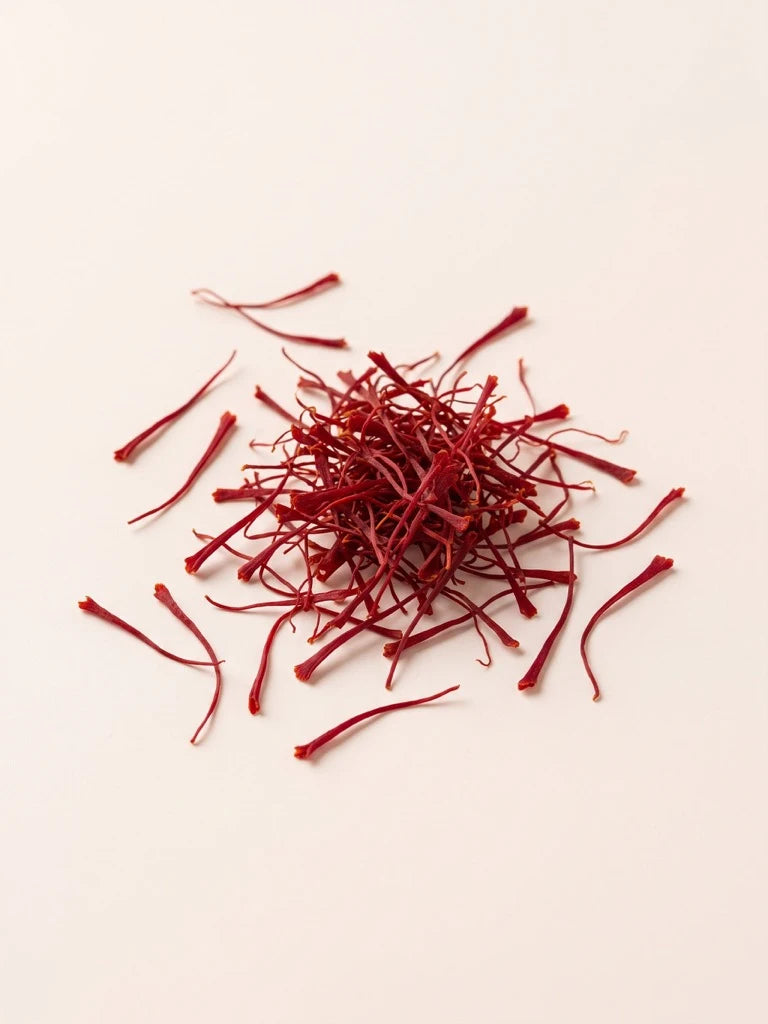
Put three threads on a white plate and photograph them with a phone at maximum zoom. You are looking for four things.
- The trumpet. A stigma is a tube that opens out at the free end into a flared, slightly ragged mouth. This is the single most reliable feature, and no counterfeit material reproduces it.
- The gradient. Colour runs from dark red at the trumpet to a lighter red, sometimes orange, at the cut base. A dyed strand has no gradient because dye does not care where it lands.
- Irregularity. Hand-cut stigmas differ in length and thickness. Some are curled, some are broken. Perfect consistency is a warning sign, not a quality sign.
- The crush. A dry saffron thread crumbles between finger and thumb into a red-orange powder that stains your skin. Corn silk bends, then tears, and the colour it leaves behind is the dye rather than the fibre.
Our full sequence for a jar you already own is on the spotting fake saffron page.
What gives corn silk away in water?
Speed and the wrong colour, in that order.
Genuine saffron holds its crocin inside plant tissue. Water has to work its way in before the pigment can come out, so the colour arrives as a slow yellow plume that deepens over ten to twenty minutes into a clear gold. The thread stays red the whole time, because you are extracting a fraction of what it holds, not stripping a coating off it.
Dye on a corn silk strand is a coating. It leaves the moment it is wet, so the water reddens in seconds and the strand goes pale as it does. If you fish out a strand after five minutes and it has turned near-white, you are holding a fake. The step-by-step version is our cold water test, and if you suspect turmeric rather than dyed fibre, the baking soda test is the better tool.
Does the smell test work on corn silk?
It works well, and it takes two seconds.
Open the jar and breathe in. Real saffron announces itself: dried hay, honey, a faint iodine or leather note behind it. That aroma is mostly safranal, and it survives dry storage for a long time. Warm the threads in your palm first and it gets stronger.
Dyed corn silk smells of nothing at all, or faintly of paper, or of whatever it was dyed with. If a jar smells only sweet, suspect a sugar or honey coating. If it smells of nothing after a minute in a warm palm, stop and run the water test before you cook with it.
One caution: old, badly stored real saffron also loses its aroma. A weak smell alone tells you the saffron is tired or fake, and only the other checks will say which.
Where does it turn up most?
Corn silk fakes cluster in the parts of the market where nobody can inspect anything.
- Souvenir and gift packaging, where the threads sit under a printed lid and behind cellophane.
- Large, cheap bags sold by weight, where the price per gram is a fraction of anything credible.
- Online marketplace listings with stock photography, no origin, no harvest year and no seller name.
- Loose market stalls that sell by the scoop.
The structural fix is not a better test. It is buying from a seller who will tell you the origin, the harvest year and the grade in writing, and who publishes a laboratory report when one exists. Ours is in progress and will go up in full on the lab report page. Until then, our claims are limited to what we can show you.
Frequently asked questions
Is dyed corn silk dangerous to eat?
Corn silk itself is edible and is sold as a herbal tea. The risk is the dye. Counterfeiters use whatever colours cheaply, which can include colourants that are not approved for food. That is a real safety concern, not just a value one.
Can dyed corn silk pass the water test?
Not if you watch the clock. Dye lifts off a fibre within seconds and turns the water red or pink, while genuine saffron takes ten to twenty minutes to release a clear golden yellow. The other tell is the strand itself, which goes pale as its dye leaves.
What if my saffron is a mix of real threads and corn silk?
Blending is common, because a majority of real threads makes the jar smell right. Tip the contents onto a white plate and sort them. Mixed lengths, missing trumpets and strands with no colour gradient are the ones to pull out.
Does powdered saffron hide corn silk?
Yes, completely. Once anything is ground, shape, gradient and crush behaviour are gone, and colour can be matched with dye. Buy whole threads and grind them yourself when a recipe needs powder.