The baking soda saffron test is a one-minute kitchen check aimed at one specific fake: turmeric. Stir baking soda into water, add a pinch of saffron, and watch the colour. Real saffron gives a clear yellow-gold. Turmeric turns red or reddish-brown. It is a useful test with a narrow scope.
What does this test actually detect?
It detects curcumin, the pigment in turmeric, and nothing else with any confidence.
That matters because turmeric is only one of several ways saffron gets faked, and it is mostly used in powder. If you are holding whole threads, turmeric is not your most likely problem — dyed fibre is. If you are holding powder, turmeric is very much a candidate, and this is the fastest check you can run.
Think of it as a single-purpose instrument. Precise at the one job it does. Silent on everything else.
How do you run it?
You need baking soda (sodium bicarbonate, not baking powder), a clear glass and lukewarm water.
- Put about a quarter teaspoon of baking soda into a clear glass.
- Add roughly half a cup of lukewarm water, around 100–120 °F (40–50 °C), and stir until it dissolves. Boiling water is unnecessary and makes the colours harder to read.
- Drop in a small pinch of the saffron you are testing — about ten threads, or a scant pinch of powder.
- Leave it alone for one minute. Do not stir again.
- Hold the glass against something white and look at the colour of the liquid, not the colour of the threads.
- Check again at five minutes. Genuine saffron keeps deepening towards gold. A turmeric reaction has already happened by then.
Run a control if you can. A pinch of turmeric in a second glass of the same solution shows you exactly what a positive looks like in your kitchen light.
What should you see?
| What the liquid does | Most likely meaning | What to do next |
|---|---|---|
| Clear yellow deepening to gold | Consistent with real saffron | Confirm with a cold water test and a smell check |
| Red, orange-red or reddish-brown | Curcumin present — turmeric, or a turmeric blend | Do not cook with it; the pigment is not saffron |
| Bright red within seconds, then fading | Surface dye leaving a fibre | Run the cold water test and inspect the strands dry |
| Cloudy or milky, sediment on the bottom | Starch, flour or mineral filler in a powder | Treat the whole jar as suspect |
| Almost no colour at all | Very old, badly stored or heavily bulked saffron | Compare against a known-good pinch before judging |
The most common misreading is calling a pale gold a failure. Genuine saffron in a small pinch is not dramatic. Drama is what dye does.
Why does turmeric turn red in baking soda?
Curcumin is a natural pH indicator. In neutral or acidic water it is the yellow everybody recognises. Raise the pH and its structure shifts, and with it the wavelengths it absorbs, so the colour swings towards red-brown. A baking soda solution sits comfortably on the alkaline side of neutral, which is enough to trigger the change. The behaviour is well documented in the chemistry literature and easy to find through PubMed.
Saffron’s colour comes from a different family of compounds. Crocin is a carotenoid bound to sugars, which is why it dissolves in water at all, and it is not a pH indicator in the way curcumin is. A mildly alkaline solution leaves it looking much as it does in plain water: yellow, then gold as more of it comes out of the thread. If you want the underlying chemistry, we cover it in what crocin is.
That difference in behaviour is the whole test. Two yellow pigments, one of which changes colour when the water turns alkaline.
What can the test not tell you?
Quite a lot, and it is worth being blunt about it.
- It cannot spot dyed fibre. Corn silk, safflower or shredded stem coloured with a red food dye may not shift at all in alkali. A pass here is not a pass overall.
- It cannot measure strength. Two genuine samples can differ enormously in colouring power and both look fine in this glass. That is what a spectrophotometer reading at 440 nm is for.
- It cannot detect bulking. Extra moisture, extra yellow style and sticky coatings all pass unnoticed.
- It gives false alarms. Some red dyes are themselves pH sensitive, so a red result occasionally means a dye rather than turmeric. Either way the sample fails, but the diagnosis differs.
- It cannot see a blend. A jar that is mostly real saffron with some turmeric in it may give a muddied gold rather than an obvious red.
Which checks should you run alongside it?
Pair it with two others and the three together cover most of what a home kitchen can cover.
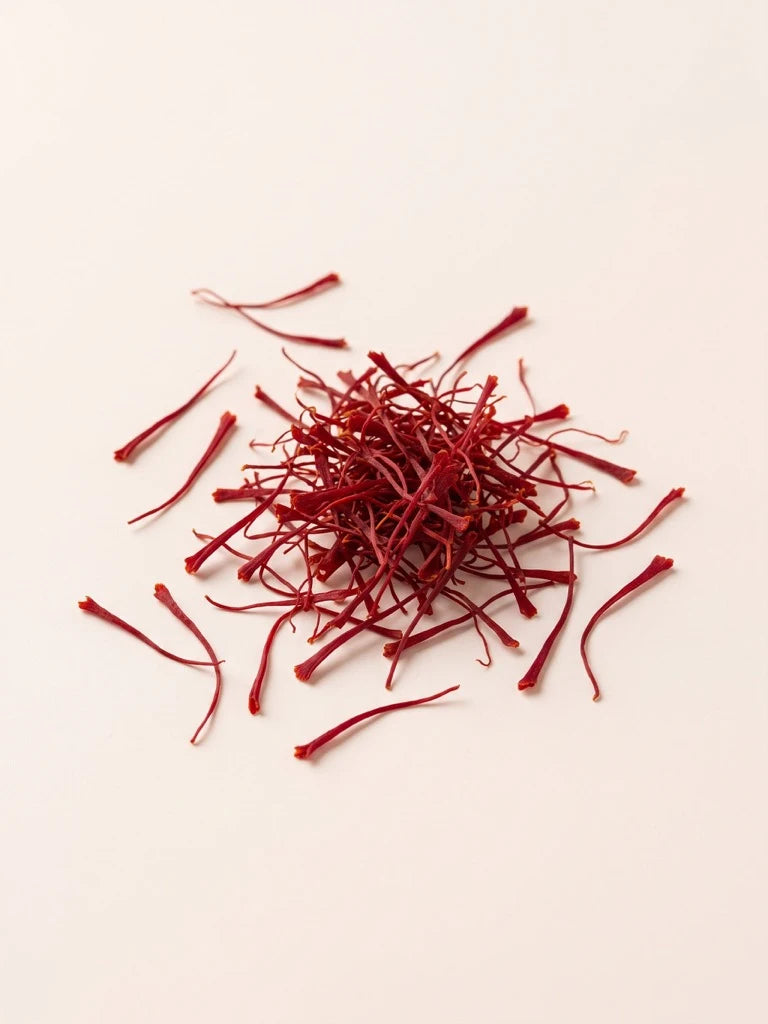
Start with your eyes. Look for the trumpet-shaped flare at one end of each thread and for colour that shades from deep red at the tip to paler at the base. That single inspection eliminates dyed corn silk and safflower faster than any glass of water.
Then run the cold water test, which reads speed rather than colour: genuine pigment emerges slowly and the thread stays red, while dye lifts in seconds and the fibre pales.
What none of them settles is how strong your saffron is. Only a laboratory reading does that, under the framework set by ISO 3632. Our own harvest is being analysed now, and the report will be published in full on our lab report page when it is issued.
Frequently asked questions
Can I use baking powder instead of baking soda?
No. Baking powder contains an acid alongside the bicarbonate, so the solution does not reach the alkaline pH the test depends on. Use plain sodium bicarbonate, which is sold as baking soda or bicarbonate of soda.
How much saffron does the test use up?
About ten threads, which is a fraction of a tenth of a gram. You do not have to waste it either. If the sample passes, the coloured liquid is a perfectly good bloom, though the baking soda makes it unsuitable for delicate dishes.
My saffron turned the water yellow but very slowly. Is that bad?
Not necessarily. A slow yellow is normal for genuine saffron, especially in a small pinch or with threads that have been stored for a while. What matters is that the colour is yellow-gold rather than red, and that it keeps developing rather than appearing all at once.
Does the test work on saffron powder?
Yes, and powder is where it earns its keep, because every visual check is unavailable once threads are ground. Expect the liquid to cloud slightly. Judge the colour of the water above the sediment, not the sediment itself.