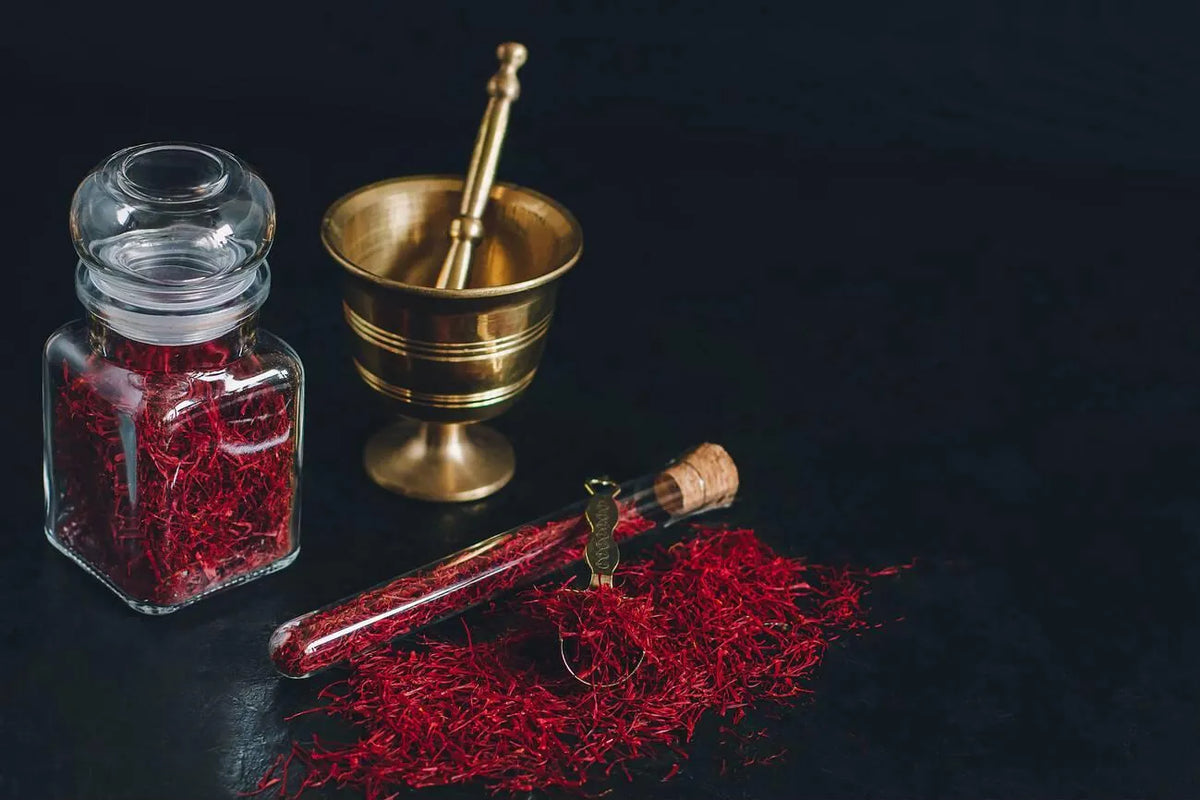
Saffron adulteration takes two forms: cheaper plant material sold as saffron, and real saffron bulked out so that it weighs more than it should. Safflower, dyed corn silk and coloured maize stem are the usual substitutes. Moisture, yellow style and sticky coatings are the usual bulking tricks. Powder hides both of them.
What are the two kinds of saffron adulteration?
Separating them is the first useful thing you can do, because they enter the supply chain at different points and they need different checks.
Substitution means selling something that is not saffron at all. Dyed fibre, shredded petals, cut paper. It is crude, it is aimed at people buying by eye in a market stall or from a marketplace listing, and a careful look plus a glass of water will usually expose it.
Bulking means selling real saffron that has been made heavier, or made to look better than it is. Extra water. Extra yellow style left on the thread. A light coating of something sticky. A wash of dye over threads that faded on a shelf. The threads are genuine. You are simply getting less saffron per gram than the label implies.
Most people worry about the first kind and quietly lose money to the second.
Which materials get sold as saffron?
The same short list recurs across markets, because these materials share three qualities. They are cheap, they are fibrous, and they hold dye.
- Safflower — the dried florets of Carthamus tinctorius. Sold honestly under its own name in several cuisines, and dishonestly as saffron in others. Flat, ragged and evenly orange-red along its whole length.
- Dyed corn silk — the pale threads from inside a corn husk, cut to length and coloured. Soft, limp and unnervingly uniform. The oldest fake in the trade.
- Maize stem and coconut fibre — shredded, dyed, sometimes stiffened. Gives itself away by being too straight and too strong to crush.
- Shredded petals — marigold and similar flowers torn into strips. Broad and papery rather than tubular.
- Dyed paper, cotton thread and plastic filament — uncommon, but they do turn up in gift-box saffron. Obvious once wet.
- Turmeric, paprika and annatto — powder only, where there is nothing left to look at.
| Material | Appearance | Behaviour in warm water | Fastest tell |
|---|---|---|---|
| Safflower | Flat orange-red florets | Colour leaves fast, water runs orange | No trumpet flare at one end |
| Dyed corn silk | Soft, very even red threads | Dye lifts within seconds | Thread turns pale once the dye is gone |
| Maize stem or coconut fibre | Stiff, straight strands | Colour bleeds, fibre stays intact | Too tough to crush between finger and thumb |
| Shredded petals | Broad papery strips | Goes translucent and tears | Flat cross-section, no tube |
| Turmeric powder | Yellow-orange powder | Clouds the water, then settles | Sharp earthy smell, not honeyed hay |
Two of these account for most of what reaches home kitchens, so they have pages of their own: telling safflower from saffron and the dyed corn silk fake.
How is real saffron made heavier?
This is the quieter half of the problem, and the reason two jars can both hold genuine saffron and still be worth very different amounts per gram.
- Water. Dried saffron pulls moisture out of humid air. A batch left open in a damp room gains weight without gaining anything you want. ISO 3632 sets a ceiling on moisture and volatile matter for exactly this reason.
- Yellow style. Below the three red stigmas sits a pale style with very little colouring power. Leaving more of it attached is legal, common and cheap. It is also why an all-red grade costs more per gram and delivers more per pinch.
- Coatings. Honey, sugar syrup, glycerine or oil brushed over threads adds weight and gloss. The threads feel tacky, stick together in the jar and leave a mark on paper.
- Added dye. Tired threads can be re-coloured. The dye sits on the surface, so it releases far faster than the pigment inside a genuine thread.
- Mineral fillers. At the worst end, dense powders are mixed into ground saffron. Nothing you can do at a kitchen counter will find these.
Two of these deserve a longer look on their own: how moisture inflates the weight you pay for and what an all-red claim actually means.
Why is powder the riskiest format?
Every check described above depends on looking at a thread. Grinding removes that possibility in one step. Powdered saffron can be cut with turmeric, paprika, safflower powder, starch, or simply with more saffron style, and no amount of squinting at the jar will tell you.
Colour is no help either, because a small quantity of dye will match the shade of the real thing. This is why the plain rule holds: buy threads, not powder, and grind them yourself when a recipe calls for it.
What can you check at home?
None of these is conclusive on its own. Run two or three together and the picture usually resolves.
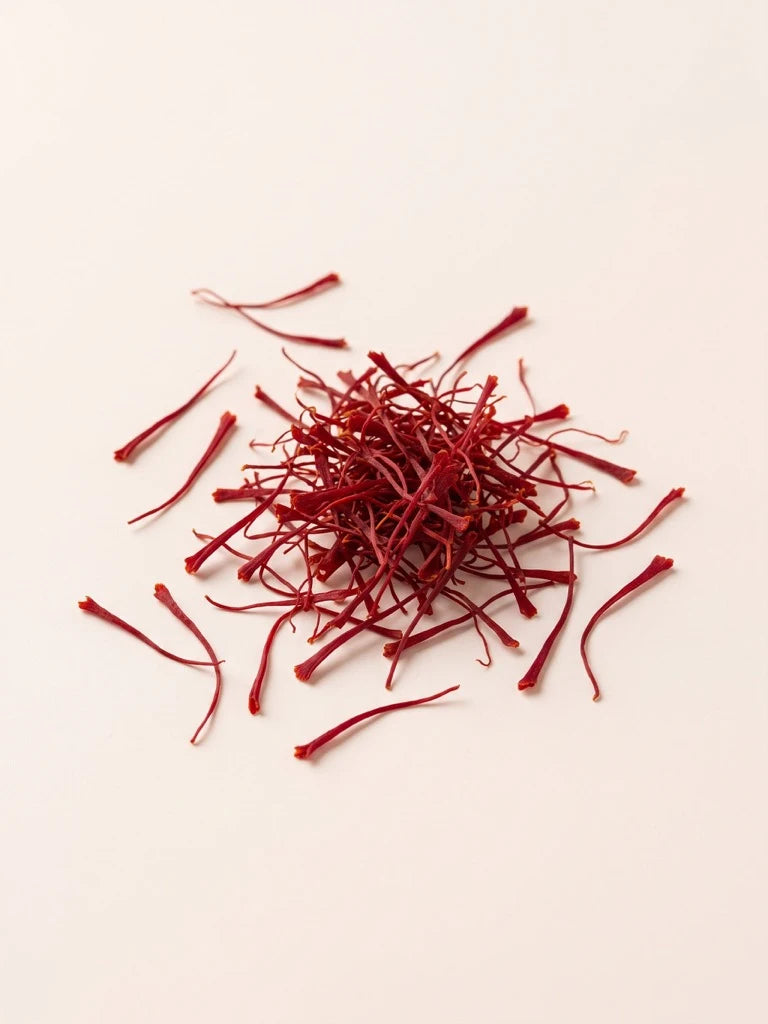
- Look at one thread against the light. Genuine saffron is a tube that flares into a trumpet at one end, and it is deeper red at the flare than at the base.
- Smell the jar. Real saffron smells of hay, honey and something faintly medicinal. Dyed fibre smells of nothing, or of paper.
- Drop a few threads into cold water and wait. The cold water test is slow on purpose — genuine colour comes out gradually and the thread stays red.
- Try a pinch in a little baking soda solution. The baking soda test is aimed squarely at turmeric.
- Rub a damp thread between your fingers. Surface dye transfers to your skin at once. Genuine pigment takes longer and stains yellow-orange, not red.
If you want the whole sequence in one place, our guide to spotting fake saffron walks through it in order.
What does a laboratory actually look for?
A laboratory does not look at threads. It dissolves a ground sample and reads its absorbance on a spectrophotometer: crocin for colour at 440 nm, picrocrocin for taste at 257 nm, safranal for aroma at 330 nm. It also measures moisture and volatile matter, and ash, which is where mineral fillers show up. The framework for all of it is ISO 3632, which defines Categories I to III.
Synthetic colourants are a separate test. Chromatography separates the compounds in an extract, and a dye that was never in a crocus flower appears as a peak that does not belong. This is the only reliable way to catch a well-executed dye job.
We are having our own harvest analysed and will publish the report in full when it is issued, on our lab report page. Until a document exists with a laboratory name and a date on it, treat any grade claim as marketing.
Frequently asked questions
Is cheap saffron always adulterated?
No, but a low price has to come from somewhere. It usually comes from more yellow style, higher moisture, older stock, or a smaller pack sold at a flattering headline price. Outright substitution is only one of the explanations, and rarely the most common one.
Can I detect adulteration by taste?
Partly. Genuine saffron is bitter before it is anything else, with a hay-like sweetness behind it. Safflower tastes of almost nothing. Turmeric tastes earthy and slightly peppery. What taste cannot tell you is whether real saffron has been bulked with moisture or style.
Does a deep red colour in water mean the saffron is good?
It usually means the opposite. A red bloom that appears within seconds points to surface dye. Genuine saffron releases a golden yellow that deepens over ten to twenty minutes, and the thread keeps its own colour while it does so.
Is saffron adulteration illegal?
Selling one material as another is fraud in most jurisdictions, and unapproved colour additives in food are regulated separately. Enforcement is the hard part, because saffron changes hands several times between a field and a jar.
Read next
- How saffron fraud works in the supply chain
- Why cheap saffron is cheap
- Our authenticity page, which sets out what we do and do not claim