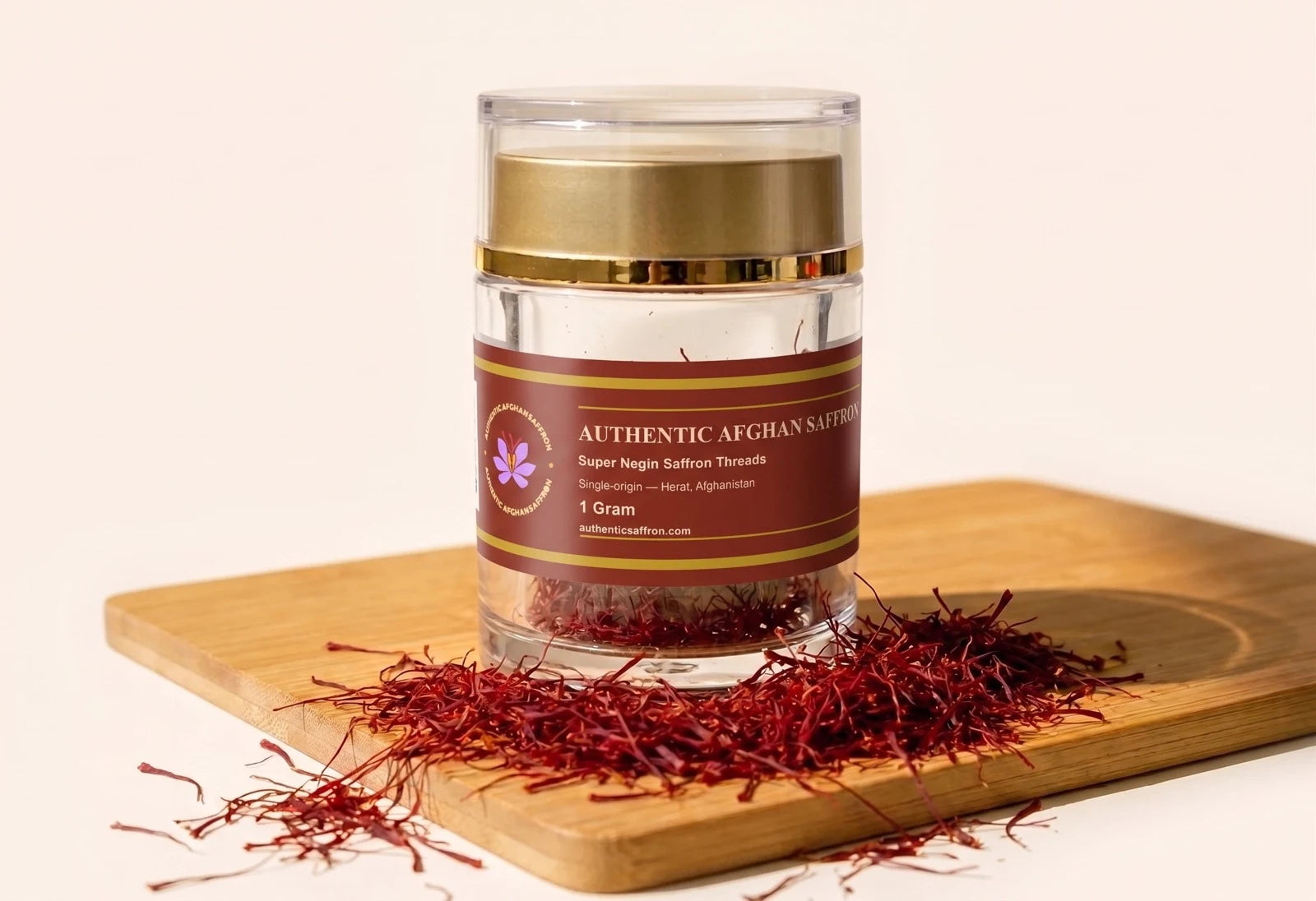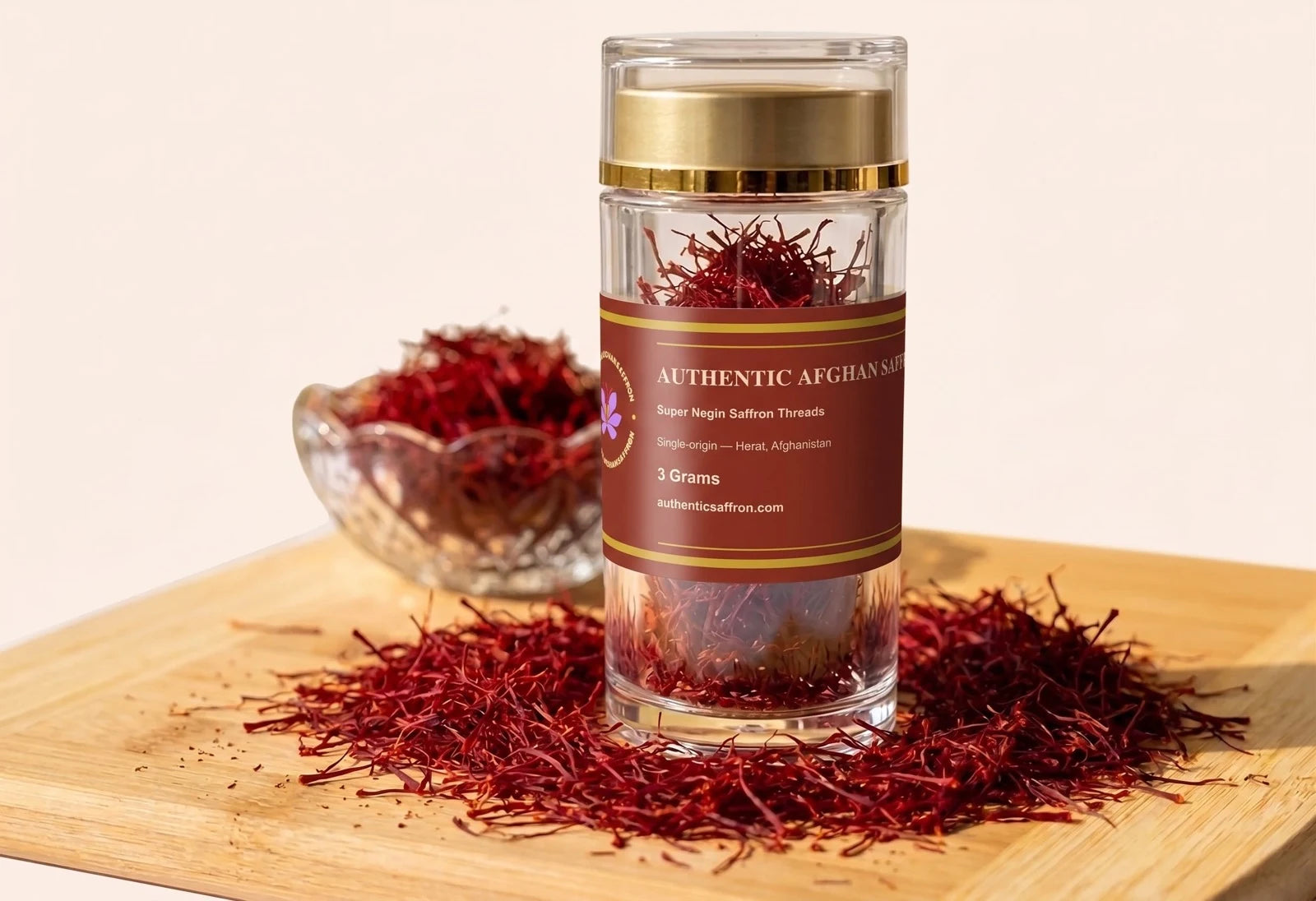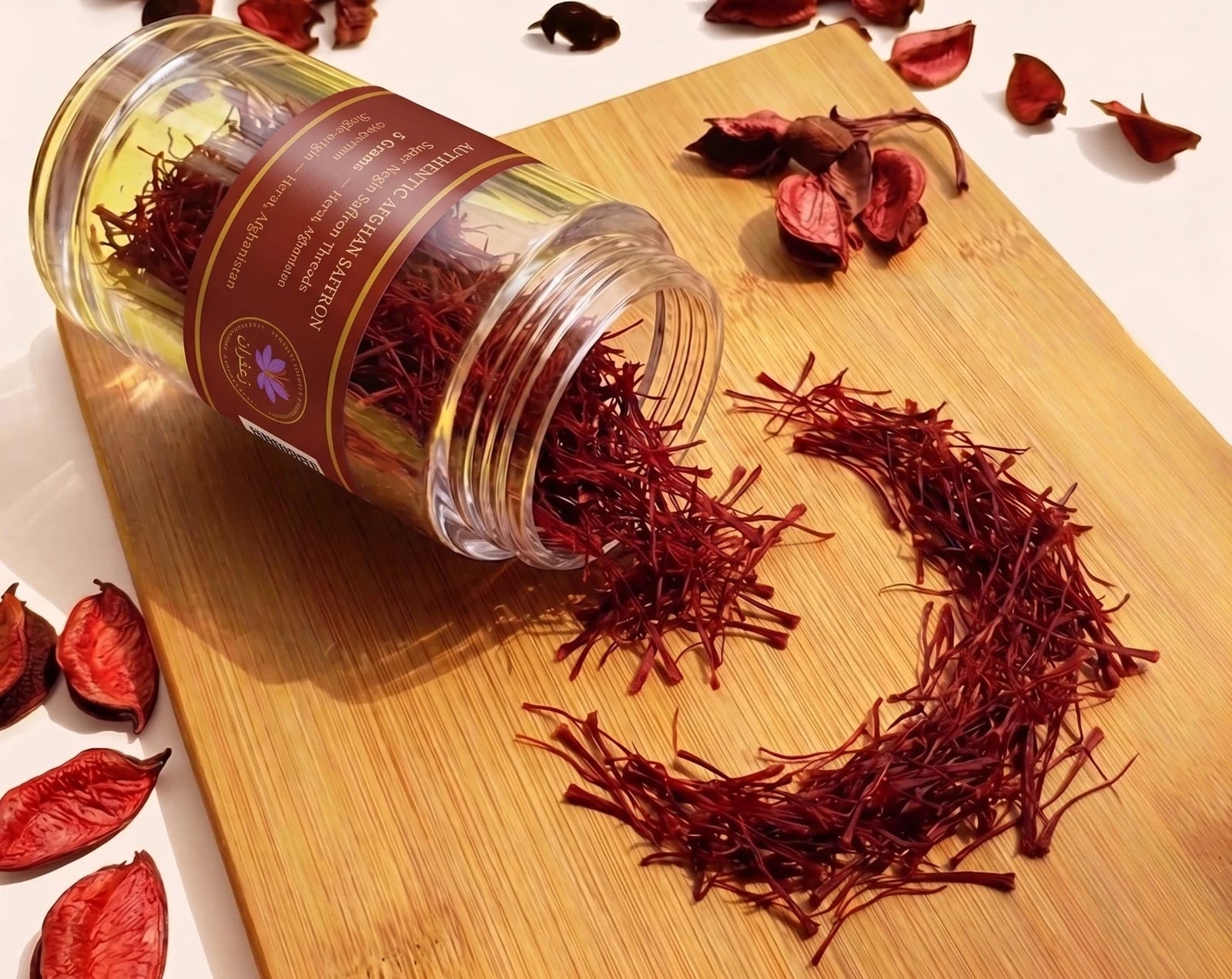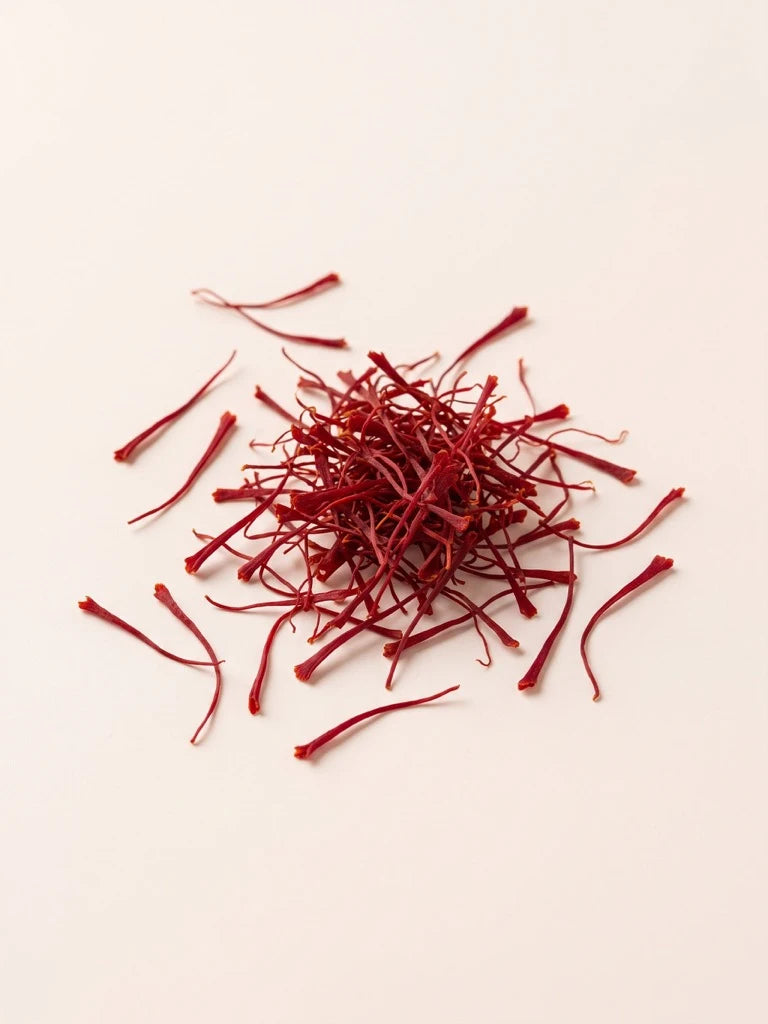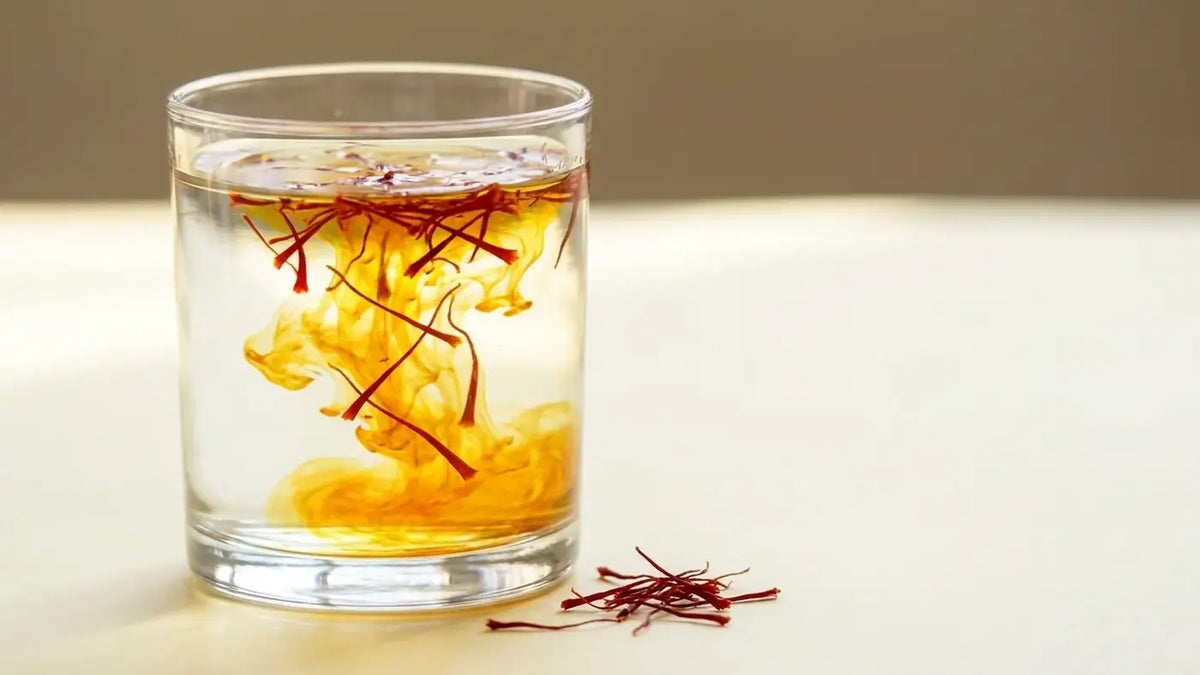
Crocin is the pigment family that gives saffron its colour, and it is the single number most quality reports lead with. Colouring strength measures how much crocin saffron threads carry, read as absorbance at 440 nm. Crocin does the colouring and almost none of the smelling. It fades with light, heat, air and time.
What is crocin?
Crocin is not a single molecule. It is a family of closely related pigments — sugar-bound forms of a carotenoid called crocetin — that the crocus flower concentrates into the three red stigmas at the centre of each bloom. Those pigments are most of what you are paying for when you buy saffron by weight.
Two properties make crocin unusual. It is intensely coloured, so a very small mass tints a very large volume of food. And unlike most carotenoids, which prefer fat, the attached sugars make crocin readily soluble in water. That single fact explains why saffron is bloomed in a spoonful of warm liquid rather than fried in oil like turmeric or paprika.
It also explains why saffron is measured the way it is. A water-soluble pigment can be dissolved, put in a cuvette and read on a spectrophotometer, which is a far more reliable comparison than looking at threads in a jar.
How does crocin fit with the other saffron compounds?
Saffron is normally described through three marker compounds, and they behave independently. Crocin carries colour. Picrocrocin carries the bitter, hay-like taste. Safranal carries most of the aroma. A batch can be strong in one and unremarkable in another, which is why a single headline figure never describes a saffron completely.
| Compound | Read at | What it governs | What you notice at the stove |
|---|---|---|---|
| Crocin | 440 nm | Colour | How deep the gold runs through rice or broth |
| Picrocrocin | 257 nm | Taste | A clean bitterness sitting under the sweetness |
| Safranal | 330 nm | Aroma | Hay, honey and warm leather off the bloom |
The distinction matters when you read a seller’s claim. “High colouring strength” says something precise about crocin and nothing whatsoever about how the saffron will smell. If you want the other two in the same detail, we have written separately on what picrocrocin does and on why a very high safranal reading is not a prize.
How is crocin measured?
The method is simple in outline. A weighed sample of dried saffron is ground, dissolved in water to a fixed concentration, and its absorbance is read across a range of wavelengths. The value at 440 nm is reported as E1%1cm, which is shorthand for the absorbance a one per cent solution would give in a one-centimetre cell, corrected to dry weight.
Because the result is corrected for moisture, a wet batch cannot fake its way to a good number — though wet saffron still costs you, because you pay for water by the gram. We unpack the notation itself in our guide to E1%1cm.
The test method and the category thresholds both come from ISO 3632, the international standard for saffron, which sorts saffron into Categories I, II and III. The standard is published by the International Organization for Standardization, and the exact floor for each category is set in the current edition rather than by whoever is writing the product page. Our own testing is underway and the report will be published in full when it is complete.
Does a higher crocin number always mean better saffron?
Higher is generally better, up to a point, and then it stops meaning much. Once a saffron is comfortably inside the top category, further increases show up as a slightly deeper gold in a bowl of rice and not as anything you would describe as a different experience. Sellers who compete purely on the colour figure are competing on the one number that is easiest to shout about.
It is worth being clear about what a colouring strength reading does not cover:
- Origin. The number says nothing about where the crocus grew or who picked it.
- Aroma. Colour and smell come from different compounds and can diverge.
- Adulteration. Dyes and bulking agents are caught by other tests, not by this one.
- Age at the point of sale. A reading describes the sample on the day it was tested.
- Handling after testing. Months in a warm, bright warehouse are invisible to a certificate.
This is why a grade claim with no document behind it is worth very little, and why the useful question to a seller is not “what category is it?” but “can I see the report, and when was it dated?” Our grading and quality hub covers how the pieces fit together.
What destroys crocin?
Crocin is a large, conjugated pigment, and the same structure that makes it so strongly coloured makes it vulnerable. Four things take it apart: light, heat, oxygen and moisture. None of them acts dramatically, which is the problem — saffron does not spoil so much as quietly get weaker.
| Exposure | Effect on crocin | What to do |
|---|---|---|
| Direct or ambient light | Breaks the pigment down; the fastest of the four | Opaque tin, or a glass jar kept inside a closed cupboard |
| Heat | Accelerates every other reaction | Never store above the stove or beside the oven |
| Air | Slow oxidation over months | Small airtight container; avoid decanting repeatedly |
| Humidity | Threads go limp, clump and lose strength per gram | Keep dry; do not refrigerate, condensation is the risk |
The practical version is short: airtight, cool, dark, dry, and bought in a quantity you will actually finish. There is more detail in our note on how to store saffron.
What does crocin mean at the stove?
Because crocin dissolves in water, it can only colour the parts of a dish that water reaches. Threads dropped in dry give you streaks: strong colour immediately around each thread and nothing elsewhere. Blooming first turns the pigment into a liquid you can stir through everything at once.
Warm liquid, not hot. Around 150°F (65°C) is enough to pull the crocin out over ten to twenty minutes, and it avoids driving off the aroma compounds that boiling water strips away. We set out the reasoning in why you bloom in warm water rather than hot, and the colour chemistry itself in why saffron turns food golden.
One more consequence worth knowing: crocin is poorly soluble in fat. Blooming threads in oil or melted butter alone will give you a weak, uneven colour. If a recipe wants saffron butter, bloom in a little water first and then combine.
Frequently asked questions
Is crocin the same thing as colouring strength?
Not quite. Crocin is the compound; colouring strength is the measurement. A lab dissolves a weighed sample in water and reads how much light the solution absorbs at 440 nm. Because crocin dominates absorbance at that wavelength, the number is effectively a crocin count, which is why the two terms get used interchangeably.
Does more crocin make saffron taste stronger?
No. Crocin carries colour, not flavour. Bitterness comes from picrocrocin and aroma from safranal. Threads can be intensely gold in the pan and still taste flat if they were dried carelessly or stored in the light.
Can you judge crocin content by eye?
Only roughly. All-red threads with no pale style attached generally carry more crocin per gram, because the yellow part adds weight and almost no pigment. Beyond that, deep colour in the jar is a weak predictor of colour in the pot.
How quickly does crocin fade?
That depends on storage far more than on the calendar. Kept airtight, cool and completely dark, saffron holds most of its colour for years. Left in a clear jar above the stove, it can lose visible strength in a few months.