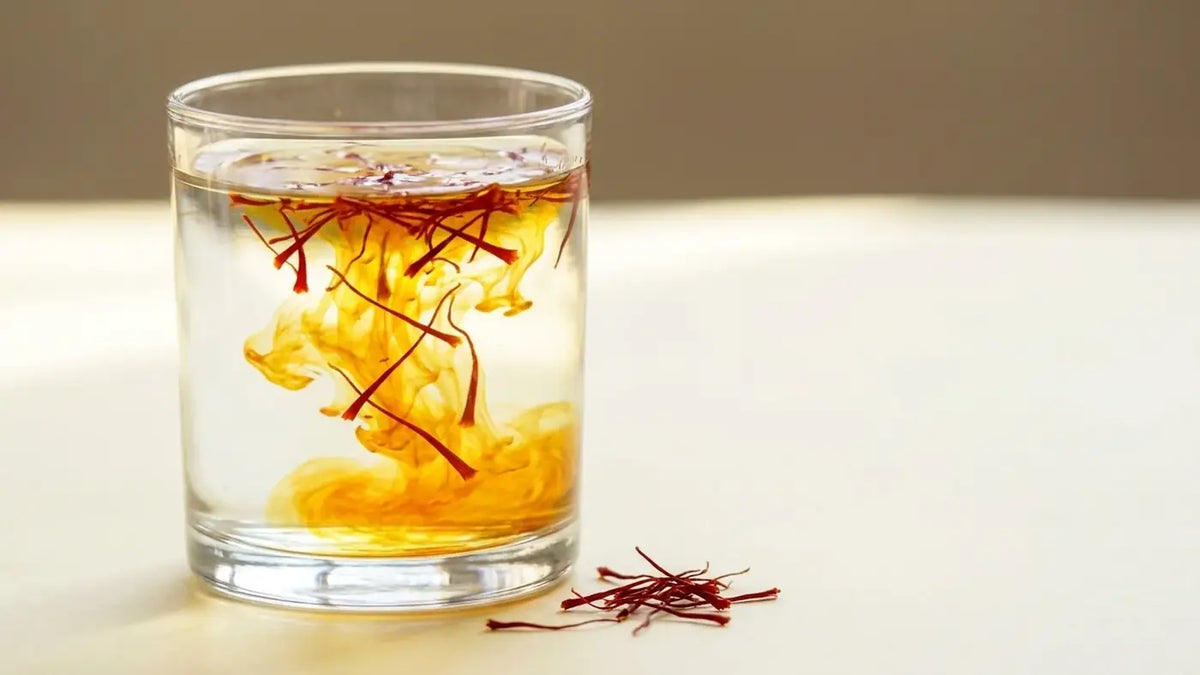
Safranal is the volatile compound that gives saffron its smell: hay, honey, warm leather. Labs read it at 330 nm. It is the one saffron marker where a bigger number is not automatically better, because safranal accumulates as saffron ages or is dried too hard, at the expense of taste.
What is safranal?
Safranal is a small, light molecule — light enough to leave the thread and reach your nose, which is the definition of an aroma compound. It is the dominant note in saffron’s smell, though not the only one; a well-dried thread carries dozens of volatiles and safranal is simply the one that leads and the one that gets measured.
Almost none of it is present in the living flower. Pick a fresh stigma and it smells green and faintly grassy. Saffron’s characteristic scent is created during drying and continues to develop afterwards, which makes it the only one of the three markers that a producer effectively builds rather than harvests.
Where does safranal come from?
It comes from picrocrocin, the bitter compound that gives saffron its taste. Picrocrocin is safranal with a sugar attached. When that bond breaks — during drying, then slowly during storage — the sugar comes away and safranal is set free.
That is the whole mechanism, and it has an uncomfortable implication. Every increase in aroma is paid for out of the taste reserve. Saffron does not make more safranal from nothing; it converts one asset into another. We set out the taste side of the trade in our piece on picrocrocin.
Why is more safranal not better?
Because on its own, a large aroma figure is ambiguous. It can mean a batch was dried with real skill. It can equally mean the batch was heat-forced to produce an impressive smell quickly, or that it has been sitting in a warehouse for three years. All three routes end at the same reading.
This is why the international standard treats safranal differently from the other two markers. Colour and taste have floors: more is better, and the categories are defined by how high you clear the bar. Safranal has a band — a floor and a ceiling — because an unusually high figure is a warning, not a distinction. The thresholds sit in ISO 3632, published by the International Organization for Standardization, and you should read them from the current edition rather than from a product page. Our grading hub explains how the categories hang together.
The practical version: judge saffron on the pattern of all three readings, not on the one that happens to flatter it.
What do the three readings tell you together?
| Pattern across the three markers | What it usually indicates | What to do about it |
|---|---|---|
| Strong colour, strong taste, moderate aroma | Young saffron, carefully dried, with headroom left | The pattern worth paying for |
| Strong colour, weak taste, very strong aroma | Aged, or dried too hard and too fast | Usable, but it should not carry a premium price |
| Moderate colour, moderate taste, weak aroma | Under-dried, or long exposure to open air | Fine for colour work; do not expect perfume |
| Weak across all three | Old, damp, or padded out with non-stigma material | Walk away and ask for a dated report |
None of these patterns can be read from a photograph, and none of them can be read from the word “premium”. They come from a document with a date on it. Our own results are not published yet; testing is underway and the report will go up in full, including anything unflattering.
Does the aroma survive cooking?
Partly, and that is the whole reason for the blooming rules people repeat without explaining. Safranal is volatile. Anything that boils will carry it off in the steam, which is why a saffron bloom made in boiling water smells wonderful in the moment and tastes of very little afterwards — the aroma went into the room instead of the pot.
Three habits keep more of it in the food:
- Bloom in warm liquid, around 150°F (65°C), for ten to twenty minutes with a saucer over the cup.
- Add the bloom late enough that it is not simmered for an hour — the last thirty minutes of a braise is plenty.
- Keep the lid on after adding, so what evaporates condenses and falls back in.
The reasoning behind the temperature is set out in why you bloom saffron in warm water and not hot. Published work on the volatile chemistry of saffron, including how extraction conditions change the profile, is indexed on PubMed if you want to read primary sources.
How do you keep safranal in the jar?
Treat aroma as something that leaks rather than something that spoils. A volatile compound escapes through any gap it is given, so the enemy is headspace and open lids as much as it is heat.
Buy in a size you will finish inside a year. Keep the threads in one small airtight container rather than moving them between jars. Store cool, dark and dry, away from the stove, and never in the fridge, where condensation does more harm than the cold does good. The full routine is in how to store saffron.
One test costs you nothing. Open the jar in a quiet, warm kitchen and smell it before you cook. If a saffron that used to announce itself now needs to be held under your nose, the safranal has largely gone, and you should use a few more threads and buy smaller next time.
Frequently asked questions
Is safranal what makes saffron expensive?
No. Cost comes from the harvest — roughly 150 flowers hand-picked and hand-separated for a single gram. Safranal is one of three compounds used to describe what you get for that effort, alongside crocin for colour and picrocrocin for taste.
Why does my saffron smell strong but colour weakly?
Most likely it is older, or it was dried harder. Both push the balance toward aroma and away from taste and colour. A strong smell in the jar is a snapshot of where a batch is in its life, not a ranking of how good it is.
Does grinding saffron release more aroma?
It releases it faster, which is not the same as releasing more. Crushing lightly before blooming is useful. Grinding to a fine powder and leaving it exposed simply lets the volatile compounds escape into the room before they reach the pan.
Can saffron lose its smell completely?
Yes. Safranal is volatile, so an old jar left loosely closed in a warm kitchen can end up nearly odourless while still holding some colour. Colour is the last of the three to go, which is why weak saffron can still look convincing.