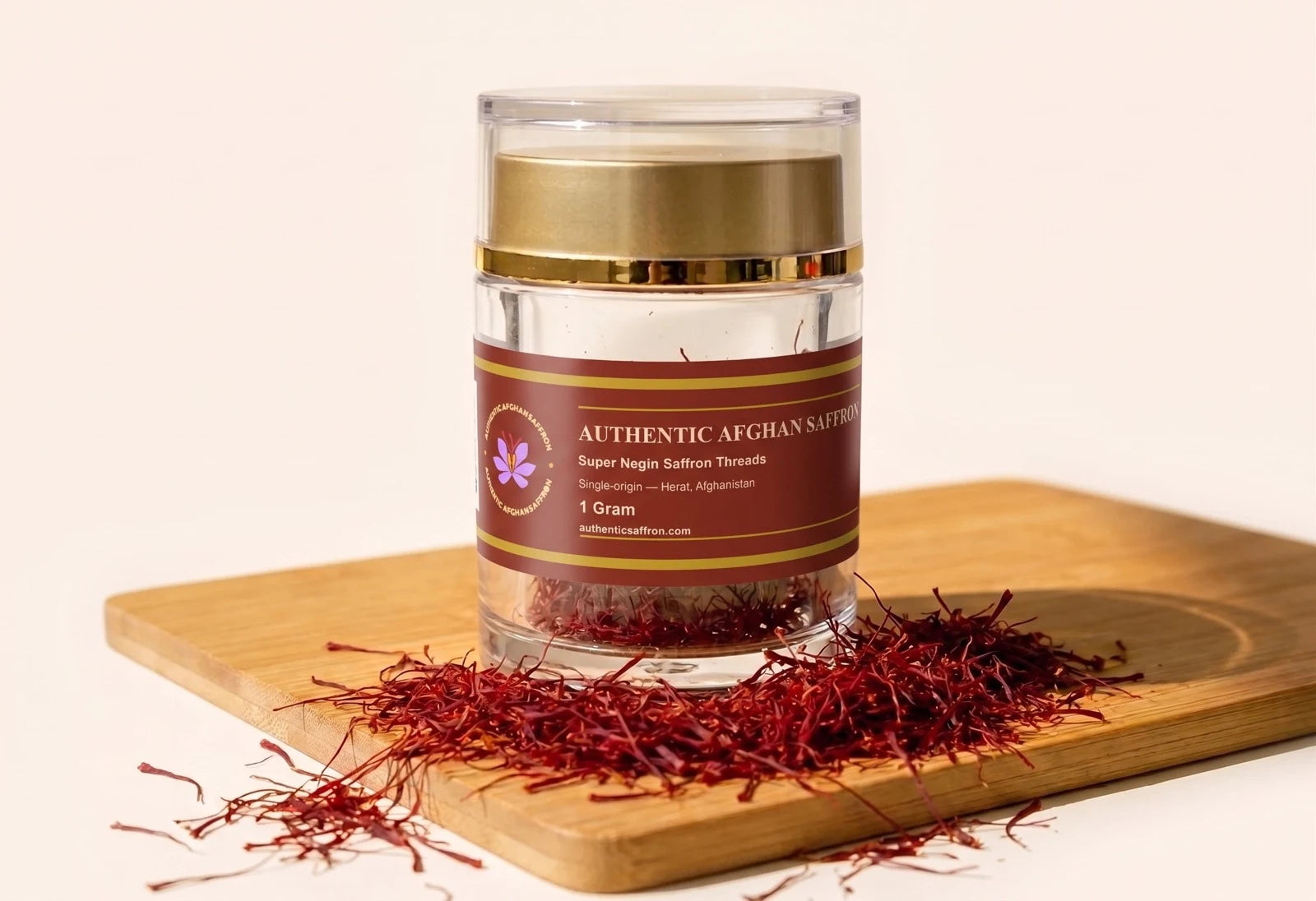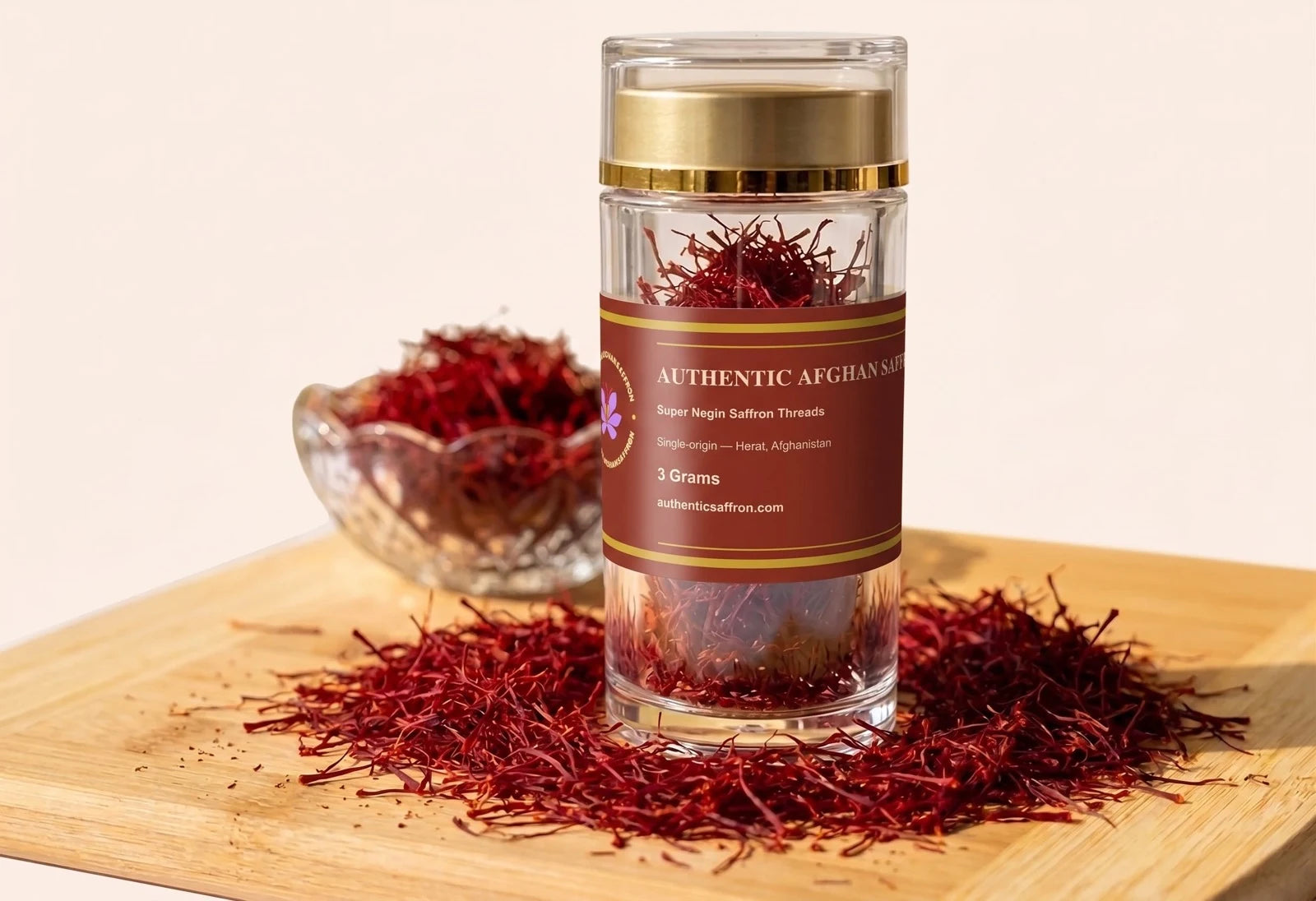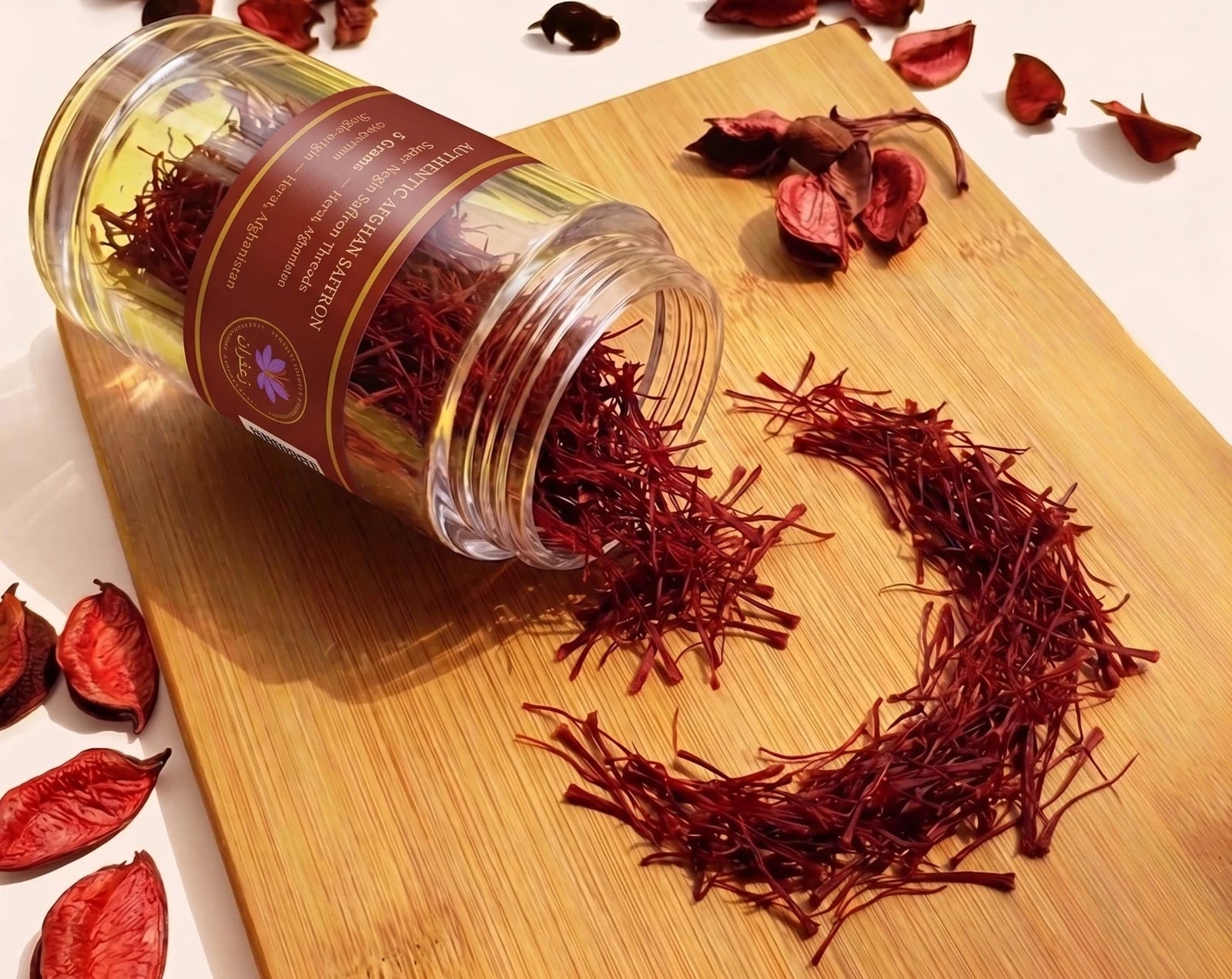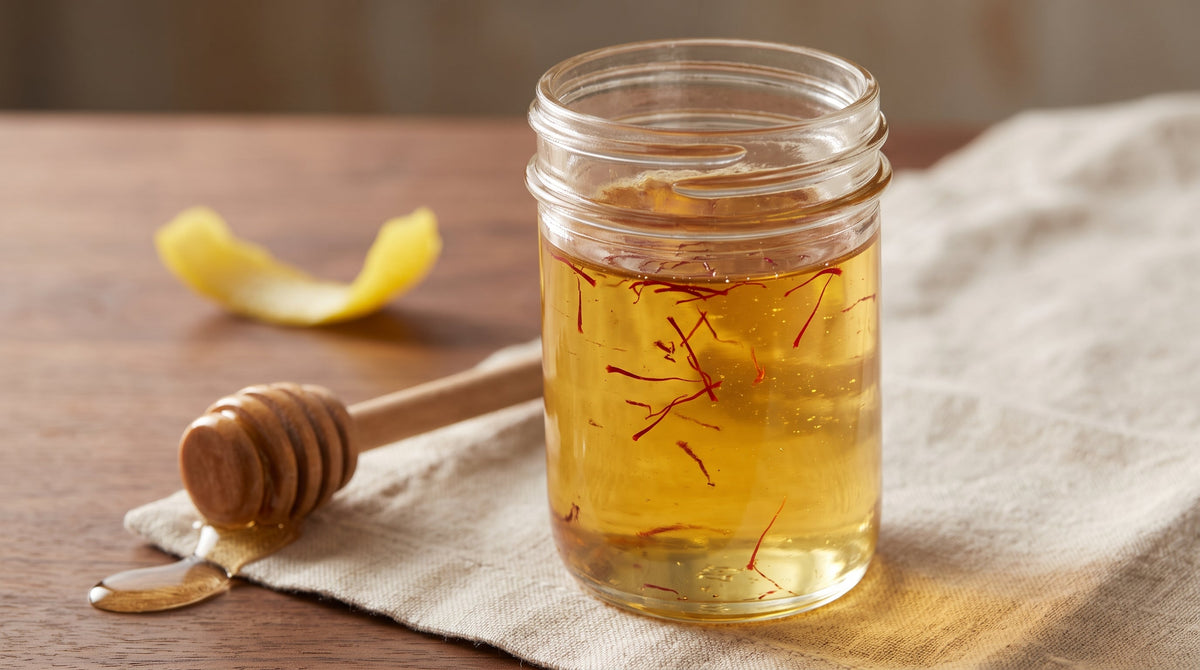
Saffron honey works because honey is almost dry — it holds around 17 per cent water, far too little to pull colour out of a thread on its own. Bloom 25 threads (0.10 g) in two teaspoons of warm water first, stir that into 340 g of gently warmed honey, then rest it overnight.
Why does honey need a different approach?
Most saffron infusions rely on a generous volume of liquid. Honey gives you almost none. Crocin, the pigment that makes saffron yellow, needs free water to dissolve into, and honey has very little to spare. Drop dry threads into a jar and come back a fortnight later: you will find threads, slightly darker at the tips, floating in honey that has barely shifted colour.
Two teaspoons of bloomed water changes that. The pigment is already in solution before it meets the honey, so it disperses in minutes rather than never. The cost is that you have raised the moisture in the jar, and moisture is the only reason honey ever spoils. That trade governs everything below: small batch, cold storage.
On heritage, a straight answer. Saffron and honey turn up together across the eastern Mediterranean and Central Asia, mostly inside sweets and warm drinks rather than as a standing pantry item. A jar of saffron honey on the counter is a modern convenience, not an old tradition. What it earns its place with is the way saffron’s hay-and-bitter edge cuts the flatness of pure sweetness — honey stops tasting one-dimensional.
How many saffron threads, and bloomed in what?
Twenty-five threads, about 0.10 g, for 340 g of honey — one standard cup, or roughly a 12 oz jar. That works out near one thread per teaspoon poured, which is the right density for something you eat by the spoonful rather than the ladleful. Push past 40 threads in this volume and the bitterness stops reading as complexity and starts reading as a mistake.
Bloom the threads in 2 teaspoons of water held at about 150°F (65°C) for 15 minutes, covered. That is water which steams steadily and shows no bubbles; a kettle boiled and left to stand four minutes lands close enough without a thermometer. Boiling water is the common error. It drives off safranal, the volatile compound that carries the smell, and leaves you with colour and very little aroma — a bad trade in a jar where aroma is the whole point.
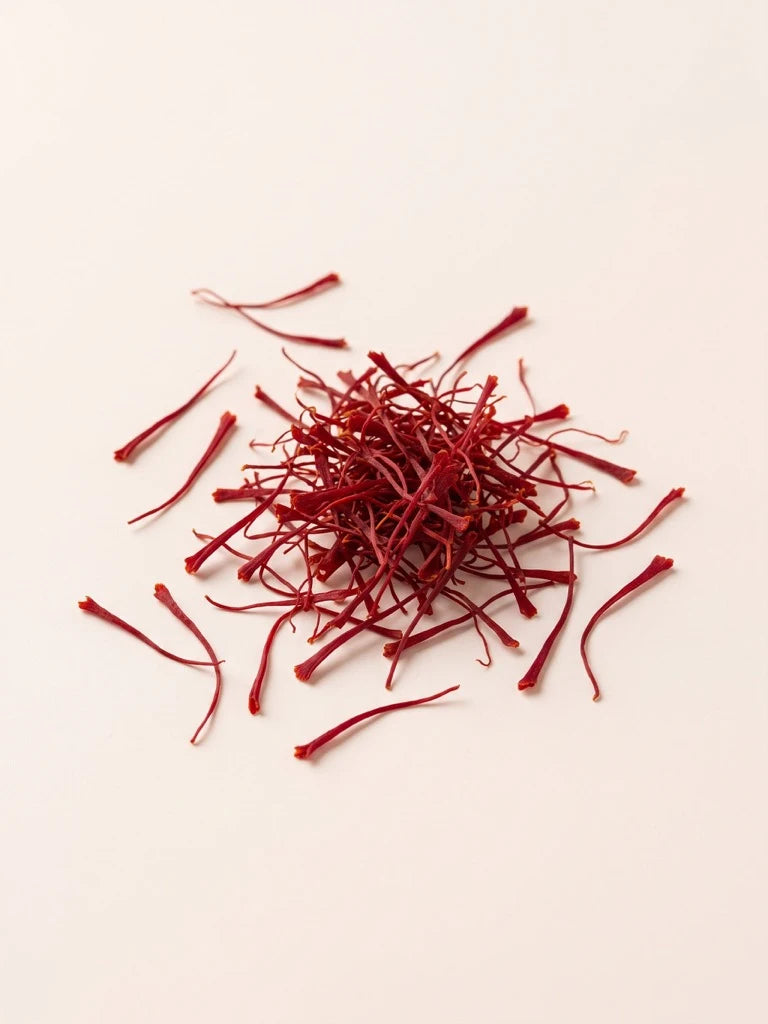
Thread quality shows plainly here, because honey is transparent and pale. Long all-red threads with no yellow style attached will sit visible in the jar and give you something to judge. Super Negin grades are cut back to the red, so nothing suspended in the honey is inert. If you want the reasoning behind that cut, our page on cooking with saffron covers dosing and blooming in one place.
What are the ingredients?
Choose the honey carefully. Acacia, clover and orange blossom are mild enough to sit under saffron. Buckwheat, chestnut and dark wildflower honeys have their own strong molasses and malt notes, and they will bury 25 threads without trace.
- About 25 saffron threads (0.10 g)
- 2 tsp (10 ml) water, for blooming
- 340 g (1 cup) mild honey, such as acacia, clover or orange blossom
- 1 wide strip of lemon peel, no white pith, optional
- 1 small pinch of flaky salt, optional
What are the steps?
- Bloom the saffron. Heat the 2 tsp of water to about 150°F (65°C), steaming with no bubbles breaking the surface. Crumble the threads between dry fingers into a small cup, pour the water over, cover with a saucer and leave 15 minutes. The liquid should finish the colour of strong orange juice.
- Warm the honey, gently. Scrape the honey into a heatproof bowl or a wide-mouth jar and stand it in a saucepan holding two inches of water at about 110°F (43°C). Take the pan off the heat. Leave it 10 minutes, until the honey runs off a spoon in a thin unbroken ribbon instead of falling in lumps.
- Keep it under 105°F. Honey held much warmer than that loses its own floral top notes and thins permanently. If you cannot hold a finger in the water bath comfortably, it is too hot for the honey. There is no rush here and no benefit to speed.
- Stir the bloom in. Tip the saffron water and every thread into the warm honey. Stir slowly with a spatula for a full minute, keeping the blade below the surface. Brisk stirring whips air into something this viscous and the bubbles take days to rise out.
- Add the peel and salt. Push the lemon peel down under the surface and add the pinch of salt if you are using it. The peel gives a lift that stops the honey tasting cloying; the salt sharpens the saffron rather than making anything taste salty.
- Rest it overnight. Cover the jar loosely and leave it on the counter for 12 hours. Colour moves from pale straw to a clear amber-orange over the first three or four hours, then keeps deepening slowly. Do not judge it at 20 minutes.
- Pull the peel, decide on the threads. Lift out the lemon peel at 12 hours or it turns bitter. Leave the threads in for looks, or strain the honey through a fine sieve warmed under a hot tap so it flows rather than clinging.
- Refrigerate and date the jar. Seal it, label it with the date and keep it cold. Use it within three weeks. Cold honey pours badly, so stand the jar in warm water for five minutes before serving.
Where does this normally fail?
Two failures account for nearly all of it, and both trace back to the water you added rather than to the saffron.
- Fermentation. Honey resists spoiling because its moisture sits below roughly 18 per cent. Two teaspoons per cup nudges it just over. If you ever see a fizz of fine bubbles, a bulging lid or catch a smell like cider, throw the jar out. Keeping it cold and keeping the batch small is the whole defence.
- Crystallisation. Extra water encourages sugar to come out of solution, so an infused jar granulates sooner than the honey did on its own. It is harmless. Stand the jar in 110°F water for 20 minutes and stir, and it clears.
- The microwave. It heats honey in violent local hot spots, scorching sugar in one part of the jar while the rest stays cold. A water bath cannot overshoot.
There is a water-free route worth knowing. Grind the threads to a fine powder with a pinch of the sugar or salt as an abrasive, then stir the powder straight into warm honey. You add no moisture, so shelf life is unchanged, but colour develops over about a week and never gets as vivid. Our note on grinding saffron properly explains why the abrasive matters.
Frequently asked questions
Will the added water make my honey ferment?
It can, which is why the recipe is small and lives in the fridge. Two teaspoons of water in 340 g of honey lifts the moisture just past the point where wild yeasts can work. Cold slows them to a crawl, so three weeks refrigerated is safe practice. Bubbles, a bulging lid or a cider smell mean discard it.
Can I skip the blooming and drop threads straight into the jar?
You can, and plenty of shop-bought jars are made that way, but you will wait weeks for a fraction of the colour. Honey has too little free water to extract crocin at any useful rate. The jar looks handsome and tastes almost entirely of honey.
What do you actually use it for?
It is best where nothing competes with it: stirred into warm milk, drizzled over thick yoghurt or ricotta, brushed on the last five minutes of roast carrots, spooned over a plain cheesecake. It is wasted in coffee and wasted in a marinade, where garlic and acid roll straight over it.
Does it need to be raw honey?
No. Raw honey is often better tasting, but the deciding factor is strength of flavour, not processing. A mild pasteurised clover honey shows saffron more clearly than a raw buckwheat ever will.
Read next
- How to bloom saffron — the base technique, in more detail
- Saffron milk before bed — the obvious use for a spoonful
- How to store saffron — keeping the threads themselves worth infusing