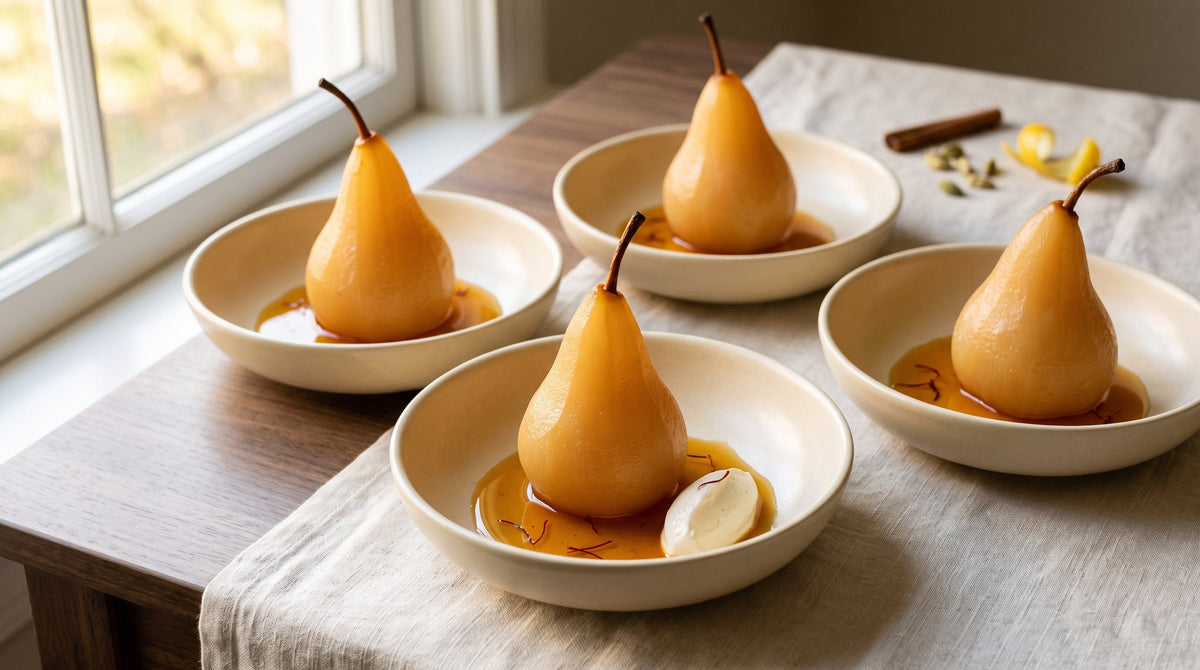
Saffron poached pears need firm fruit and a low flame. Twenty threads, about 0.08 g, bloomed in warm water, turn a plain sugar syrup amber and give the pears a scent of honey and hay. Bosc or Anjou, just underripe, poach in twenty-five to thirty-five minutes at a bare simmer.
Buy the pears three days early. You want fruit that yields slightly at the neck and nowhere else.
Why poach pears in saffron?
A poached pear is mostly texture. The fruit is delicate to the point of vagueness once cooked, which is why the classic versions lean on red wine, vanilla or star anise.
Saffron fits for a reason worth knowing: pears and saffron share aroma territory. Both are soft, faintly floral and honeyed, and neither has much acidity. Rather than layering a contrast on top, saffron deepens what the pear already suggests. The lemon peel is what stops it going cloying.
The colour matters too. Saffron takes the pears from pale ivory to a translucent amber that goes right through the flesh overnight. Wine-poached pears are dramatic; these are quieter and, cut open, more interesting.
How much saffron does this need?
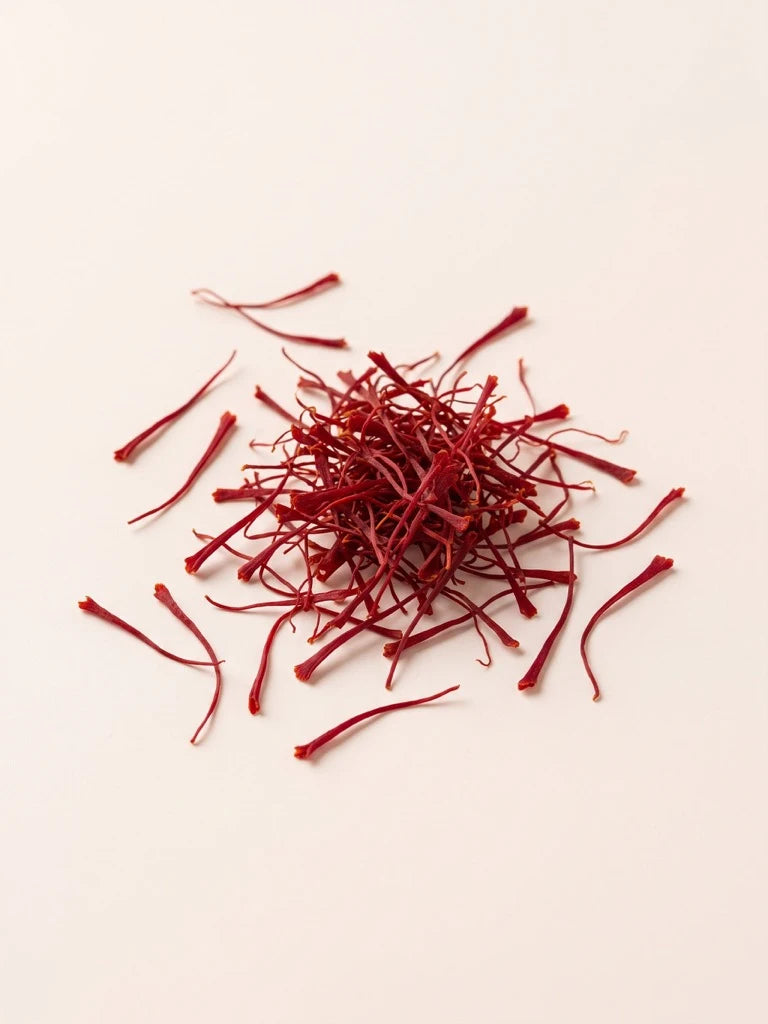
Twenty threads, or about 0.08 g, for four pears and three cups of syrup. A light hand on purpose: the syrup is reduced at the end, concentrating everything in it threefold, so a dose that seems generous at the start turns aggressive by the plate.
Bloom the threads in a quarter cup taken from the recipe water, heated to about 150°F (65°C). Steaming, with no movement on the surface. Fifteen minutes covered is enough; twenty is better. Boiling water is the thing to avoid, since it drives the aroma off as steam and leaves the colour behind.
Water is the right medium here rather than milk or alcohol, because the poaching liquid is water-based and you want the two to combine cleanly. The technique is walked through in how to bloom saffron properly.
Add the bloomed liquid and the threads at the start, not the end. The pears need the whole poach to take up colour, and threads dropped in late just sit on the surface. If you are scaling up, how much saffron per person has the arithmetic.
What is in the poaching liquid?
Serves four. The pan matters as much as the ingredients: use one just wide enough to hold the pears lying down, around 8 inches across.
- 4 firm Bosc or Anjou pears (about 1 1/2 lb / 700 g)
- About 20 saffron threads (0.08 g)
- 3 cups (700 ml) water, divided
- 3/4 cup (150 g) granulated sugar
- 2 wide strips of lemon peel, pith scraped off
- 1 tbsp lemon juice
- 1 cinnamon stick
- 3 green cardamom pods, cracked
- 1 tsp vanilla extract, or half a vanilla pod, split
- Pinch of fine salt
- Crème fraîche or thick yoghurt, to serve
How do you poach them?
- Bloom the saffron. Heat 1/4 cup of the water to about 150°F (65°C) and pour it over the threads in a small cup. Cover and leave 15 to 20 minutes, until the water is the colour of amber glass. Do not use boiling water.
- Peel the pears. Peel from stem to base in long strokes with a swivel peeler, keeping the shape smooth — every flat spot shows on the plate. Leave the stems on. Cut a thin disc off each base so the pears will stand up later. Drop them into a bowl of water with the lemon juice as you go.
- Core them, or do not. If you want them cored, work a melon baller or a 1/2 tsp measuring spoon up through the base and turn it twice to lift out the seed case. It is easier to do now than after cooking, and it makes them cleaner to eat, but a whole pear holds its shape better.
- Build the syrup. Put the remaining water, the sugar, lemon peel, cinnamon, cardamom, vanilla and salt in a saucepan about 8 inches wide. Bring to a simmer and stir until the sugar has dissolved. A wider pan means more syrup to cover the fruit, and a weaker result.
- Add the pears and the saffron. Slide the pears in on their sides and pour in the saffron water with the threads. The liquid should come almost to the top of the fruit. Cut a circle of parchment the width of the pan with a coin-sized hole in the middle, and lay it directly on the surface.
- Poach at a bare simmer. Bring it to the point where one bubble breaks every second or two, around 180°F (82°C), and hold it there. A rolling boil knocks the pears against each other and rounds off the edges. Turn them every 10 minutes so the colour takes evenly.
- Test with a knife tip. After 25 minutes, slide the tip of a paring knife into the thickest part near the base. It should meet slight resistance and then glide. Firm pears can need 35 minutes or more. If the knife drops straight through with no resistance at all, they have gone past it.
- Cool in the syrup. Take the pan off the heat and leave the pears in the liquid for at least two hours, or overnight in the fridge. This is where most of the colour arrives — a pear lifted out hot is pale, and the same pear the next morning is amber to the core.
- Reduce and serve. Lift the pears out. Strain the syrup, return it to the pan, and boil hard for 8 to 12 minutes until it is down to about a cup and coats the back of a spoon. Cool slightly, stand a pear in each bowl, spoon the syrup over, and add crème fraîche alongside.
Why do poached pears go mushy?
Nearly always the fruit, not the cooking. Bartlett and Comice are bred to be eaten soft and collapse into sauce in about fifteen minutes. Bosc is the reliable choice — dense flesh, tapered shape, holds its edges. Anjou works. Underripe is a feature here, not a compromise.
The other cause is heat. A rolling boil knocks the fruit about and forces liquid in faster than it can absorb, so the outside breaks down while the core is still raw. If your smallest burner runs hot, use a diffuser or slide the pan half off the flame.
- Test ripeness at the neck. Press just below the stem: slight give there and firmness everywhere else is the window you want.
- Do not skip the cartouche. Without it the exposed top of each pear goes grey-brown while the submerged half turns amber.
- Keep the syrup. Strained and refrigerated it lasts a fortnight, and it is excellent over yoghurt or brushed onto a plain cake.
- Half water, half white wine is a good variation. Use a dry Riesling, cut the sugar to 1/2 cup, and expect a sharper result.
One thing that is not a mistake: threads floating at the start. They sink within a few minutes as they take up liquid.
Frequently asked questions
Which pears hold up best?
Bosc first, for its dense flesh and long neck, then Anjou. Avoid Bartlett and Comice, which are bred for eating raw and turn to pulp within about fifteen minutes. Whatever you buy, choose fruit that is still firm at the shoulder.
Can I use white wine instead of water?
Yes, and half wine to half water is the version we make most often. Use something dry, drop the sugar to 1/2 cup because wine adds its own sweetness, and expect the saffron to read as sharper and less floral against the acidity.
Do I have to core the pears?
No. Coring makes them easier to eat and lets the syrup reach the middle, but an uncored pear keeps its shape better through a long poach. If you are serving them whole and upright, core from the base so the top stays intact.
How long do they keep?
Five days in their syrup in a covered container in the fridge, and they get better for the first two or three as the colour deepens. Serve them cold or let them come up to room temperature, but do not reheat them.
Read next
- Saffron simple syrup — what to do with the reduced poaching liquid
- Saffron pairings — which fruits and spices it works with, and which it fights
- Cooking with saffron — the basic dosing and blooming rules