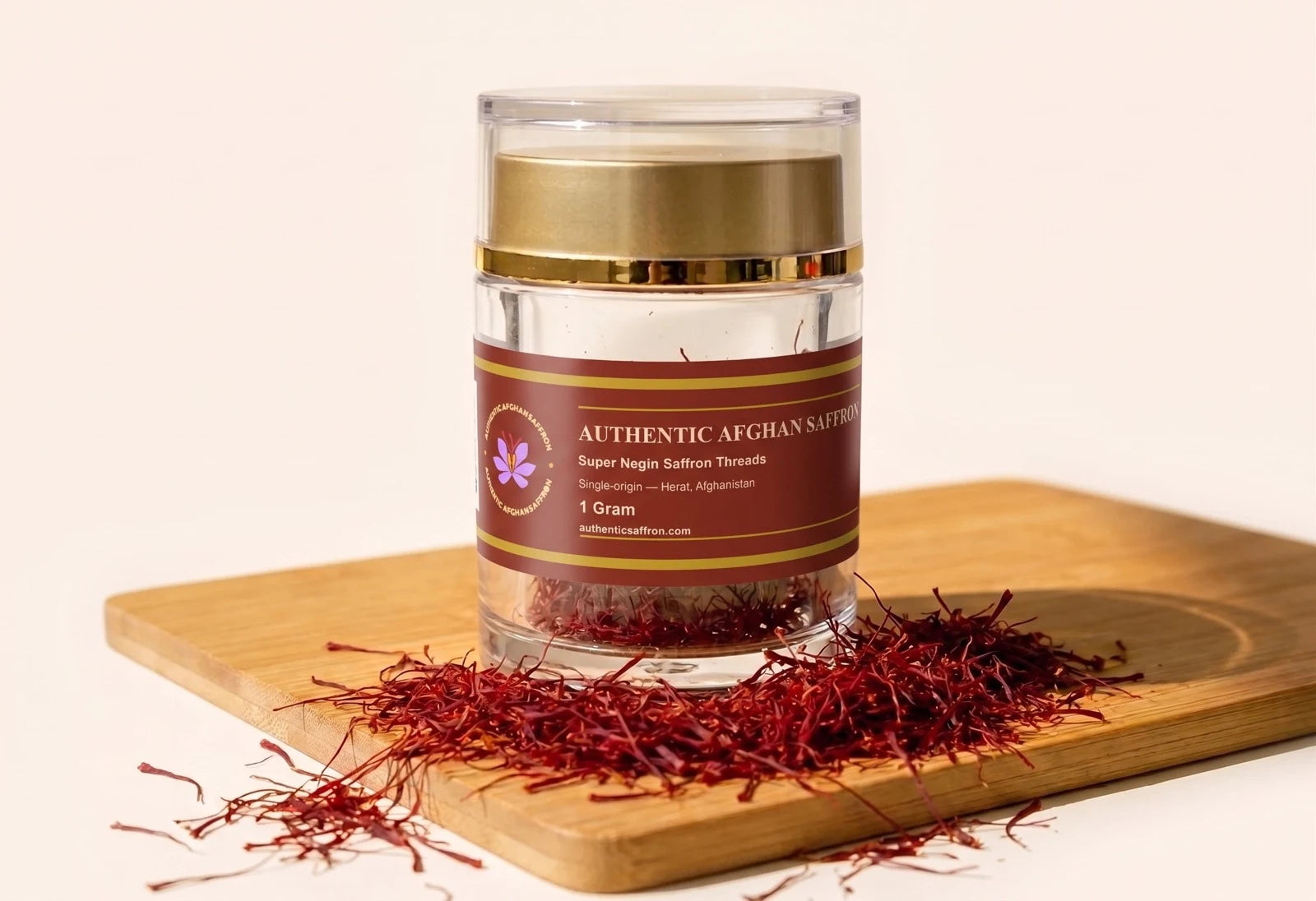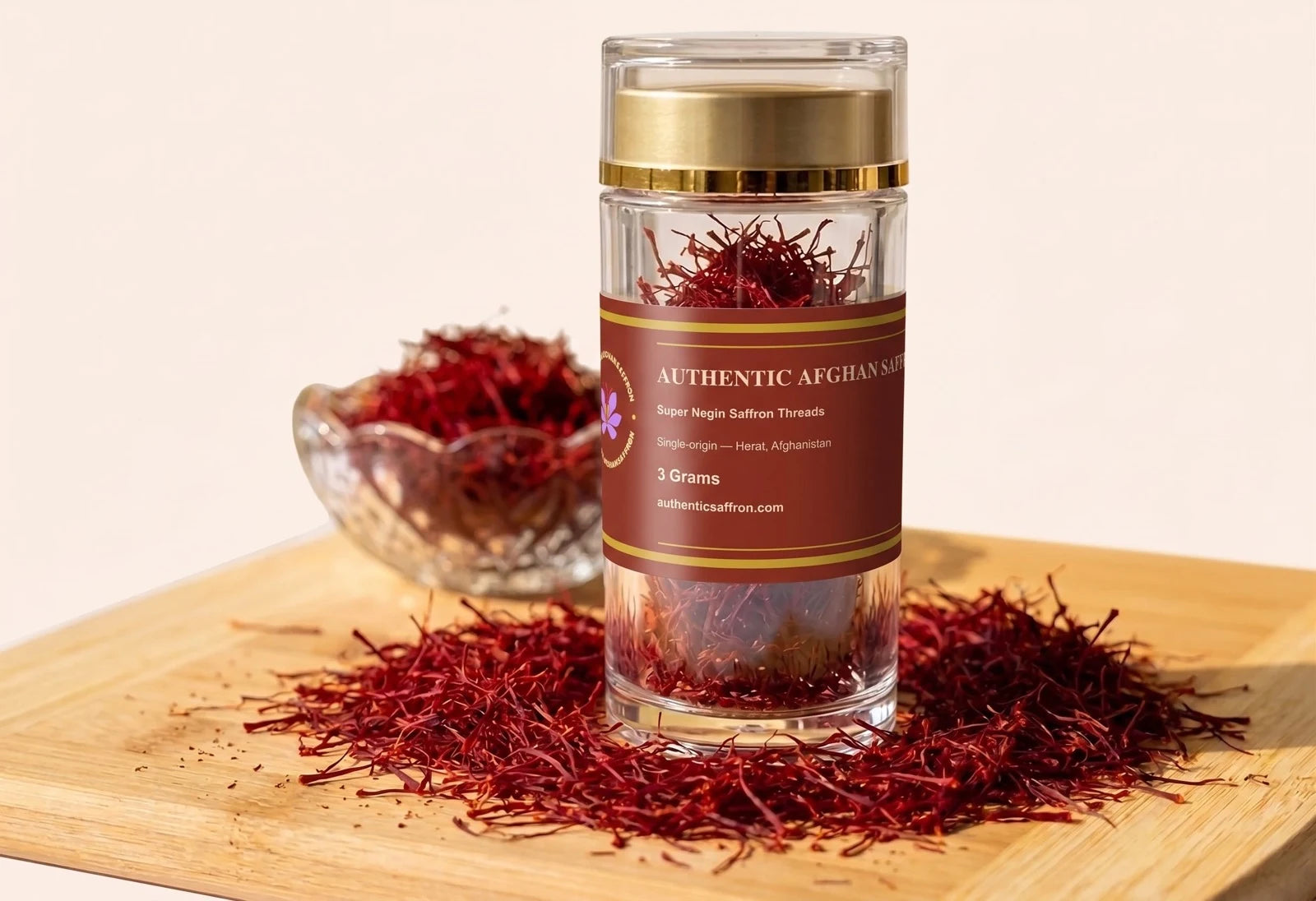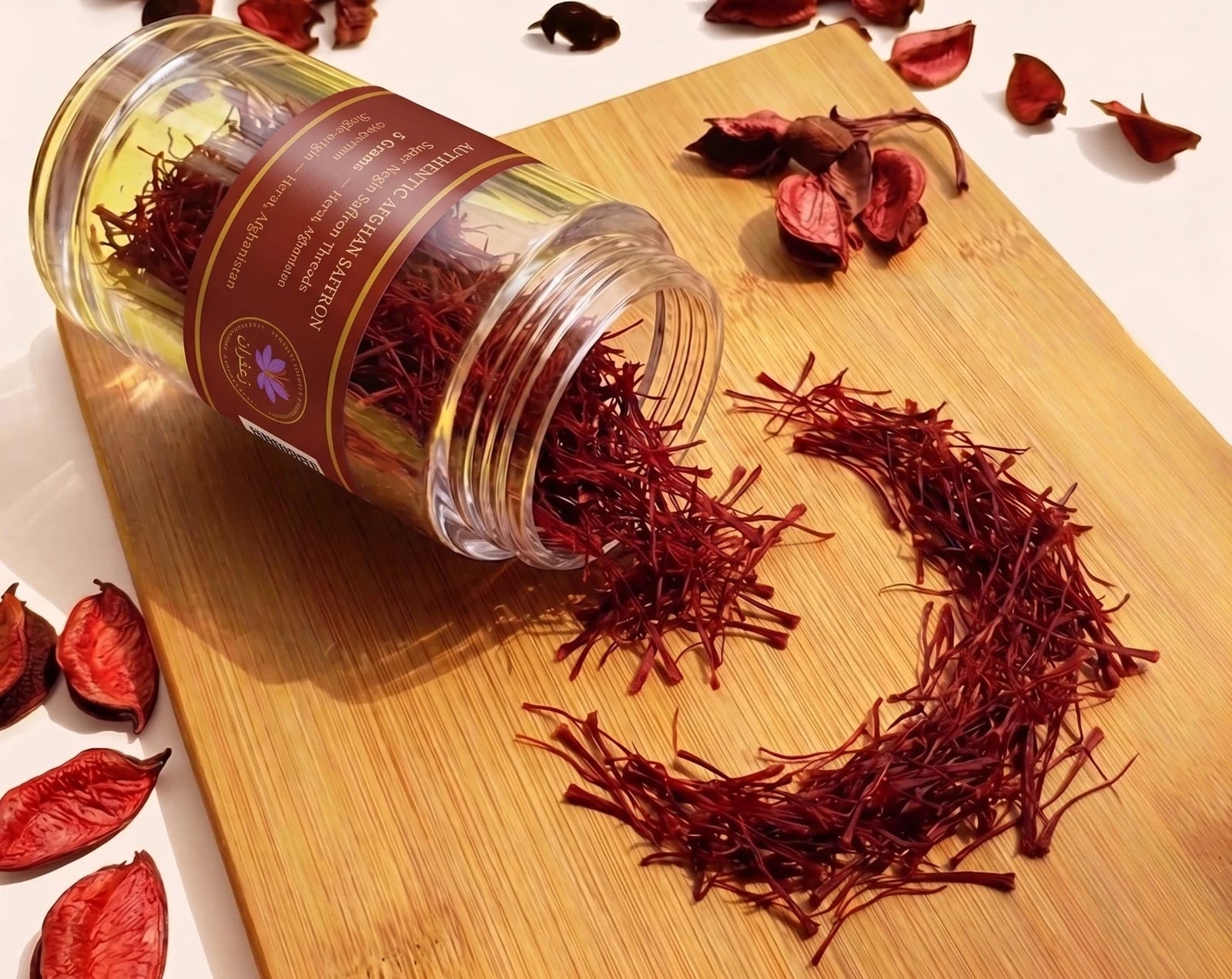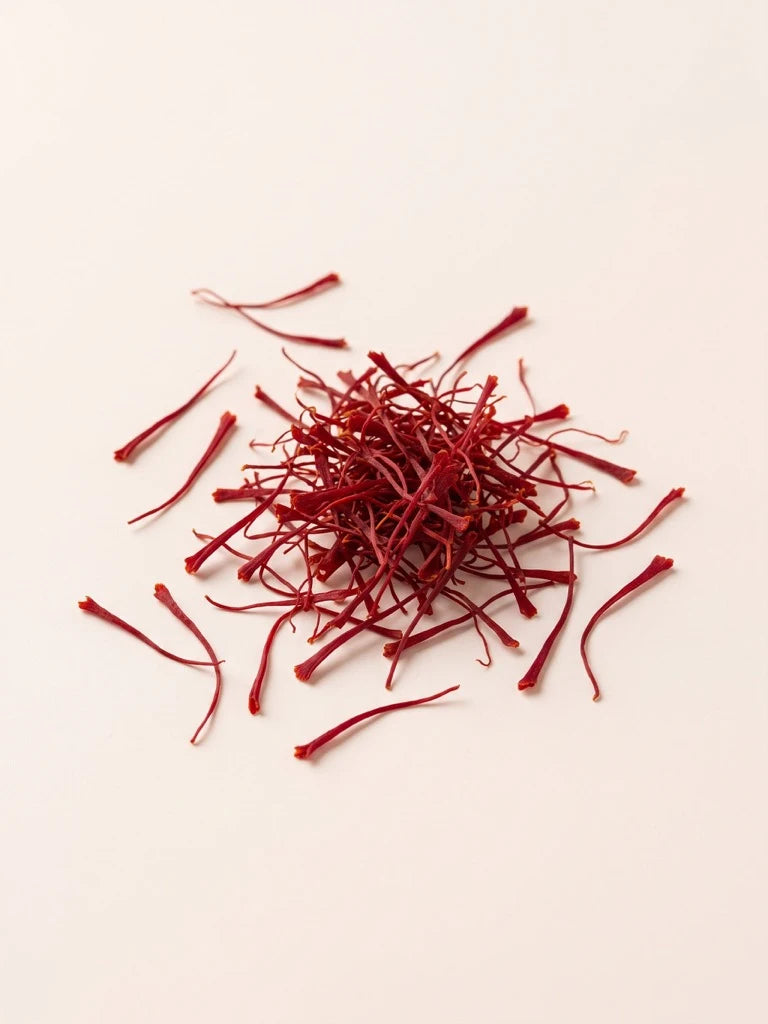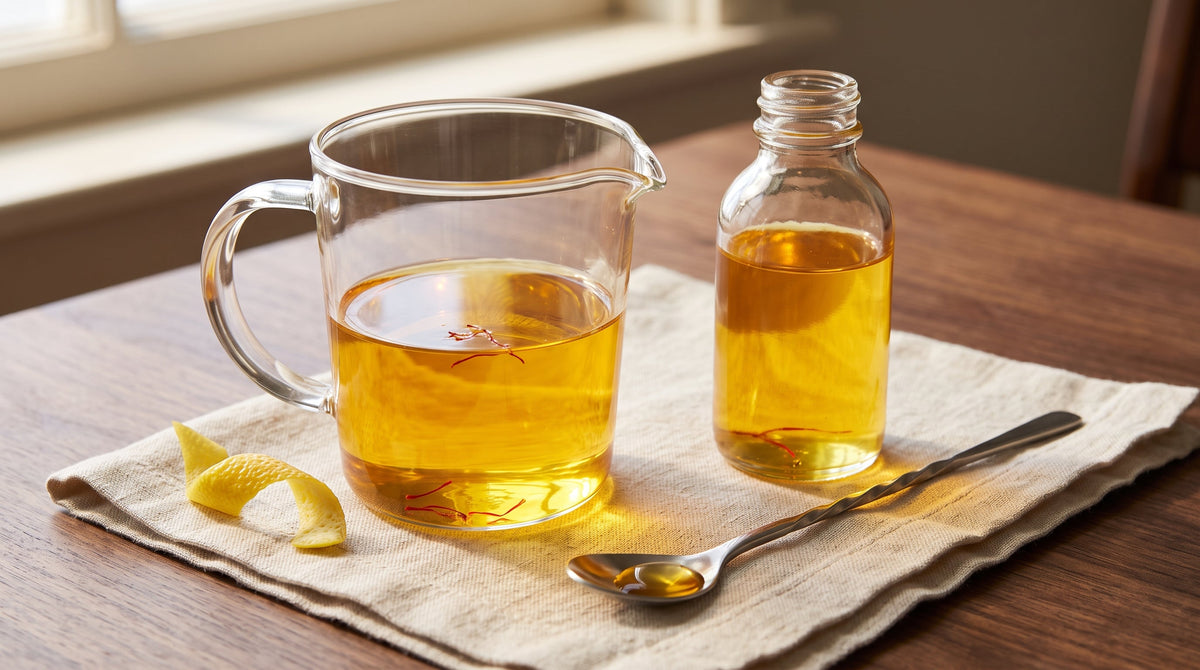
A saffron syrup is one cup of sugar dissolved in one cup of water, cooled to about 150°F, then steeped with 20 threads — 0.08 g — for 20 minutes. That yields roughly 1 1/3 cups. Bottle it, keep it cold, and use it within three weeks in drinks, sorbets and poaching liquid.
Why cool the syrup before the saffron goes in?
Because sugar syrup runs hotter than water. Plain water tops out at 212°F; a one-to-one syrup keeps climbing past that as it reduces, and even a gentle simmer sits near 215°F. Saffron does not survive that well. The colour compounds are sturdy, but safranal — the thing that makes a kitchen smell like saffron — boils off, and you are left with an orange liquid that tastes mostly of sugar.
So the syrup is made first and the saffron goes in afterwards, into liquid that has fallen back to blooming temperature. The syrup is doing double duty: it is both the sugar base and the blooming medium. That is convenient, but it also means the steep takes longer than usual. Syrup is viscous and much of its water is already committed to holding sugar, so extraction is slower. Twenty minutes, not ten.
Unlike a lot of saffron in a Western pantry, this one has real precedent. Sharbat — a sweet concentrate diluted with cold water and poured over ice — is standard summer drinking across Afghanistan and South Asia, and saffron and rose are two of its oldest flavourings. A jar of this in the fridge is a shortcut to that, and to a great deal else.
How much saffron does a cup of syrup need?
Twenty threads, roughly 0.08 g, per cup of water. That gives a syrup you can taste at a tablespoon per glass. Thirty threads is the right dose if the syrup is destined for cocktails, where citrus and spirit bury delicate things; above about forty the bitterness comes forward and stops being pleasant in something this sweet.
The blooming rule is unchanged even though the liquid is sweet: hold it near 150°F (65°C) — steaming, no bubbles — for 20 minutes with a lid on. A pan pulled off the heat will drop through that window on its own in six or seven minutes, and a cheap probe thermometer removes the guesswork. Never crumble threads into syrup that is still bubbling.
One variation to note. If you want a rich two-to-one syrup for longer keeping, bloom the threads in the plain water first, then stir the sugar in afterwards. At that concentration there is barely enough free water left to extract anything, and threads dropped into finished rich syrup will sit there looking decorative. Our comparison of blooming liquids covers why water beats milk, alcohol and oil for speed. For what makes a thread worth steeping in the first place, see why we buy from Herat.
What goes into it?
Plain white granulated sugar. Unrefined or golden sugars carry their own caramel and molasses notes, and in a syrup this lightly flavoured they win.
- About 20 saffron threads (0.08 g), or 30 for cocktail syrup
- 200 g (1 cup) granulated white sugar
- 240 ml (1 cup) water
- 1/2 tsp lemon juice
- 1 tiny pinch of fine salt
- 1 wide strip of lemon peel, no white pith, optional
How do you make and bottle it?
- Dissolve the sugar without boiling. Put the sugar and water in a small saucepan, about one quart, over medium heat. Stir until the liquid turns from cloudy to glass-clear, roughly three minutes. There is no reason to boil it; boiling only evaporates water and changes the ratio you measured.
- Wash down the pan walls. Dip a pastry brush in water and wipe the inside of the pan above the syrup line. Stray sugar crystals up there are what seed a crust later on the neck of the bottle.
- Let it fall to 150°F. Take the pan off the heat and leave it six or seven minutes. In a light metal pan that lands close to 150°F (65°C). The surface should steam without a single bubble breaking.
- Steep the saffron for 20 minutes. Crumble the threads across the surface, add the lemon peel if you are using it, and cover the pan with a lid. Do not stir. Syrup extracts more slowly than water, so give it the full 20 minutes even though it looks finished at five.
- Season it. Stir in the lemon juice and the pinch of salt. The acid does two useful things: it lifts the flavour and it inverts a little of the sucrose, which keeps the syrup from crystallising in the fridge.
- Check the colour. Finished syrup should be a clear marigold gold you can read newsprint through. Cloudiness means it was boiled hard or the pan was not clean, and it will not clear on standing.
- Bottle it warm. Funnel the syrup, threads and all, into a scalded swing-top bottle or jar. Filling while it is still warm helps sterilise the neck and the seal.
- Label and chill. Write the date on the bottle and refrigerate. Strain the threads out after 24 hours if the syrup is going into cocktails, since thread fragments clog a jigger and a fine strainer.
What goes wrong with a saffron syrup?
It is a forgiving recipe with three predictable failure points, none of them to do with the saffron itself.
- A crust of crystals at the neck. Undissolved sugar from the pan wall, or evaporation in a badly sealed bottle. The lemon juice largely prevents it; a swing-top with an intact gasket does the rest.
- Mould after two weeks. A one-to-one syrup is only about 50 per cent sugar, which is not enough to preserve itself indefinitely. It wants the fridge and a clean bottle. A two-to-one rich syrup keeps around two months.
- Colour without smell. Almost always heat. If the syrup came out vividly orange but smells of nothing, the threads went in above 180°F. Nothing recovers that batch.
- Getting lost in the glass. Three quarters of an ounce of syrup in a sour with lemon and gin is a lot of competition. Make the cocktail version stronger rather than pouring more of a weak one.
Freezing is underrated here. Pour the syrup into an ice cube tray, freeze, and bag the cubes: one cube is about a tablespoon, it keeps six months, and it drops straight into a glass of soda water. For everything else about keeping saffron itself in good condition, our guide to storing saffron is the place to start, and the broader dosing rules live on our cooking with saffron page.
Frequently asked questions
Do I have to strain the threads out?
Only if the syrup is going into shaken drinks. Left in, they keep giving up colour for another day or two and they look good in a clear bottle. After about a week they start to soften and shed fragments, which is when a bartender will curse you.
Can I use honey or maple syrup instead of sugar?
You can, but both bring flavours strong enough to argue with saffron, and neither dissolves into a clean pourable syrup at the same ratio. Honey in particular is better infused on its own terms. Agave is the closest neutral substitute if you need one.
Why is mine orange but barely fragrant?
Heat, nearly every time. Crocin holds up to a boil and safranal does not, so an overheated batch looks correct and smells of nothing. Check the temperature before the threads go in rather than after.
How much should go in a drink?
Start at one tablespoon per 8 oz glass for lemonade or iced tea, and three quarters of an ounce in a shaken cocktail. For poaching pears or peaches, dilute one part syrup to two parts water and add a strip of citrus peel.
Read next
- Saffron lemonade — the first thing to do with a full bottle
- Saffron spritz mocktail — the same syrup, longer and drier
- Saffron rose sharbat — the tradition this borrows from