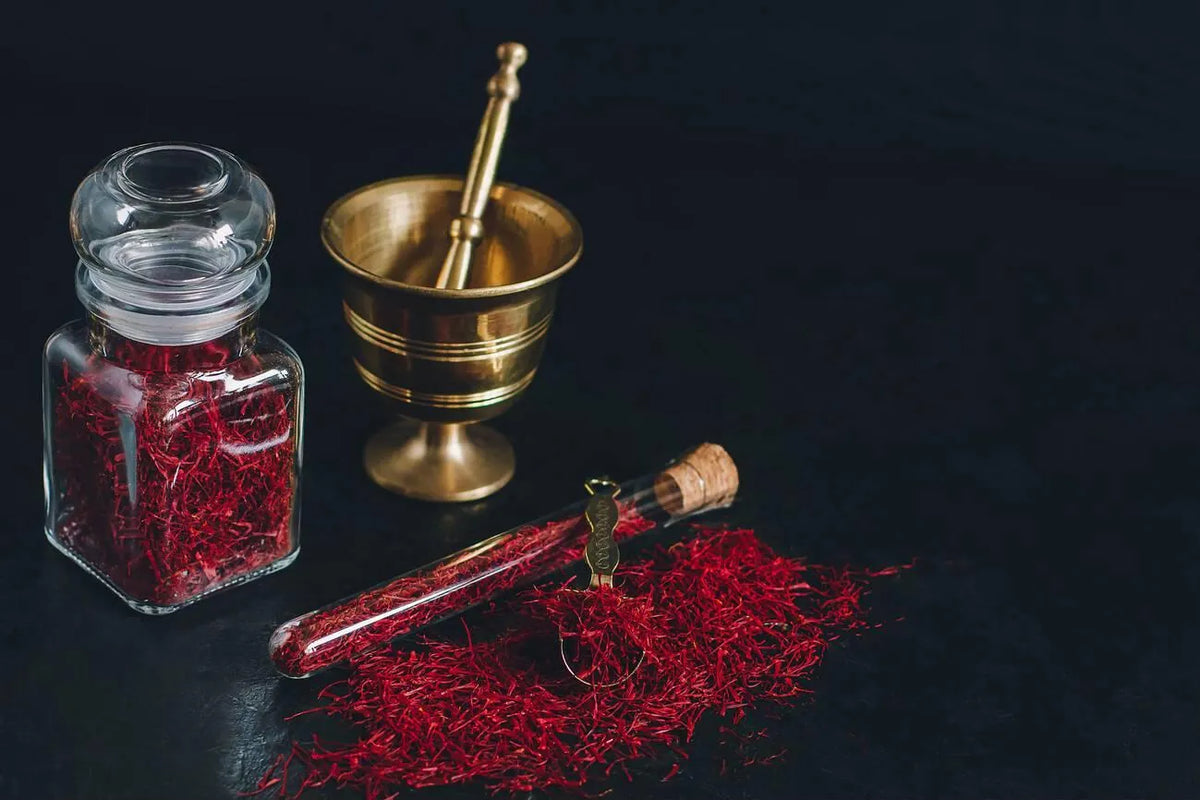
Most saffron sold online as Kashmiri does not come from Kashmir. The growing area is tiny, the crop is small, and the number of listings claiming it is not. Anyone searching “kashmiri saffron fake or real” is really asking an arithmetic question, and the arithmetic is not close.
Why is genuine Kashmiri saffron so scarce?
Saffron in Kashmir grows on a narrow band of raised alluvial terraces called karewas, mostly around Pampore in the valley south-east of Srinagar, with a smaller pocket in the Kishtwar district. That is close to the whole of it. It is not a region with room to expand: the karewas are finite, and a good deal of the historic ground has gone to roads, housing and quarrying over the past few decades.
The area under cultivation has shrunk rather than grown. Yields swing hard with autumn rainfall, and the valley has had a run of dry Octobers. Published figures for annual output vary by source and by year, so we will not quote one. The useful point stands regardless: Kashmir contributes a very small share of world saffron, while Afghanistan, Spain, Greece, Morocco and several other producers account for the great majority between them.
Now hold that next to the marketplace. Search any large platform and you will find hundreds of sellers offering Kashmiri saffron, in every pack size, in stock all year. Those two facts cannot both be true.
Where does the rest of it actually come from?
Usually from a larger producing country, bought in bulk, repacked, and given a Kashmiri name because the name carries a premium. The saffron in the jar is often real saffron. It is simply not from where the label says.
This is worth separating from crude faking. Dyed corn silk and shredded safflower are a different problem, aimed at a different buyer. Origin relabelling is quieter and more profitable, because the product survives every kitchen test a customer is likely to run. It blooms. It smells right. It colours rice. The only thing wrong with it is the story.
The US Food and Drug Administration has a name for this category of substitution — economically motivated adulteration, where an ingredient is swapped or misdescribed for financial gain rather than to poison anyone. You can read the agency’s general food safety and labelling material at fda.gov. Enforcement against origin claims on small imported spice lots is, in practice, thin.
What does genuine Kashmiri saffron look like?
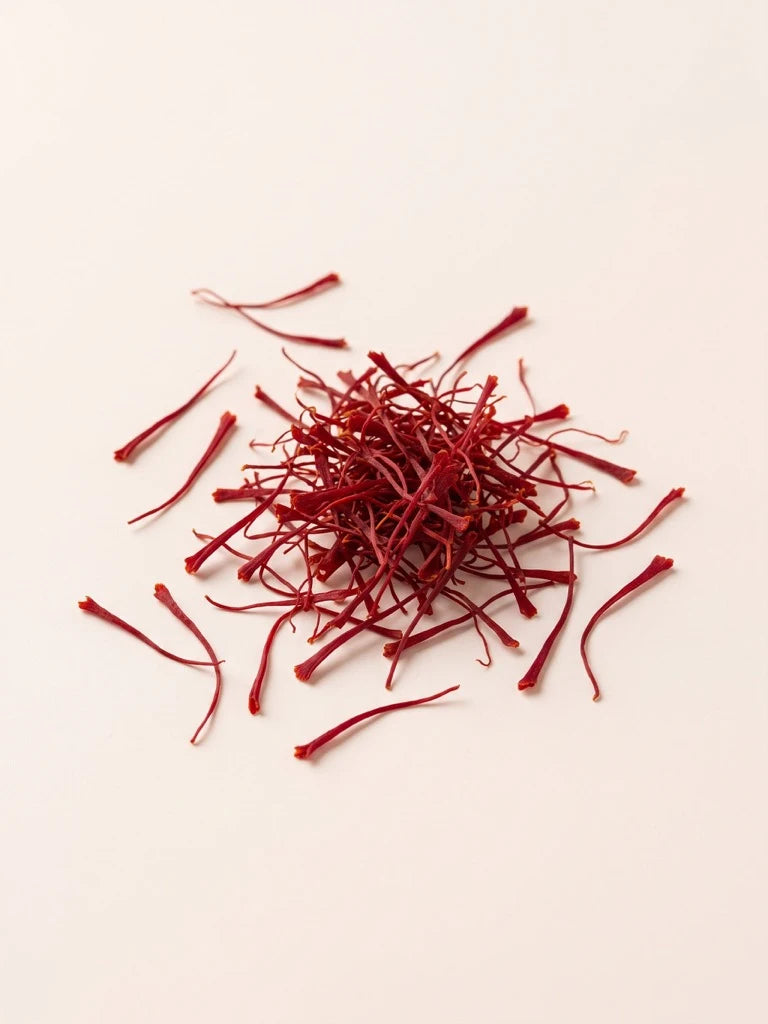
Kashmiri saffron is sold under two trade names that a genuine seller will use correctly. Mongra is the red stigma alone, separated from the pale style. Lachha is the stigma still joined to a length of style, sold as such and priced accordingly. A listing that says “Kashmiri A++ grade” and nothing else is using invented vocabulary.
Kashmir saffron also holds a Geographical Indication registration in India, which means legitimate trade has a paper trail to point at — a lot, a season, a registered packer. Sellers with that trail tend to mention it. Sellers without it tend to talk about softness, aroma and heritage instead.
| Signal | Consistent with genuine Kashmiri | Consistent with relabelled stock |
|---|---|---|
| Place named | Pampore, Kishtwar, or a named grower or cooperative | “Kashmir” alone, or no place beyond the product title |
| Trade terms | Mongra or lachha, used and explained correctly | A++, royal, premium, super grade |
| Price | High, and high all year | At or below the going rate for Afghan or Spanish threads |
| Availability | Limited, seasonal, frequently sold out | Every size in stock, restocked indefinitely |
| Paperwork | Lot number, harvest year, GI or packer reference | A certificate image with no lab name, date or lot |
| Photography | The actual lot, flaws included | The same stock image used across a dozen sellers |
Which listing signals should make you pause?
None of these prove anything on its own. Together they change the odds a great deal.
- Unlimited depth. A crop this small cannot supply a seller who never runs out.
- A price that undercuts larger producers. Scarce goods do not sell below abundant ones. If Kashmiri costs less than Afghan on the same page, one of the two labels is wrong.
- Grade language borrowed from elsewhere. A++ is not a saffron grade anywhere. Neither is “royal”. Read our note on grade claims made without certificates for why these words persist.
- Threads that are unusually long and perfectly even. Real stigmas vary. Read what all-red saffron actually means before you treat uniformity as a virtue.
- Origin as the only claim. When a seller can tell you nothing about the lot except where it supposedly grew, the origin is doing all the work.
If you want the physical checks that catch the cruder fakes, they are collected on our guide to spotting fake saffron. Bear in mind that those checks test whether it is saffron, not whether it is Kashmiri. Nothing you can do in a kitchen will tell you a stigma’s postcode.
Is Kashmiri saffron better than saffron from anywhere else?
Not inherently, and this is the part the marketing skips. Kashmiri saffron at its best is excellent: deep colour, a heavy floral aroma, threads with real body. So is the best Afghan Super Negin, and so is good La Mancha. Origin sets a plausible range. Harvest timing, how quickly the stigmas were separated, how gently they were dried and how they were stored decide where in that range a given lot lands.
A carelessly dried Kashmiri lot will lose to a carefully dried Afghan one every time. We set out the honest differences between the three most-compared origins on our Afghan, Spanish and Kashmiri comparison, and the wider question of what origin does and does not guarantee on our origin page.
So the answer to a Kashmiri listing is not to hunt for a better Kashmiri listing. It is to stop buying on origin words and start buying on evidence: a named lot, a harvest year, a seller who will tell you what the yellow style content is, and a measured colour figure when one exists.
Frequently asked questions
Is all Kashmiri saffron sold online fake?
No. Genuine Kashmiri saffron is sold online, including by growers and cooperatives in the valley. It is simply outnumbered many times over by listings that use the name without the origin. Treat the label as a claim to be supported, not as a description.
Does relabelled saffron mean I am getting bad saffron?
Not necessarily. Origin relabelling often involves perfectly good saffron from a large producer. What you lose is the money, because you paid a scarcity premium for something abundant, and you lose the ability to trust anything else that seller told you.
Can I test at home whether saffron is from Kashmir?
No. Water tests, crush tests and aroma tests distinguish saffron from imitations. None of them identify a growing region. Origin can only be supported by documentation, and in laboratory work by trace element or isotope analysis, which is expensive and rare in retail.
What is the difference between mongra and lachha?
Mongra is the red stigma separated from the pale style. Lachha is the stigma left attached to a length of style. Mongra carries more colour per gram and costs more. A seller who uses these terms correctly is at least trading in the right vocabulary.