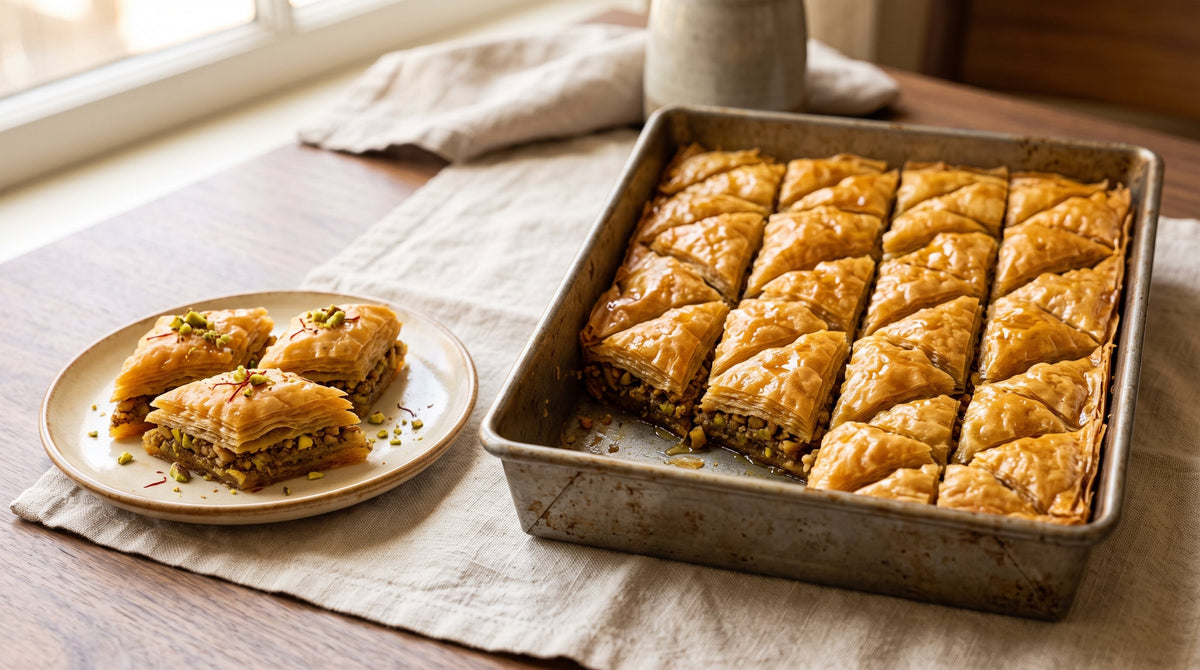
Saffron belongs in the syrup, not the nut filling. Thirty threads — about 0.12 g — bloomed in warm water and stirred into a cooled lemon syrup will perfume a 9 x 13 pan of saffron baklava without ever fighting the pistachios. Pour that syrup cold over the pastry the moment it leaves the oven.
Why does the saffron go in the syrup?
Baklava is a lot of dry heat. Seventy-five minutes at 325°F drives moisture out of forty sheets of phyllo, which is what makes it crisp and is also the environment that flattens saffron. Safranal, the compound behind the aroma, is volatile. Put threads in the nut layer and most of what you paid for leaves through the oven vent.
The syrup sidesteps that. It is boiled before the saffron goes near it, cooled, then never heated again, so the threads steep at room temperature. And because syrup runs down every scored line, one small dose reaches the whole tray.
Worth being straight about heritage: saffron baklava is not the classic. Turkish, Greek and Levantine versions lean on lemon, honey and sometimes rosewater. Saffron in layered nut pastry turns up further east, in Gulf and Central Asian sweets. This is a variation, not a restoration.
How much saffron does this need?
Thirty threads, roughly 0.12 g, for a pan that cuts into twenty-four diamonds — a little over one thread per piece. It sounds like nothing, but in a dish this sweet the ceiling is lower than you would guess. Somewhere around 45 threads the floral note curdles into something bitter and vaguely pharmaceutical.
Bloom them in 2 tablespoons of water held at about 150°F (65°C) for 20 minutes, covered — water that steams when you look at it and shows no bubbles. A mug of just-boiled water left to stand four minutes is close enough without a thermometer. Never pour boiling water straight onto threads: you get strong orange colour and a duller smell.
Add the bloomed liquid and threads to the syrup only once it has cooled to room temperature. The threads settle over a few hours and end up in the bottom layer of pastry. If you want colour spread evenly with nothing visible, crush the wet threads against the cup with a spoon first — our note on grinding saffron properly explains why a pinch of sugar helps.
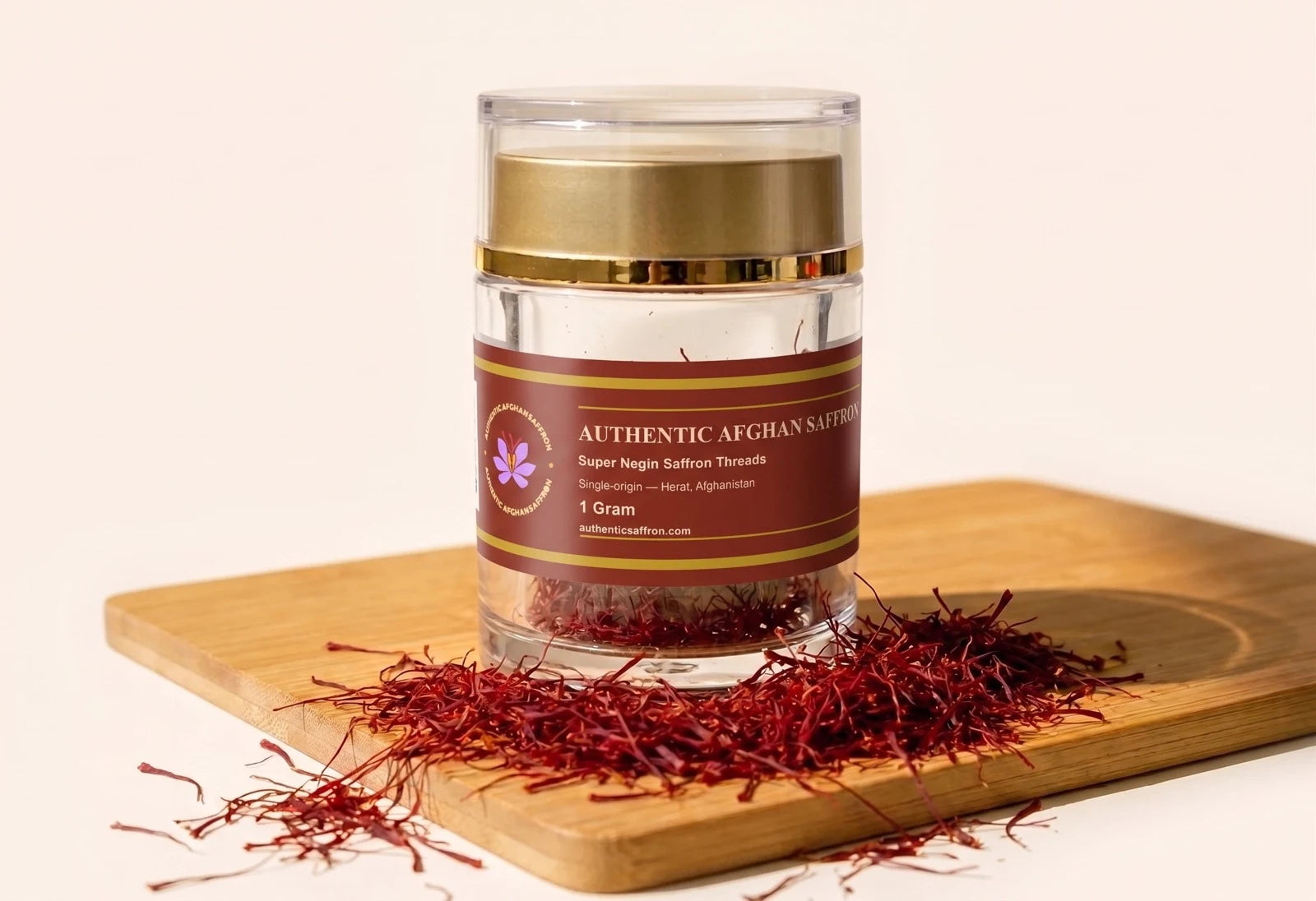
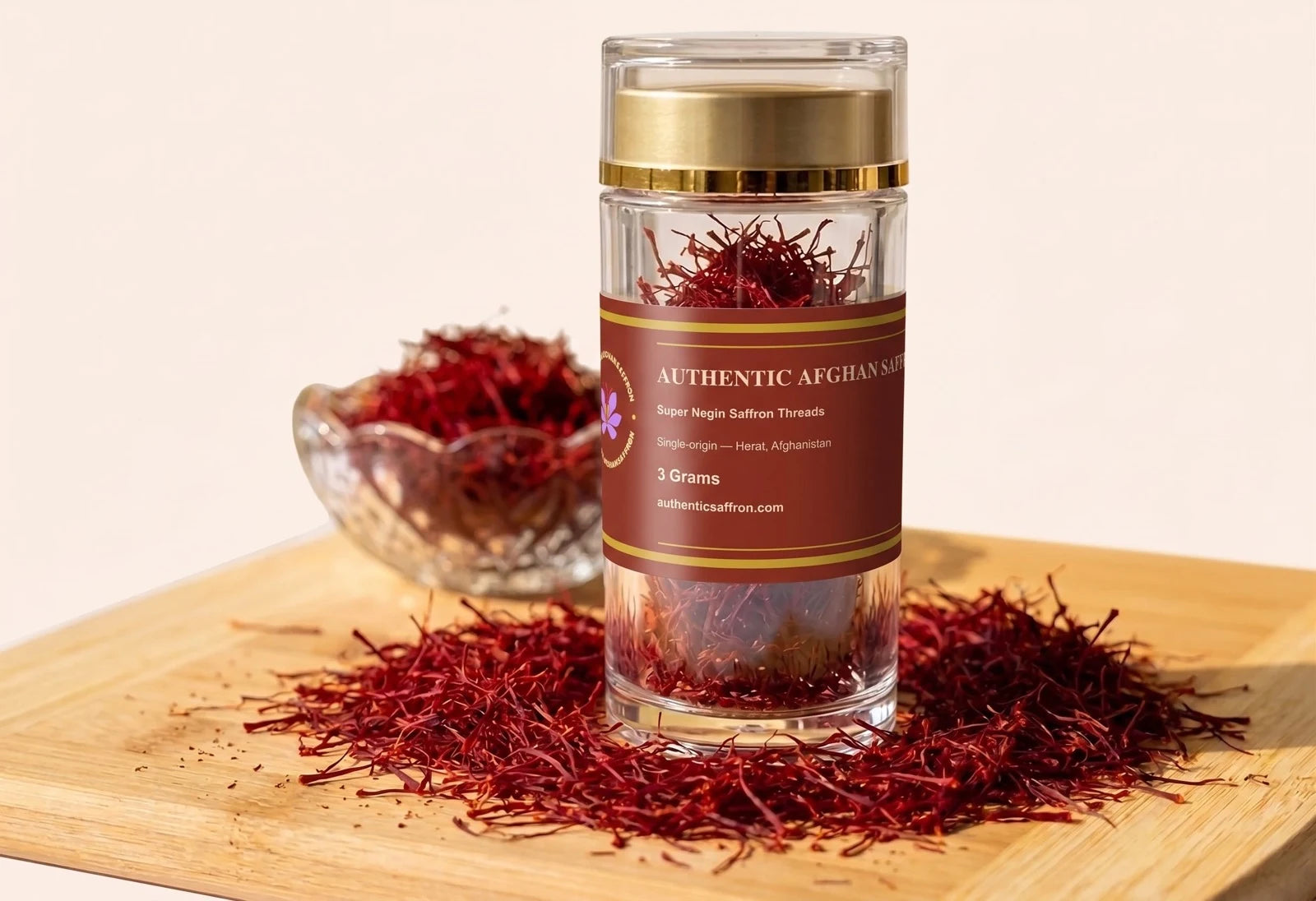
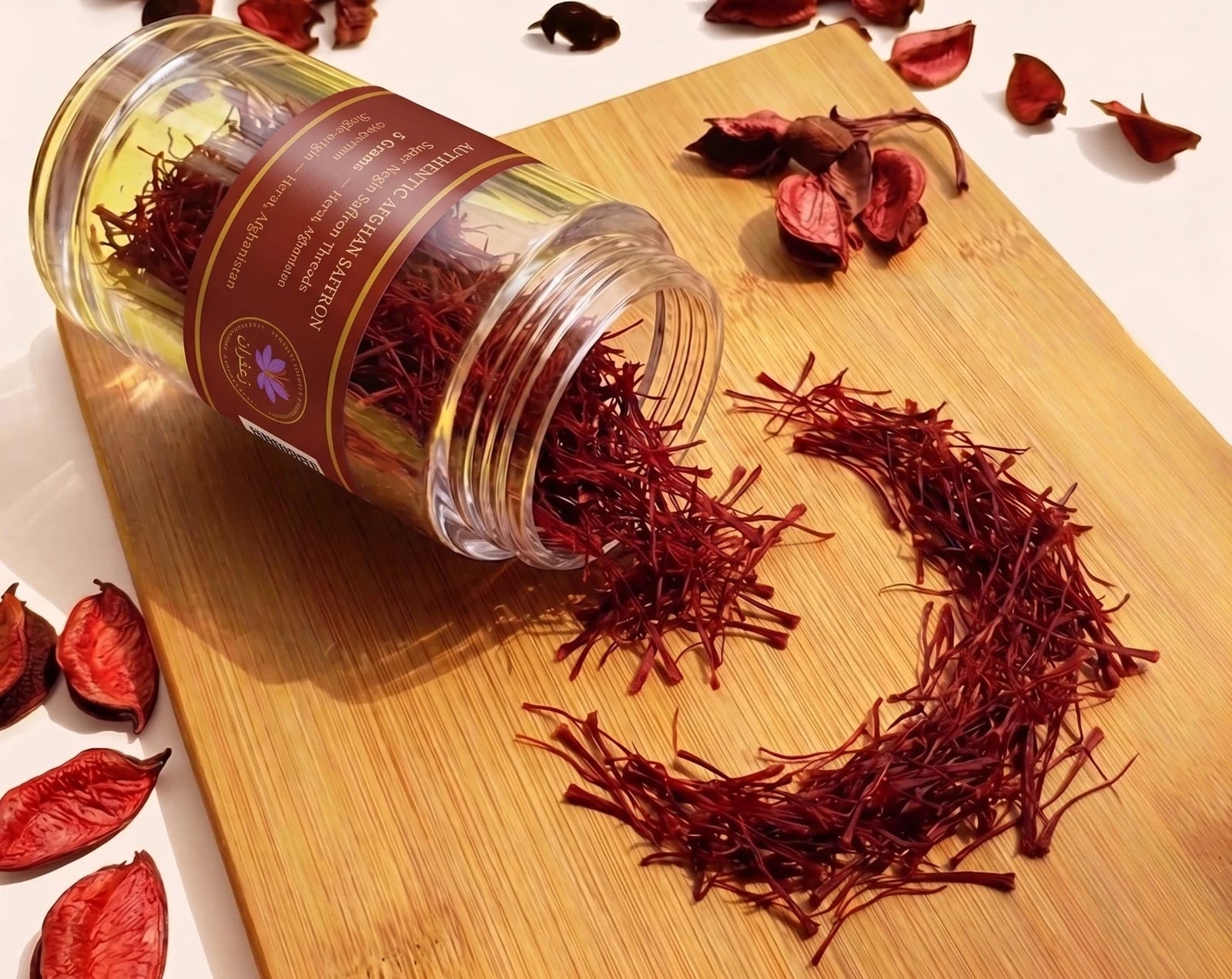
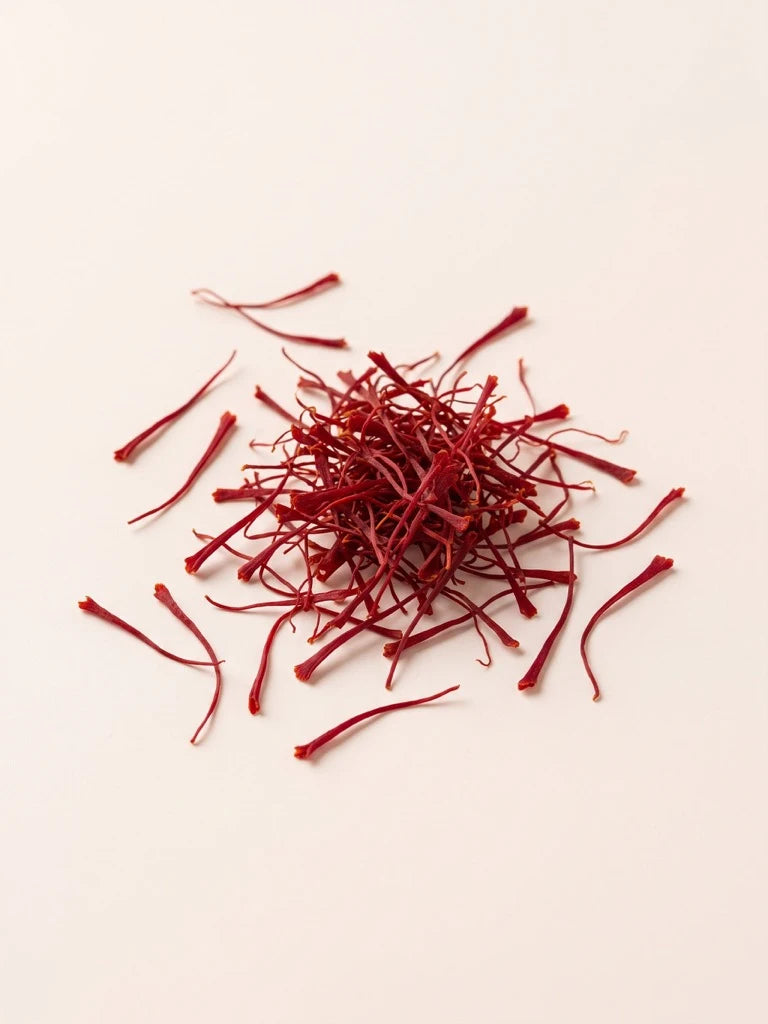
Use long all-red threads here, because you can see them suspended in clear syrup and judge what you bought. Super Negin grades are cut free of the pale style, so nothing floating in the cup is inert filler.
What will you need on hand?
For one 9 x 13 inch pan, twenty-four pieces. Buy phyllo in the 9 x 14 inch sheet size if you can find it; 14 x 18 sheets need folding, which builds a thick seam down one side.
For the saffron syrup
- About 30 saffron threads (0.12 g)
- 2 tbsp (30 ml) water, for blooming
- 400 g (2 cups) granulated sugar
- 240 ml (1 cup) water
- 120 g (1/3 cup) honey
- 2 wide strips of lemon peel, no white pith
- 1 tbsp (15 ml) lemon juice
For the pastry and filling
- 300 g (2 1/2 cups) shelled unsalted pistachios
- 150 g (1 1/2 cups) walnut halves
- 50 g (1/4 cup) granulated sugar
- 1 tsp ground cinnamon
- 1/4 tsp fine salt
- 450 g (1 lb) phyllo in 9 x 14 inch sheets, thawed overnight in the fridge
- 285 g (1 1/4 cups) unsalted butter, clarified
How do you assemble and bake it?
- Boil the syrup first. Put the sugar, 1 cup of water, the honey and the lemon peel in a small saucepan. Bring to a boil, then simmer 10 minutes, until a spoon lifted out wears a thin coat rather than beading dry. Off the heat, stir in the lemon juice.
- Bloom the saffron while the syrup cools. Heat the 2 tbsp of water to about 150°F (65°C), steaming with no bubbles breaking. Crumble the threads in, cover the cup, and leave 20 minutes. Boiling water strips the aroma and leaves colour only.
- Finish and chill the syrup. Fish out the lemon peel. Once the syrup has cooled to room temperature, stir in the bloomed water and its threads. Refrigerate until cold, at least two hours. It can sit overnight.
- Clarify the butter. Melt the butter over low heat without stirring, skim the foam, then pour off the clear yellow fat and leave the milky solids in the pan. Those solids scorch between sheets of phyllo long before the pastry is done.
- Chop the nuts coarse. Pulse the pistachios and walnuts with the 50 g of sugar, the cinnamon and the salt in short bursts, until it looks like coarse gravel with a few larger pieces. Keep going and the oils release into a paste that bakes into a dense wet layer.
- Lay the base. Heat the oven to 325°F (160°C) and brush a 9 x 13 inch metal pan with butter. Lay in 10 sheets one at a time, brushing each lightly and letting the edges climb the sides. Keep the unused stack under a barely damp tea towel.
- Build the layers. Scatter a third of the nut mixture over the base. Add 5 more sheets, brushing each, then another third of the nuts, 5 more sheets, and the last of the nuts. Finish with the remaining 10 sheets and brush the top until evenly glossy.
- Score it before it bakes. With a thin sharp knife, cut the tray into diamonds, pressing down to the pan on every line. Baked phyllo shatters if you cut it afterwards, and the syrup needs those channels to reach the bottom.
- Bake for 75 minutes. Bake 1 hour 15 minutes, turning the pan front to back at 45 minutes, until the top is deep even gold and the layers stand apart at the cut edges. Pale baklava has not dried enough and will go soft.
- Pour cold syrup over hot pastry. The moment the tray comes out of the oven, ladle the cold saffron syrup slowly over it, moving across the surface so every cut line fills. It will hiss. Leave it uncovered at room temperature for at least 6 hours, ideally overnight.
What should you watch out for?
Baklava fails in two directions, soggy or pale, and both come down to temperature discipline rather than skill.
- Keep one side cold. Hot pastry, cold syrup — or, if you baked yesterday, cold pastry and hot syrup. Two warm things make a wet tray.
- Thaw phyllo in the fridge overnight. Counter thawing sweats the sheets together and they tear into confetti. Tears in the middle layers are invisible, so save your best sheets for the top and bottom ten.
- Brush, do not paint. Each sheet wants a light film. Too much butter and the layers fuse instead of separating.
- Leave it uncovered while it drinks. Six hours open on the counter. A lid traps steam and undoes the crispness you spent 75 minutes building.
The other trap is dose creep. Sweet, buttery dishes mute aroma, so the instinct is to keep adding threads until you can smell them in the raw syrup. By then the finished baklava will taste bitter. See saffron in sweet versus savoury cooking for where that ceiling sits.
Frequently asked questions
Can you actually taste saffron against honey and nuts?
Yes, but as a background note rather than a headline. It reads as a warm, faintly bitter floral thing under the honey, most obvious in the first bite and in the syrup pooled at the base. If you want it louder, go to 40 threads rather than 60.
Why did the top of my baklava go soft?
Almost always because the syrup and the pastry were close in temperature. Cold syrup on hot pastry is drawn downward and the top stays crisp; warm on warm sits on the surface and steams it. The other common cause is covering the tray while it soaks.
Can I use only walnuts, or only pistachios?
Either works. All walnut is more tannic and crowds the saffron a little. All pistachio is sweeter and greener and lets it through more clearly, so if you are buying saffron for this tray, use pistachios.
How long does it keep?
Four to five days at room temperature, loosely tented with foil once it has finished soaking. Do not refrigerate it: the butter firms, the phyllo turns leathery and the syrup weeps. An unsyruped baked tray freezes fine for a month.
Read next
- Saffron simple syrup — the same logic, kept in a jar
- Saffron halwa — saffron as the main event
- Cooking with saffron — blooming and dosing rules