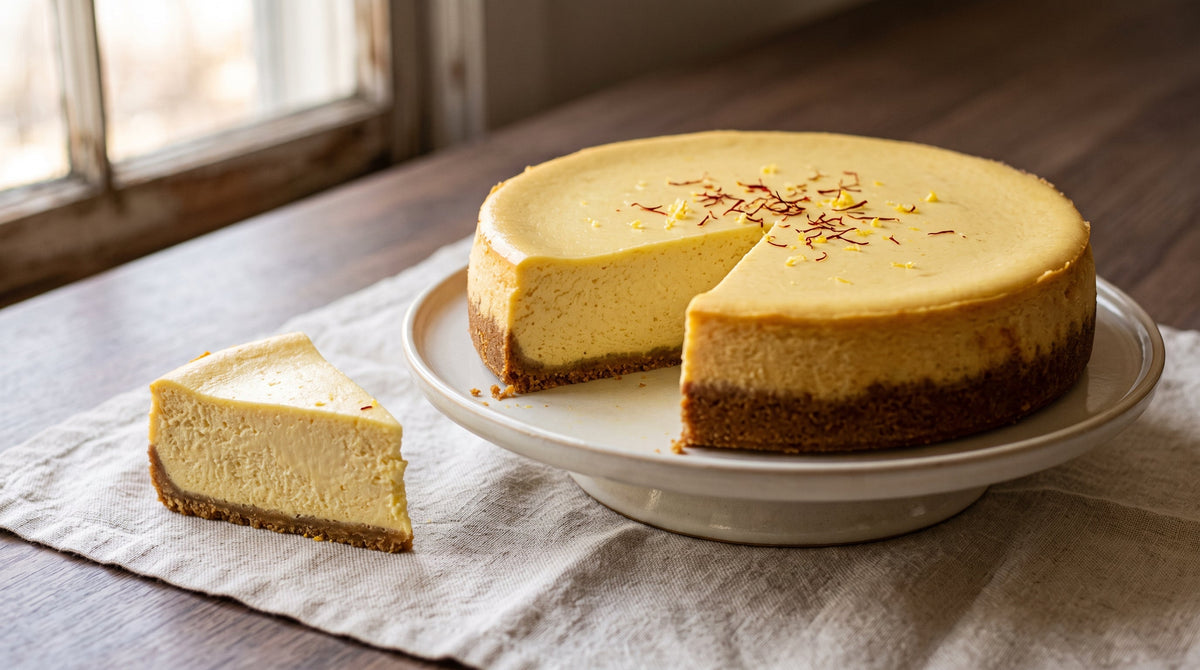
Saffron cheesecake is not a traditional dish anywhere. What saffron does here is cut the flatness of baked cream cheese: 30 threads, about 0.12 g, bloomed in warm cream, give the batter a honeyed edge and a pale gold colour. Bake it low in a water bath and chill it overnight.
The recipe below is a plain baked cheesecake with one change. The low oven, the wrapped pan and the slow cool all exist to stop it cracking, and none of that is saffron’s doing.
Why does saffron work in cheesecake?
Cream cheese is sour, fatty and slightly one-dimensional. Most recipes reach for vanilla and lemon zest, which add brightness at the top of the flavour. Saffron works lower down, adding a warm, faintly bitter, honeyed depth the dairy has nothing of its own to offer.
There is a practical reason it holds up. Saffron aroma is fat-soluble and a cheesecake is roughly forty per cent fat, so blooming the threads in cream puts the flavour where it will stay.
No heritage claim attaches to this. Baked cheesecake is a European and American dish, and saffron is a late addition made by cooks who liked the pairing. Worth saying, because a recipe that invents a tradition is usually inventing other things too.
How much saffron goes in, and how do you bloom it?
Thirty threads, or roughly 0.12 g weighed, for a 9-inch cheesecake that cuts into twelve. Across nine hundred grams of cream cheese that sounds thin, and it is deliberately close to the floor. Past forty threads the bitterness competes with the sourness of the cheese instead of balancing it.
Bloom them in 3 tablespoons of heavy cream held at about 150°F (65°C) for twenty minutes, covered. In practice that is thirty seconds in a small pan over low heat, then off — steam and a faint film, not a simmer. Boiling cream takes the aroma with it and leaves colour behind.
Let the bloomed cream return to room temperature before it meets the batter; warm liquid hitting cold cream cheese makes lumps that never go. For why cream beats water or milk here, we compared the common blooming liquids side by side.
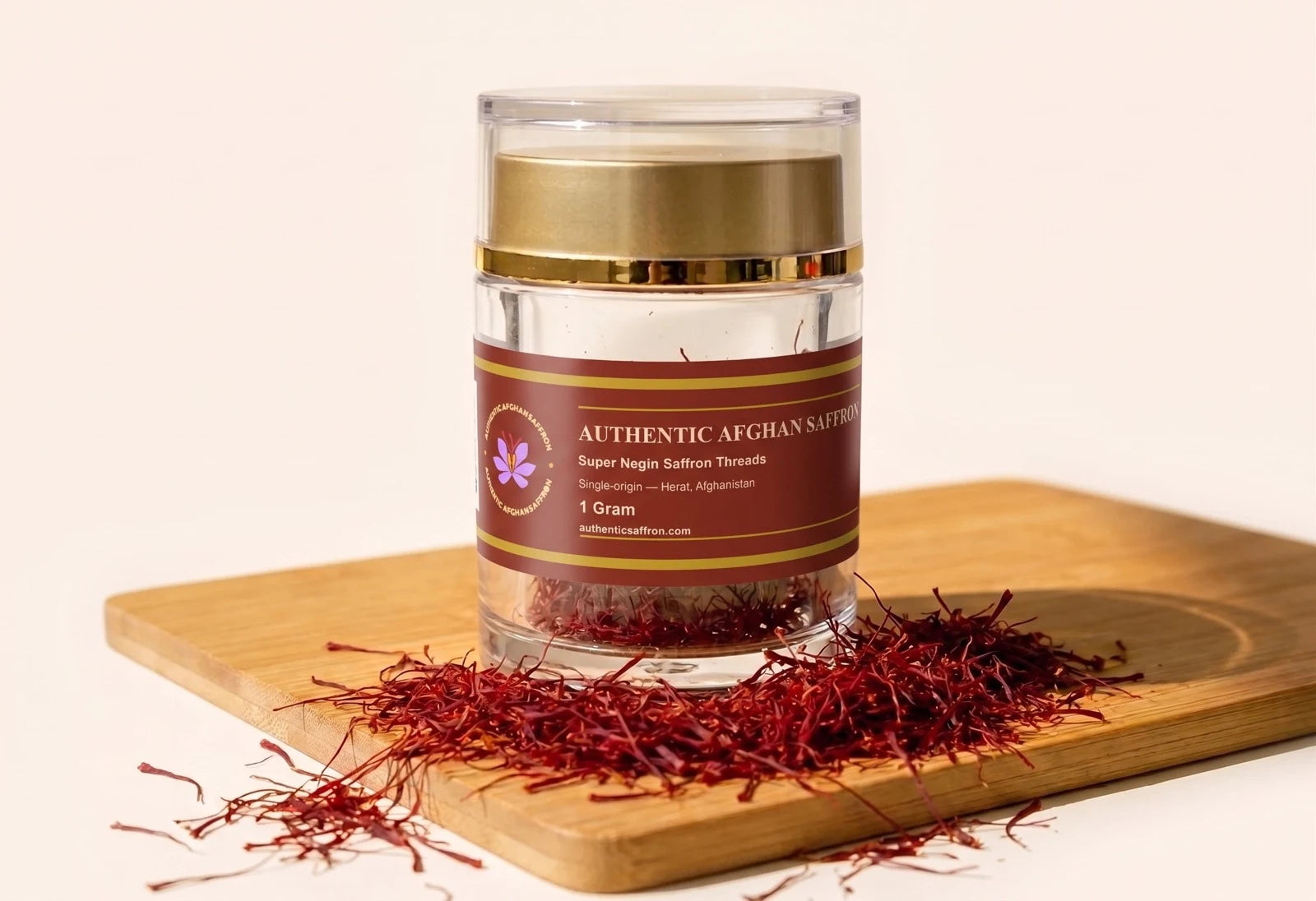
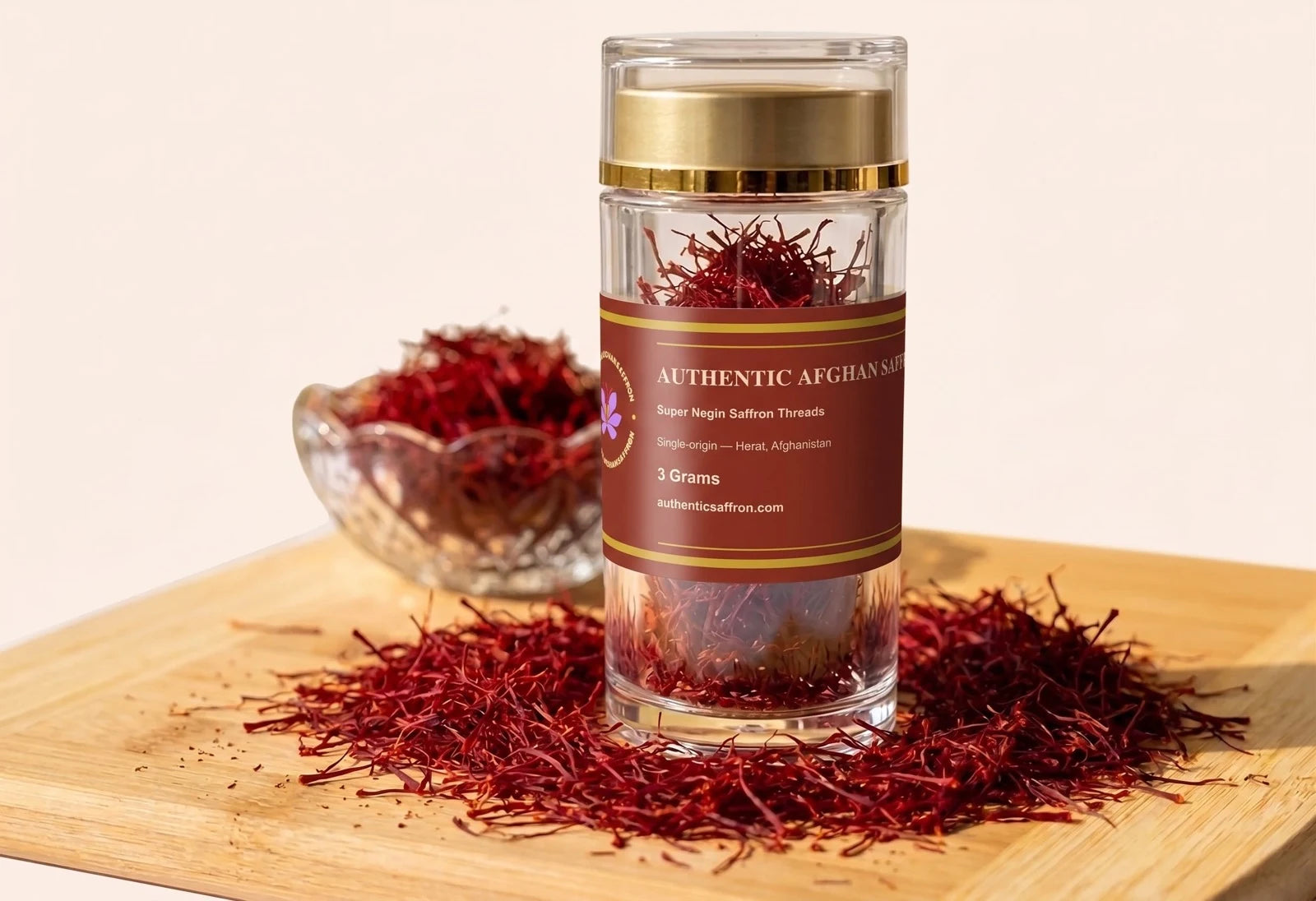
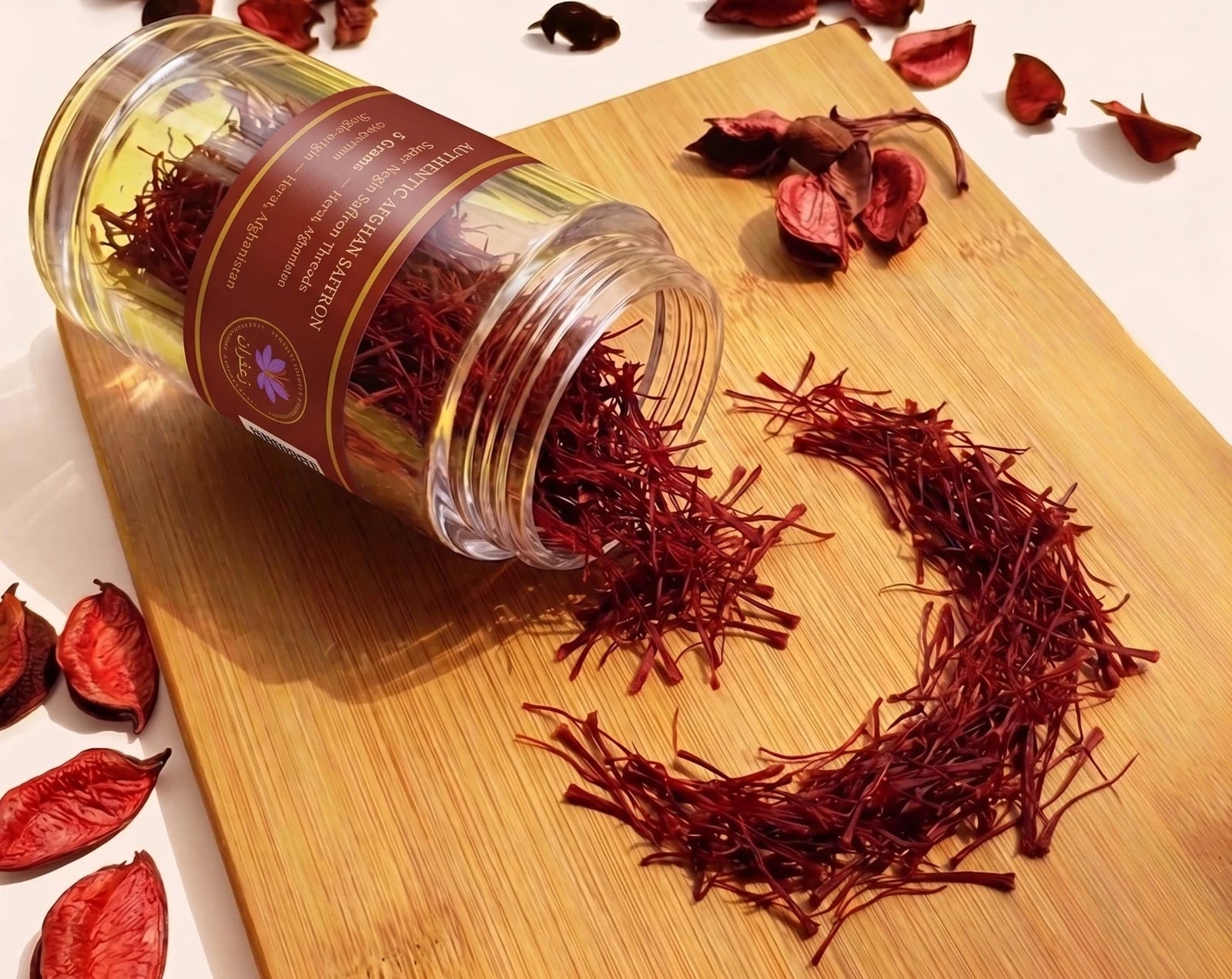
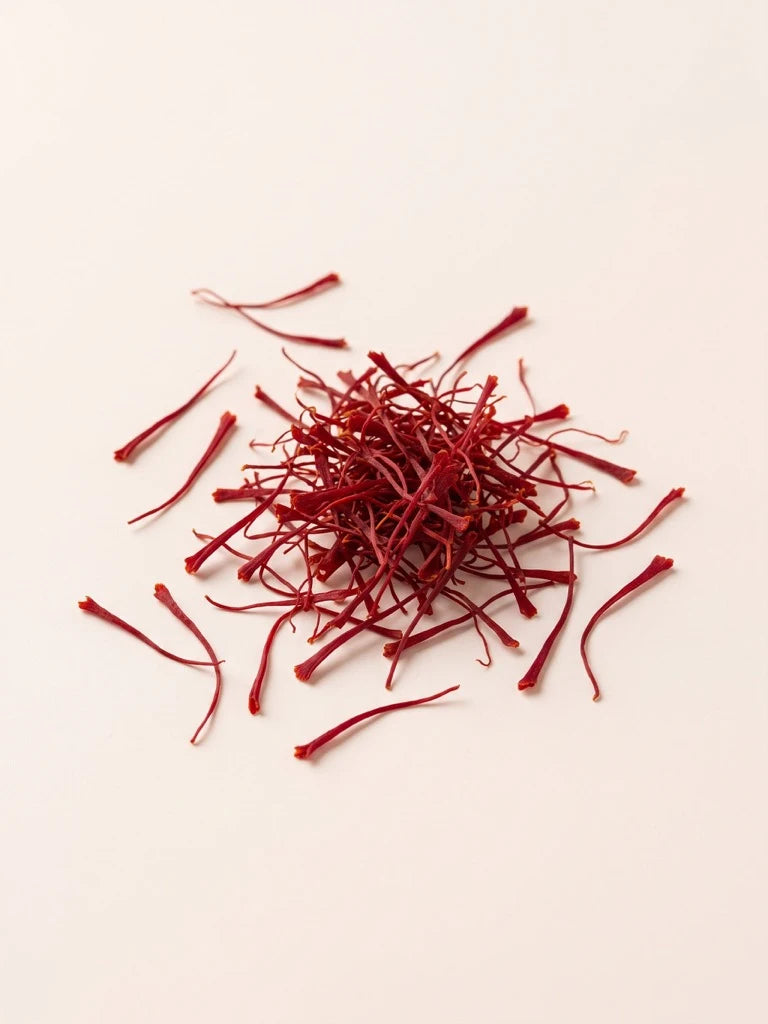
Use whole threads and pour them in with the cream. In a batter this pale they stay visible in the slice, which is a useful check on what you bought. Super Negin threads are all-red and long, so they read as deliberate rather than as debris.
What is in it?
For a 9-inch springform, twelve slices. Every dairy item has to be at room temperature before you start, which takes about two hours out of the fridge.
For the crust
- 200 g (about 14 whole graham crackers or 14 digestive biscuits), finely crushed
- 85 g (6 tbsp) unsalted butter, melted
- 25 g (2 tbsp) granulated sugar
- Pinch of fine salt
For the filling
- About 30 saffron threads (0.12 g)
- 3 tbsp (45 ml) heavy cream
- 900 g (2 lb, four 8 oz blocks) full-fat cream cheese, at room temperature
- 200 g (1 cup) granulated sugar
- 2 tbsp (16 g) cornstarch
- 1/4 tsp fine salt
- 4 large eggs, at room temperature
- 120 g (1/2 cup) sour cream
- 1 tsp vanilla extract
- Finely grated zest of half a lemon
How do you bake it?
- Bloom the saffron first. Warm the cream in the smallest pan you own until it steams, about 150°F (65°C), then take it off the heat. Crumble in the threads, cover, and leave for 20 minutes. Do not let it boil. Set it aside to cool to room temperature while you do everything else.
- Bake the crust. Heat the oven to 350°F (175°C). Mix the crumbs, sugar, salt and melted butter, tip into the springform, and press flat and firm with the base of a glass, taking it about half an inch up the sides. Bake 10 minutes and cool.
- Wrap the pan. Wrap the outside of the springform in two layers of heavy-duty foil, taken all the way up the sides in one piece each. A single layer leaks. Drop the oven to 325°F (160°C) and put a kettle on.
- Beat the cheese, gently. With a paddle attachment on low speed, beat the cream cheese with the sugar, cornstarch and salt for about two minutes, scraping the bowl twice, until there is not a single lump. Keep the speed low throughout. Air beaten in now is what cracks the top later.
- Add the eggs one at a time. Still on the lowest speed, add the eggs one by one, mixing only until each disappears. Then add the sour cream, vanilla, lemon zest and the saffron cream with its threads. The batter should be the colour of thin custard and pour like heavy paint.
- Bake in a water bath. Pour the batter over the cooled crust and smooth the top. Set the pan inside a roasting tray, slide it into the oven, and pour boiling water into the tray until it reaches halfway up the springform. Bake 60 to 75 minutes.
- Judge it by the wobble. It is done when the outer two inches are set and a circle about three inches across in the centre sways as one piece when you nudge the tray. If it ripples like liquid it needs longer; if nothing moves at all it has gone too far.
- Cool it slowly, then chill. Turn the oven off, prop the door open with a wooden spoon, and leave the cheesecake inside for an hour. Then lift it out of the water, take off the foil, and cool on the counter for another hour. Refrigerate uncovered for at least 8 hours, ideally overnight.
- Slice. Run a thin knife around the inside of the ring before releasing it. Cut with a long knife dipped in hot water and wiped dry between every slice.
What makes cheesecakes crack?
A crack is rarely the oven being too hot on its own. It is air in the batter, and the surface setting faster than the middle.
- Beat on low, always. A stand mixer on medium whips in enough air to lift the cheesecake like a soufflé and then drop it. The paddle on its slowest setting is the trick.
- Room temperature really means it. Cold cream cheese needs beating to smooth out, and beating is what you are trying to avoid. Two hours on the counter solves it.
- Do not open the oven before 55 minutes. A draught sets the top and leaves the middle to rise underneath it.
- Cool in stages. Straight from a 325°F oven into a cold kitchen is the most common cause of a split down the centre.
On the saffron side the mistake is over-dosing. Cheesecake is mild and served cold, and cold mutes aroma further, so there is a temptation to keep adding. Saffron turns medicinal well before it turns strong, and you cannot take it back out; saffron in sweet dishes covers where the ceiling sits. If a crack appears anyway, cover it with whipped cream and nobody will know.
Frequently asked questions
Can I skip the water bath?
You can bake it at 300°F without one for roughly the same time, and it will taste identical, but the odds of a crack and a dry outer inch go up sharply. If your foil habitually leaks, put the springform on a rack above a tray of boiling water instead of in it.
Should I strain the saffron threads out of the cream?
No. Left in, they soften completely during baking and show as fine red flecks in the slice. Straining them out costs you aroma, because a good part of it is still held in the thread after twenty minutes of steeping.
Can I actually taste the saffron, or is it just colour?
You can taste it, but not as a separate flavour. It reads as a honeyed, slightly bitter warmth behind the dairy, most obvious in the first second and the aftertaste. If you want it more forward, serve the cheesecake at cool room temperature rather than fridge-cold.
How far ahead can I make it?
Bake it two days before you need it. The texture improves on the second day as the crumb tightens, and the saffron distributes more evenly through the fat. Keep it covered in the fridge and slice it straight from cold.
Read next
- Saffron crème brûlée — the same custard logic with a thinner set
- Saffron panna cotta — no oven, no cracking, forty minutes of work
- Cooking with saffron — the blooming and dosing rules in one place