Saffron vegetables go wrong when the threads go into the oven at the start. Roast the vegetables plain at 425°F (220°C) until they are properly browned, then toss them with 20 threads — about 0.08 g — bloomed in warm water and whisked into olive oil. Eight more minutes, and a final spoonful off the heat.
Dry oven heat and delicate aromatics are a bad match. Anything volatile enough to smell of saffron is volatile enough to leave a hot sheet pan within minutes, and the threads themselves scorch to brown crumbs at roasting temperatures.
Splitting the job in two solves it. The vegetables get the heat they need, the saffron gets the gentle treatment it needs, and they meet near the end.
Why add the saffron at the end?
Roasting works because the outside of a vegetable dries out and browns while the inside steams. That takes 425°F and half an hour. Saffron aroma starts leaving the party well below that, and bare threads sitting on hot metal simply burn.
Bloomed saffron behaves differently. Once the colour and flavour are in a liquid, whisked into oil, they coat the vegetables rather than sitting on them, and the water in the mixture keeps the surface temperature down. Eight minutes in that state is survivable. Thirty is not.
Holding back a third of the dressing to add off the heat is the other half of the trick. The cooked portion soaks in and the raw portion sits on top, so you get depth and top notes in the same mouthful. Nobody in Herat has been roasting sheet pans of cauliflower for generations — this is a modern side dish, and saffron earns its place in it by making sweet roasted vegetables taste less one-dimensionally sweet.
How many saffron threads, and bloomed in what?
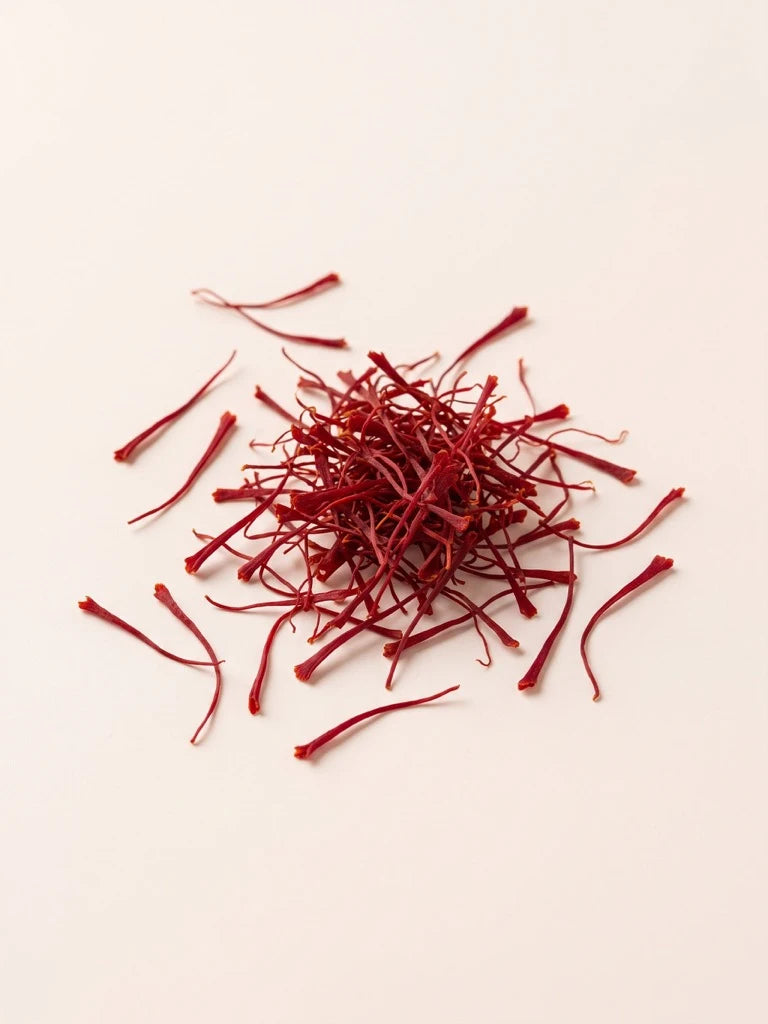
Twenty threads, or 0.08 g on a scale, for about 2 1/2 lb of vegetables serving four. Roasted vegetables come out sweet and slightly caramelised, and that sweetness needs something floral and faintly bitter pushing back, so this dose sits a little higher than it would in a soup.
Bloom the threads in 3 tablespoons of water at roughly 150°F (65°C) for 15 to 20 minutes. Water rather than stock: you are about to whisk this into olive oil and lemon, and stock muddies it. Boiling water is the one thing to avoid — it takes the aroma with the steam and leaves colour behind. The blooming method is worth reading once and then never thinking about again.
Crushing the threads between your fingers before they go into the water speeds extraction. Grinding them to powder is unnecessary here and makes it easy to overdose by eye. Our list of common saffron mistakes covers the ones that cost the most.
Which vegetables and what else?
- 1 medium cauliflower (about 1 1/2 lb / 700 g), cut into 1 1/2-inch florets
- 1 lb (450 g) carrots, peeled and cut on the bias into 2-inch pieces
- 1 large red onion, cut through the root into 8 wedges
- About 20 saffron threads (0.08 g)
- 3 tbsp (45 ml) water, for blooming
- 5 tbsp (75 ml) extra virgin olive oil, divided
- 1 garlic clove, finely grated
- 1 tsp honey
- Zest and juice of 1 lemon
- 1/4 cup (30 g) sliced almonds, toasted
- A handful of flat-leaf parsley and mint, roughly chopped
- Flaky sea salt and black pepper
Dense, sweet, low-sulphur vegetables are the ones that flatter saffron. Cauliflower, carrot, fennel, potato and winter squash all work. Broccoli and sprouts fight it.
How do you roast them?
You need a half-sheet pan, roughly 18 by 13 inches, and the discipline to use two if the vegetables do not fit in one layer.
- Bloom the saffron. Warm the 3 tbsp of water to about 150°F (65°C), crush the threads lightly between your fingers, and drop them in. Cover and leave 15 to 20 minutes. The water should end up the colour of strong tea.
- Heat the oven and the pan. Set the oven to 425°F (220°C) and slide a half-sheet pan onto the middle rack while it comes up to temperature. Vegetables hitting hot metal start browning immediately instead of sweating.
- Cut everything to size. Aim for pieces that will cook in the same 25 minutes: cauliflower in 1 1/2-inch florets, carrots in 2-inch bias-cut lengths, onion in wedges with the root left on so they hold together. Dry the cauliflower well.
- Oil, salt and spread. Toss the vegetables with 2 tbsp of the olive oil and a generous teaspoon of salt. Pull out the hot pan, tip them on and spread them into a single layer with space between the pieces. Use a second pan if they crowd.
- Roast without touching. Roast for 25 minutes. Do not stir, do not open the door to check. The undersides should be deep brown and the carrots should give when pressed with a spoon.
- Whisk the saffron dressing. While they roast, whisk the bloomed saffron liquid and its threads with the remaining 3 tbsp of oil, the grated garlic, the honey and the lemon zest. It will look split and cloudy, which is fine — whisk again just before you use it.
- Dress and finish roasting. Pour about two thirds of the dressing over the hot vegetables, toss them on the pan with tongs, and return to the oven for 8 minutes. The edges will darken and the liquid will mostly disappear into the vegetables.
- Dress again off the heat. Off the heat, spoon over the remaining dressing, squeeze on the lemon juice and toss. Taste for salt now, not before — roasted vegetables need more than you expect.
- Rest and serve. Scatter over the almonds, parsley and mint, grind on some pepper, and leave the pan alone for 5 minutes. Serve warm rather than hot, straight from the pan or piled onto a platter.
Why are my vegetables steaming instead of browning?
- The pan is crowded. Vegetables need air between them. Piled up, they release water faster than the oven can drive it off and you get pale, floppy pieces. Two pans, always, rather than one deep layer.
- They went on wet. Cauliflower holds water in its crevices. Dry the florets on a towel before oiling them.
- You stirred too soon. Browning needs uninterrupted contact. Leave the pan alone for the first 25 minutes, however tempting it is.
- The oven was not really at 425°F. Most home ovens run cool and the dial lies. An oven thermometer costs less than a gram of saffron.
Frequently asked questions
Which vegetables should I avoid?
Brassicas with a strong sulphur note — broccoli, sprouts, cabbage — overwhelm saffron rather than carry it. Beets are a colour problem more than a flavour one: they stain everything crimson and you lose the amber you paid for. Cauliflower is the exception in that family and is arguably the best vegetable here.
Can I do this in an air fryer?
Yes, in batches, and it suits the two-stage method well. Cook the vegetables at 400°F for 15 to 18 minutes, shaking the basket once, then toss with two thirds of the dressing and give them 3 more minutes. The basket holds far less than a sheet pan, so resist filling it.
Does the saffron survive the second stint in the oven?
Most of it does, because it is suspended in liquid and oil rather than exposed as dry threads, and eight minutes is short. Reserving a third of the dressing for the end is the insurance. If you added everything before the final roast you would still get colour, but the perfume would be noticeably quieter.
Can I prepare this ahead for a dinner?
Roast the vegetables and make the dressing up to four hours ahead, then keep both at room temperature. Reheat the vegetables on a hot pan for 6 minutes, dress, and give them the final 8 minutes as written. What does not work is dressing them early and reheating — they go soggy and the saffron fades.
Read next
- Saffron couscous – the obvious thing to serve underneath these
- Saffron flavour pairings – which vegetables and aromatics actually help it
- Saffron aioli – another way to get bloomed threads into a dressing