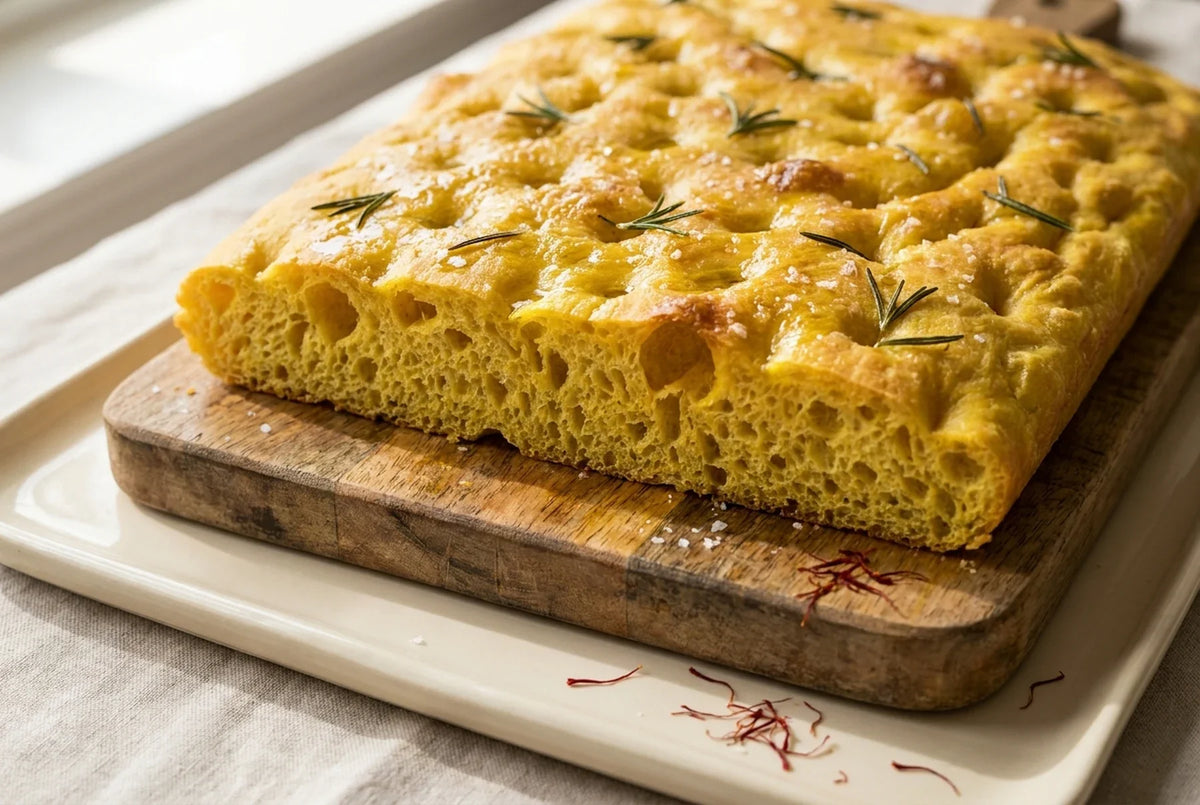
Saffron focaccia works best with 40 threads, about 0.16 g, bloomed into the dough water rather than scattered on top. The dough is wet, rests overnight in the fridge, and bakes in a heavily oiled 9 by 13 inch metal pan at 450°F (230°C) for roughly twenty-two minutes. Active work is under half an hour.
Most of this recipe is waiting. The only moment that needs real attention is deciding when the dough in the pan is ready to dimple.
Why put saffron in focaccia at all?
Focaccia is a bread with almost no ingredients, which means every one of them is exposed. Flour, water, salt, olive oil. The oil carries the flavour, and that turns out to matter for saffron, because the aroma compounds are happier in fat than they are in water alone.
What you get is a bread that smells faintly of hay and honey when it comes out of the oven, and a crumb that is properly yellow rather than the beige of a plain dough. It is not a strong flavour. It reads as depth more than as saffron, unless you know what you are looking for.
How much saffron do you need?
Forty threads, or 0.16 g on a scale, for a 500 g flour batch that fills a 9 by 13 pan. Bread takes more saffron per serving than a sauce does, because the dough is bulky and dilutes everything: the same forty threads would be overwhelming in a bowl of rice.
Bloom them in 100 g of the recipe water held at about 150°F (65°C) for twenty minutes, then let that liquid cool to lukewarm before it goes anywhere near the yeast. This is the one blooming rule people break in bread — hot saffron water poured into flour and yeast will kill the rise. Never boil it either; boiling strips the aroma and leaves colour.
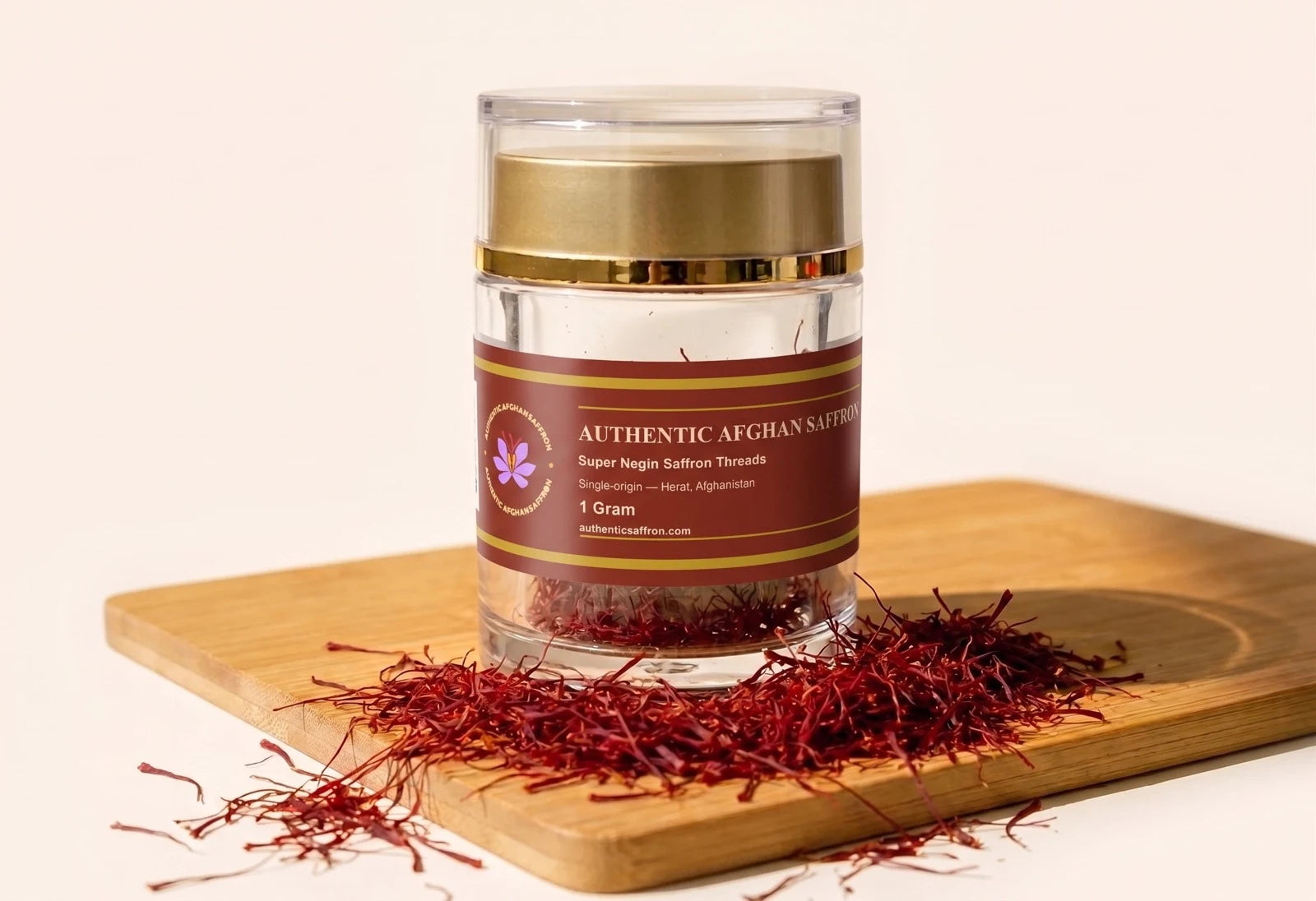
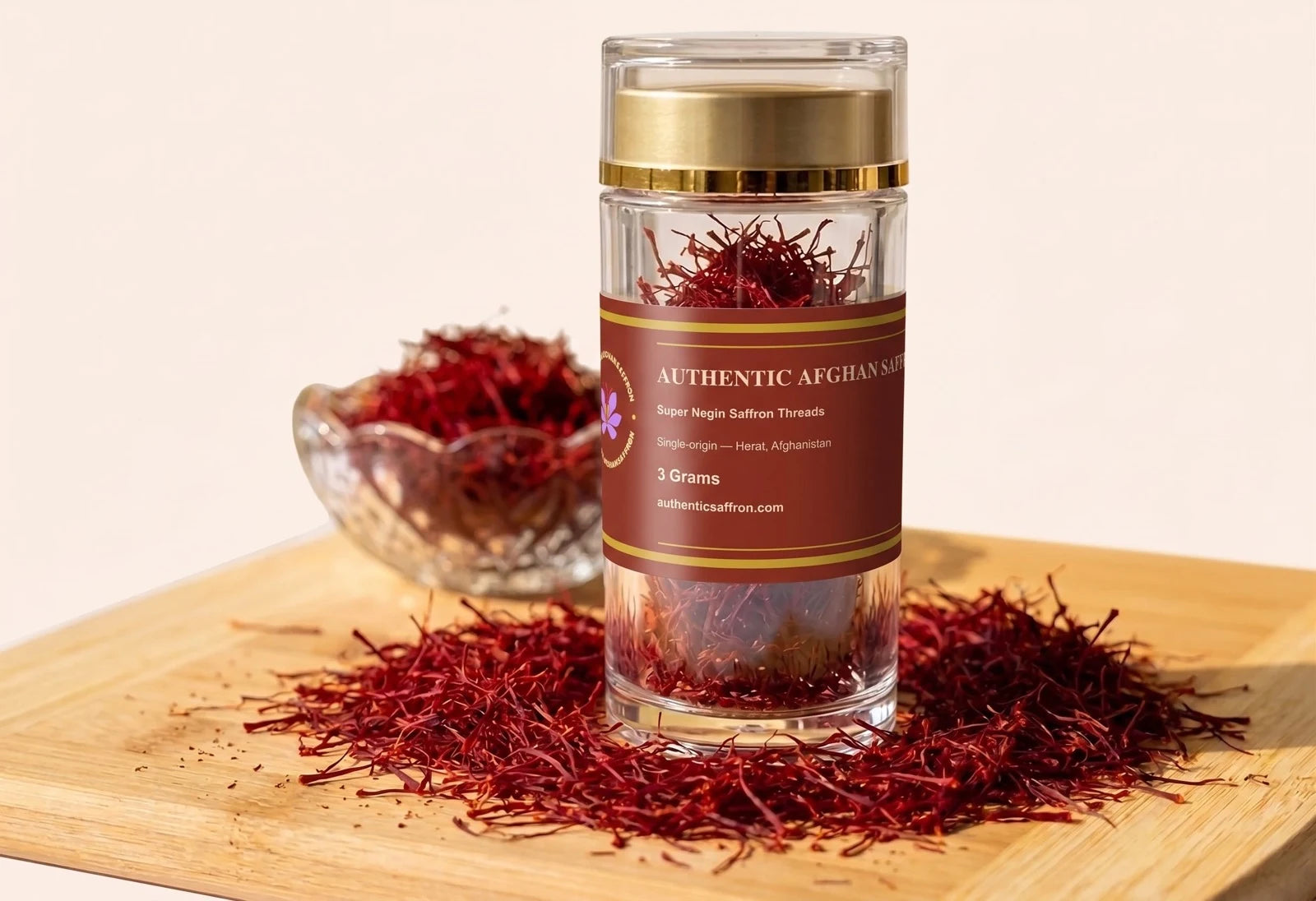
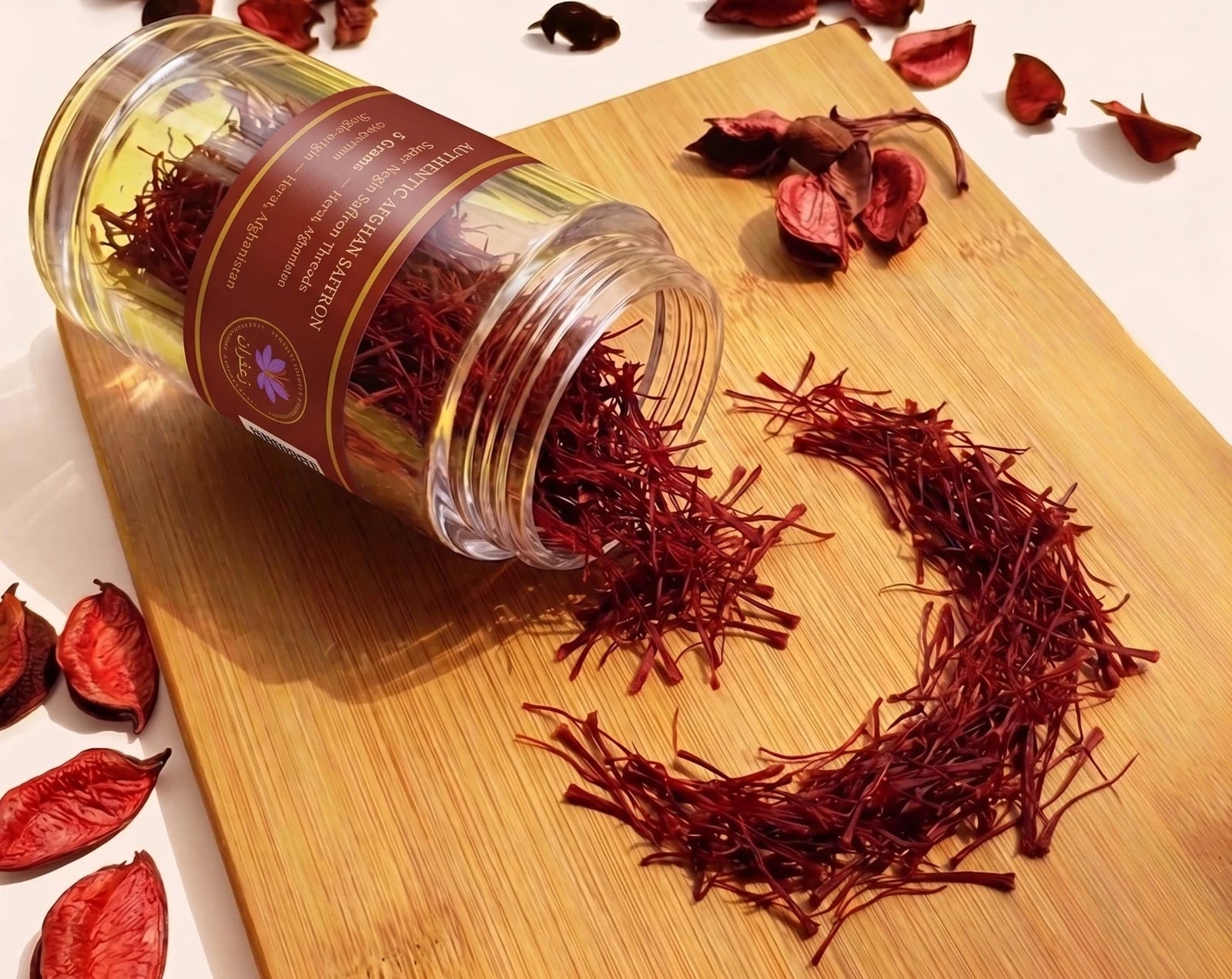
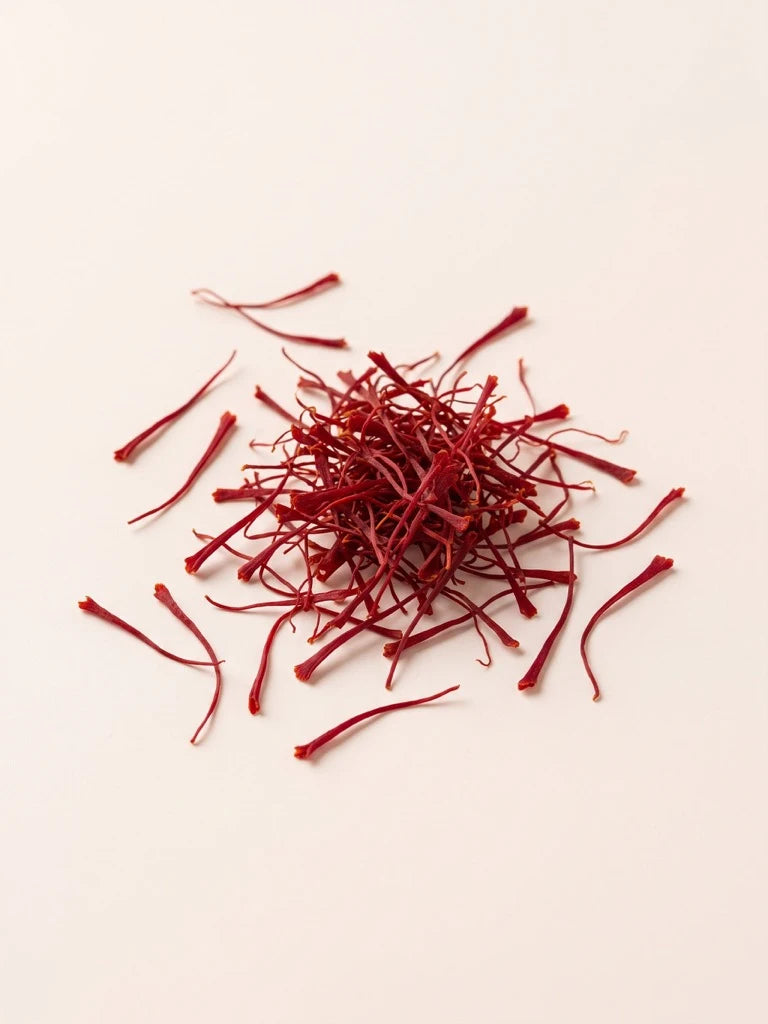
Use whole threads, not powder. Powder is where adulteration hides, and in a dough you lose the visual confirmation that you are looking at stigmas at all. Our note on threads versus powder goes through the trade-offs, and a 1 g bottle is roughly twelve batches of this bread.
What is in the dough?
- 500 g (about 4 cups) bread flour
- About 40 saffron threads (0.16 g)
- 400 g (1 3/4 cups) water, divided
- 4 g (1 1/4 tsp) instant yeast
- 10 g (1 3/4 tsp) fine sea salt
- 40 g (3 tbsp) extra-virgin olive oil for the dough
- 3 tbsp olive oil for the pan, plus 1 tbsp to finish
- 1 tsp fennel seed or picked rosemary leaves
- Flaky salt, for the top
How does it come together?
- Bloom the saffron. Heat 100 g of the water to about 150°F (65°C) — steaming, not simmering — and pour it over the threads. Cover and leave 20 minutes, then let it cool to lukewarm. Yeast dies above roughly 130°F (54°C), so this has to come down before it meets the dough.
- Mix a shaggy dough. Combine the flour and yeast in a large bowl. Add the saffron water, threads included, and the remaining 300 g of water. Stir with a stiff spatula until no dry flour is left. It will look wet and lumpy. Cover and leave 20 minutes.
- Work in the salt and oil. Sprinkle over the salt, add the 40 g of olive oil, and squeeze the dough through your fingers for a minute until both disappear. The dough will feel slack and slippery. That is correct at this hydration.
- Fold, four times. Wet one hand, reach under the dough, stretch a section up and fold it over the middle. Rotate the bowl a quarter turn and repeat three more times. Do a full round of four folds every 30 minutes, four rounds in all. By the last one the dough should hold together and feel springy.
- Cold-ferment overnight. Cover tightly and refrigerate for 12 to 24 hours. This is where the flavour comes from, and it also firms the dough enough to handle. The saffron colour deepens overnight from pale straw to a clear yellow.
- Oil the pan and transfer. Pour 3 tbsp of olive oil into a 9 by 13 inch metal pan and spread it up the sides. Scrape the cold dough in, turn it once to coat both faces, and stretch it gently towards the corners. It will pull back. Leave it.
- Let it wake up. Cover and leave at room temperature for 2 to 3 hours, until the dough has filled the pan and wobbles like set custard when you shake it. Under-proofed focaccia bakes dense, so wait for the jiggle rather than the clock.
- Dimple and dress. Heat the oven to 450°F (230°C). Oil your fingertips, then press straight down through the dough to the pan floor, all over, at roughly one-inch intervals. Scatter the fennel seed or rosemary and flaky salt.
- Bake. Bake on a low rack for 22 to 25 minutes, until the top is deep gold and the underside, lifted with a spatula, is crisp and evenly browned. A pale base means the pan was too thin or too dry — give it another 4 minutes.
- Turn out at once. Slide the focaccia straight out onto a wire rack. Left in the pan it steams and the crisp bottom softens within five minutes. Brush with the last tablespoon of oil and cut after ten minutes.
What goes wrong with saffron focaccia?
The commonest failure is a pale, soft bottom, and it is a pan problem rather than a dough problem. Glass and thin non-stick sheets do not conduct enough heat. Use aluminium or steel, use all three tablespoons of oil, and bake low in the oven so the base gets the direct heat.
The second is dimpling too early. If you press a dough that has not finished proofing you knock out the gas and it will not come back. Shake the pan first: a ready dough moves as one soft mass.
Third, over-flouring your hands. Every pinch of dry flour worked into an 80 per cent hydration dough tightens it, and by the fourth fold you have a stiff dough that bakes tight. Wet your hands instead. Water does not change the recipe.
Finally, do not judge the saffron while the bread is hot. Warm focaccia smells mostly of olive oil; the saffron only becomes legible once the crumb has cooled and set. If it has faded entirely by the next day, suspect the storage rather than the dose — see how to store saffron.
Frequently asked questions
Is saffron focaccia a traditional bread?
No. Ligurian focaccia is olive oil, flour, water and salt, and saffron has no part in it. Saffron does have a long history in Italian baking further south, in the regions that grow it, so the pairing is not invented out of nothing — but this is a modern crossover and worth calling one. Saffron adds colour and a faint bitterness that plays against the salt and oil.
Can I skip the overnight rest?
You can, and the bread will still be good, but it will taste mainly of yeast and oil. The cold rest builds the background flavour that lets saffron read as a top note. If you must rush, give the dough three hours at room temperature after the folds.
Why did mine come out dense?
Almost always the second rise. Cold dough straight from the fridge needs real time in the pan — two hours at a minimum, three in a chilly kitchen. If the dough is still firm and does not wobble when you shake the pan, it is not ready, and dimpling it at that point pushes out what little gas it has.
Should the saffron go into the dough or on top?
Into the dough, always. Threads scattered on the surface sit in the direct heat of a 450°F oven and scorch, which tastes of burnt hay. Bloomed in the water they colour the whole crumb evenly, and you get the aroma through the bread instead of on it.
Read next
- Saffron dinner rolls, the enriched version of the same idea.
- Naan-e roghani, a flatbread that takes saffron as a glaze rather than in the crumb.
- Saffron in sweet and savoury cooking and why the dose differs.
- What saffron should cost per gram before you buy in bulk for baking.