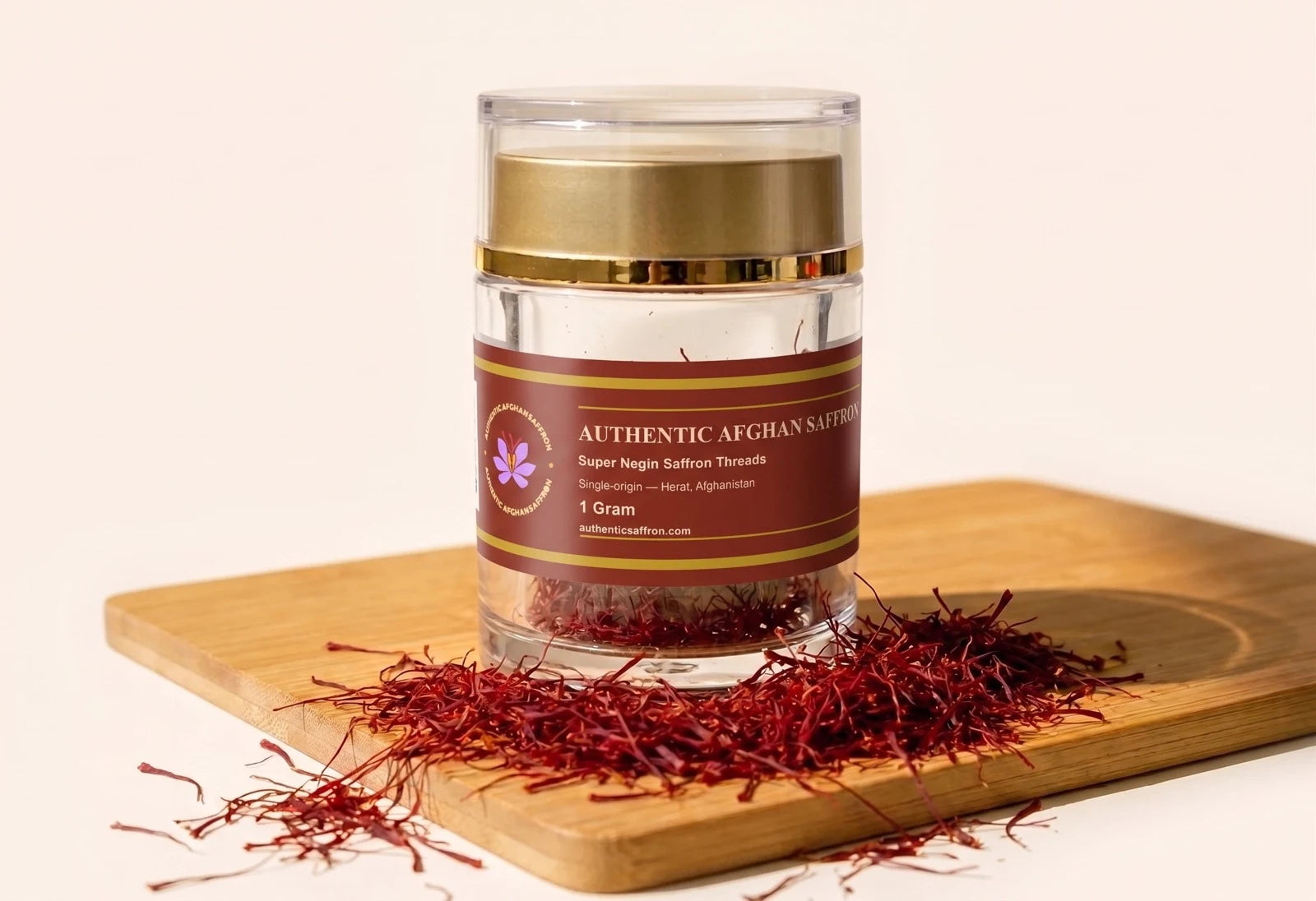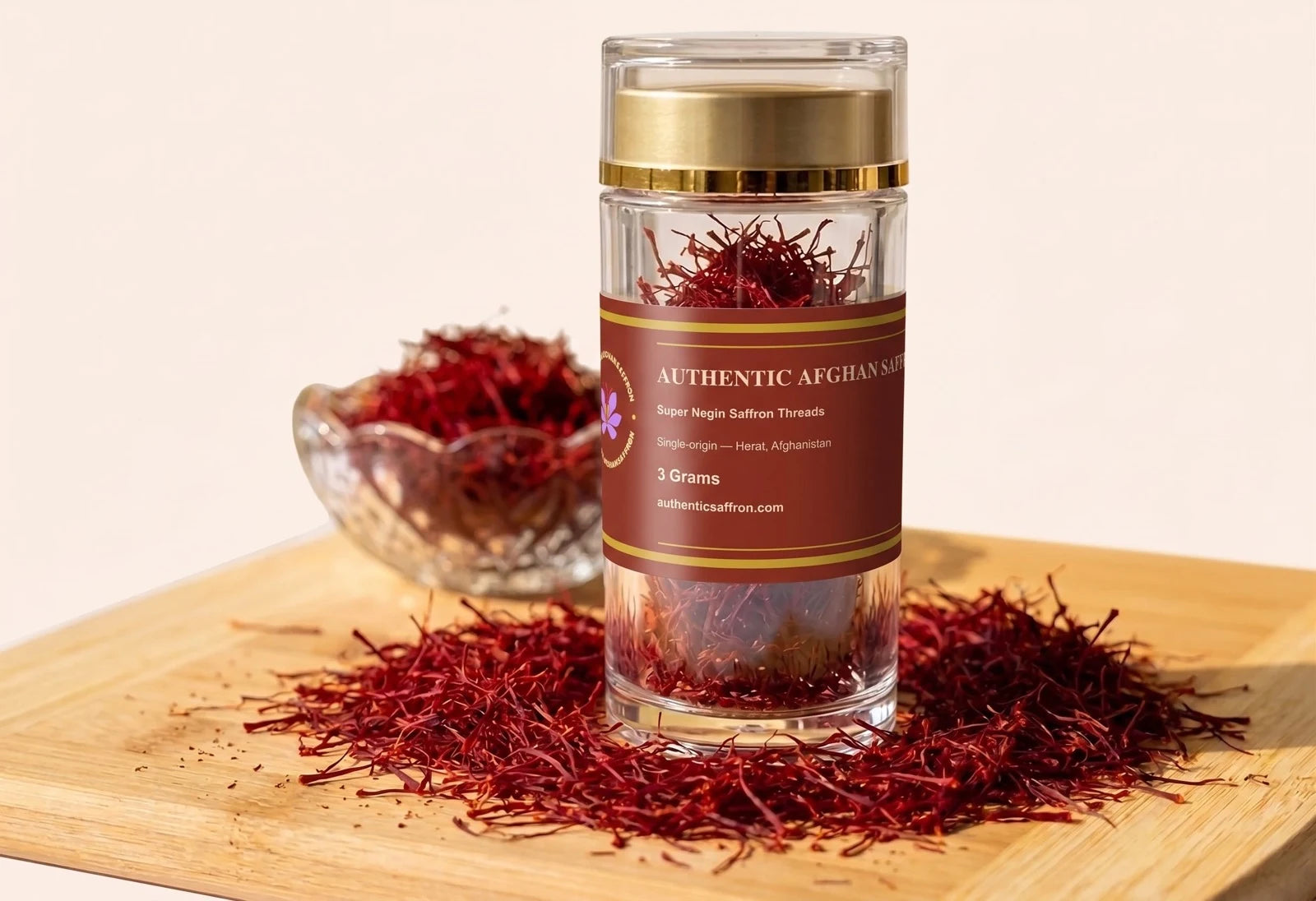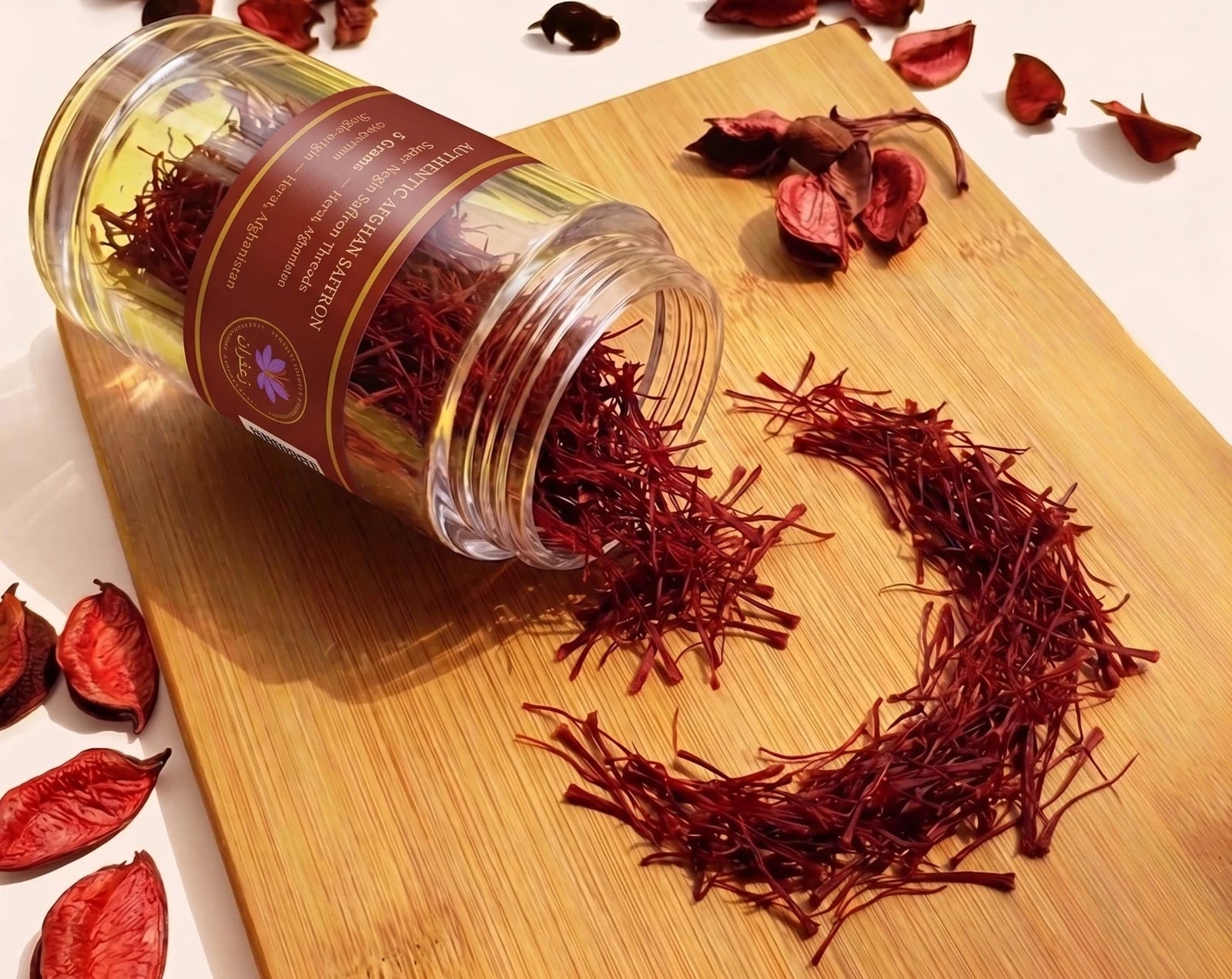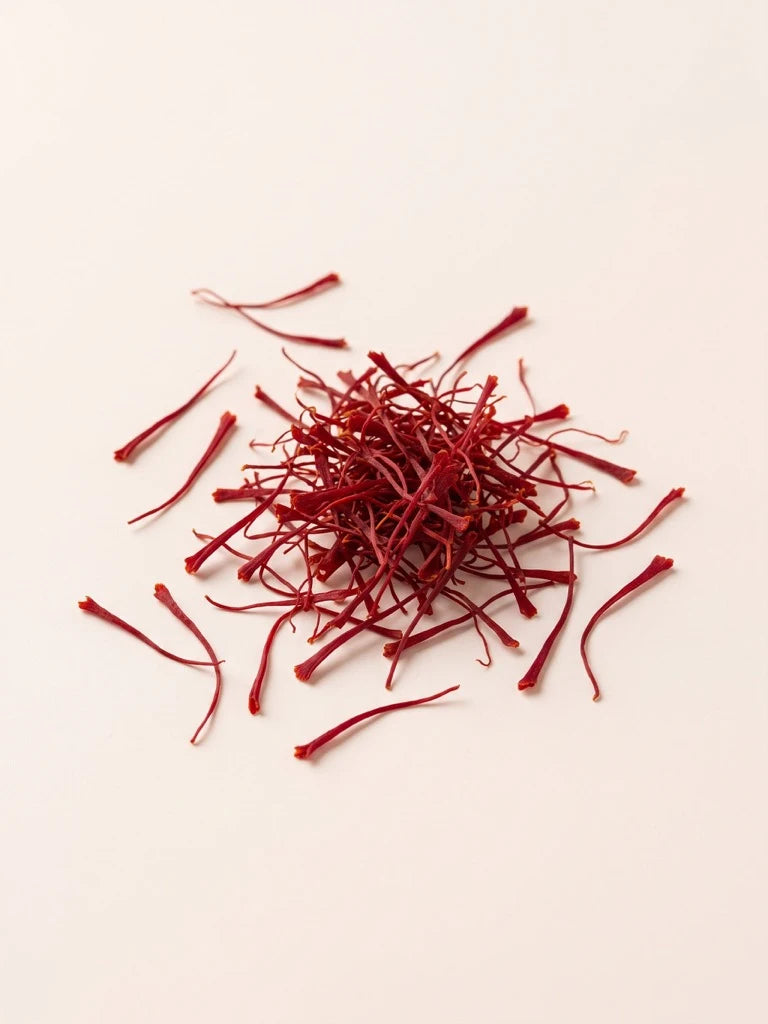
A saffron price per gram is the only number that lets you compare two sellers honestly. Divide the total price by the net weight in grams, then look at what that gram contains: whole red threads, a stated harvest year, and an origin the seller is willing to name. The arithmetic is easy. The reading takes a minute longer.
Saffron is sold in packages small enough that the sticker price hides the real cost. A jar that looks affordable at a glance may hold half a gram. A tin that looks extravagant may hold five. Converting everything to a per-gram figure strips the packaging out of the comparison and puts two listings on the same axis.
What does price per gram actually measure?
One thing only: what you pay for a unit of weight. It says nothing about freshness, colouring strength, or whether the threads in the jar are saffron at all. Treat it as a normaliser rather than a verdict. It gives the rest of your judgement something to stand on.
To calculate it you need the net weight — not the jar weight, not the shipped weight. In the United States, packaged foods carry a declared net quantity of contents on the label, and those labelling rules come from the US Food and Drug Administration. Online, the same figure usually sits in the product title or the specification block. If a listing states no net weight anywhere, the assessment stops there. You cannot price what you cannot weigh.
- Find the net weight and convert it to grams.
- Divide the total price, before shipping, by that number.
- Run the sum again with shipping included. On a one-gram order, delivery can be a third of what you pay.
- Check the pack count. Multi-packs sometimes quote the price of a single unit in large type and the bundle price in small type.
How do you convert ounces and pounds to grams?
Not every seller uses grams. Some US listings quote ounces or fractions of an ounce, and wholesale listings often quote pounds or kilograms. The conversions are fixed, so this part is mechanical rather than a matter of judgement.
| Unit as listed | Grams | What to watch for |
|---|---|---|
| 0.5 gram | 0.5 g | A very common retail size. Skim-read, it looks like a one-gram price. |
| 1 gram | 1 g | The cleanest unit for comparison. No conversion needed. |
| 2 grams | 2 g | Standard jar and tin size for regular home cooks. |
| 1/8 ounce | 3.54 g | Sounds smaller than a gram to a US ear. It is three and a half times larger. |
| 1/4 ounce | 7.09 g | Often the point at which per-gram pricing starts to drop. |
| 1 ounce | 28.35 g | More than most households will use before the aroma fades. |
| 1 pound | 453.59 g | Wholesale territory. Different questions apply entirely. |
| 1 teaspoon | Not a weight | A volume. Threads pack loosely and unevenly, so the gram figure varies. |
Two habits help. Round to two decimal places rather than eyeballing, because at these unit prices small slips compound quickly. And read the number, not the shape of the package — tall jars and wide tins are designed to make a small net weight look generous.
A worked example, start to finish
The figures below are invented to demonstrate the arithmetic. They are not quotes from any seller and should not be read as market rates.
- Listing A is described as 1/8 ounce for $24. Convert first: 1/8 ounce is 3.54 g. $24 ÷ 3.54 = $6.78 per gram.
- Listing B is a 2 g tin for $40. $40 ÷ 2 = $20.00 per gram.
- Listing C is 5 g for $85. $85 ÷ 5 = $17.00 per gram.
- Now add delivery. If A charges $8 shipping, its true cost becomes $32 ÷ 3.54 = $9.04 per gram. If C ships free, it stays at $17.00.
- Rank them, then stop and ask the useful question: what would explain a gap this wide between A and C?
That last step is where the arithmetic hands over to judgement. A gap of two or three times between listings is not a bargain you have spotted before anyone else. It is a signal that the two jars do not contain the same thing.
Why is the cheapest gram usually the wrong gram?
Because weight is the easiest thing in saffron to inflate. Several routine practices add grams without adding much of what you are actually buying, which is colour and aroma in the pan.
- Style included. The pale yellow or white base of the thread weighs something and contributes almost nothing. A gram with a lot of style in it dyes noticeably less than a gram of all-red stigma.
- Residual moisture. Saffron is hygroscopic. Underdried or rehumidified threads weigh more per thread, and you pay for the water. This is covered in more depth in our note on saffron moisture content.
- Powder. Ground saffron cannot be inspected, which is why we suggest you buy threads rather than powder at any price.
- Age. Old stock weighs the same as fresh stock and performs worse. Colouring strength declines with time, light and warmth.
ISO 3632 is the international standard that sets out how saffron’s colouring strength, bitterness and aroma are measured and how Categories I to III are divided. The standard itself is published by the International Organization for Standardization. A gram of Category I saffron and a gram of Category III saffron cost the same to ship and look broadly similar in a jar, but they do not do the same work in a dish. Our longer piece on why cheap saffron is cheap walks through how the discount is usually generated.
What else belongs beside the number?
Once you have the per-gram figure, four pieces of information turn it into a decision rather than a guess.
- Harvest year. Saffron is harvested once a year, in autumn. A seller who cannot tell you the crop year is either far from the farm or not asking.
- Named origin. A country is a start. A region is better. Vague sourcing usually means blended lots.
- Form. Whole threads, all-red or nearly so, with visible trumpet-shaped ends.
- Documentation. Whether a certificate of analysis exists, and whether it is published rather than merely mentioned. Our current lot is being tested now, and we will publish the report in full when it comes back.
The saffron price guide sets out what the per-gram bands tend to signal, and the buying saffron hub covers the wider decision.
Frequently asked questions
Is a higher price per gram always better saffron?
No. Price tracks quality loosely at best, and a high price can reflect packaging, retail markup or brand spend rather than what is in the jar. Price per gram is useful for eliminating listings that are implausibly cheap, not for ranking the ones that are not.
Should shipping be included in the price per gram?
Yes, run both numbers. On a one or two gram order, delivery can add a large fraction to the real cost, which changes the ranking. On a five gram order it usually barely moves the figure.
Why do supermarket packets look cheap until you do the maths?
Because they are usually very small. A packet holding a fraction of a gram can carry a low sticker price and still work out expensive per gram. Convert before comparing, every time.
How many grams does a home cook actually need?
For most households a gram or two covers several months of occasional cooking, since a dish for four typically uses a pinch rather than a spoonful. Buying more than you will use within a year or so trades a lower per-gram price for lost aroma.
Where should you read next?
- Pack sizes and the per-gram trick — how package design bends the comparison.
- Supermarket saffron versus specialist sellers.
- How to spot fake saffron, for when a price looks too good.