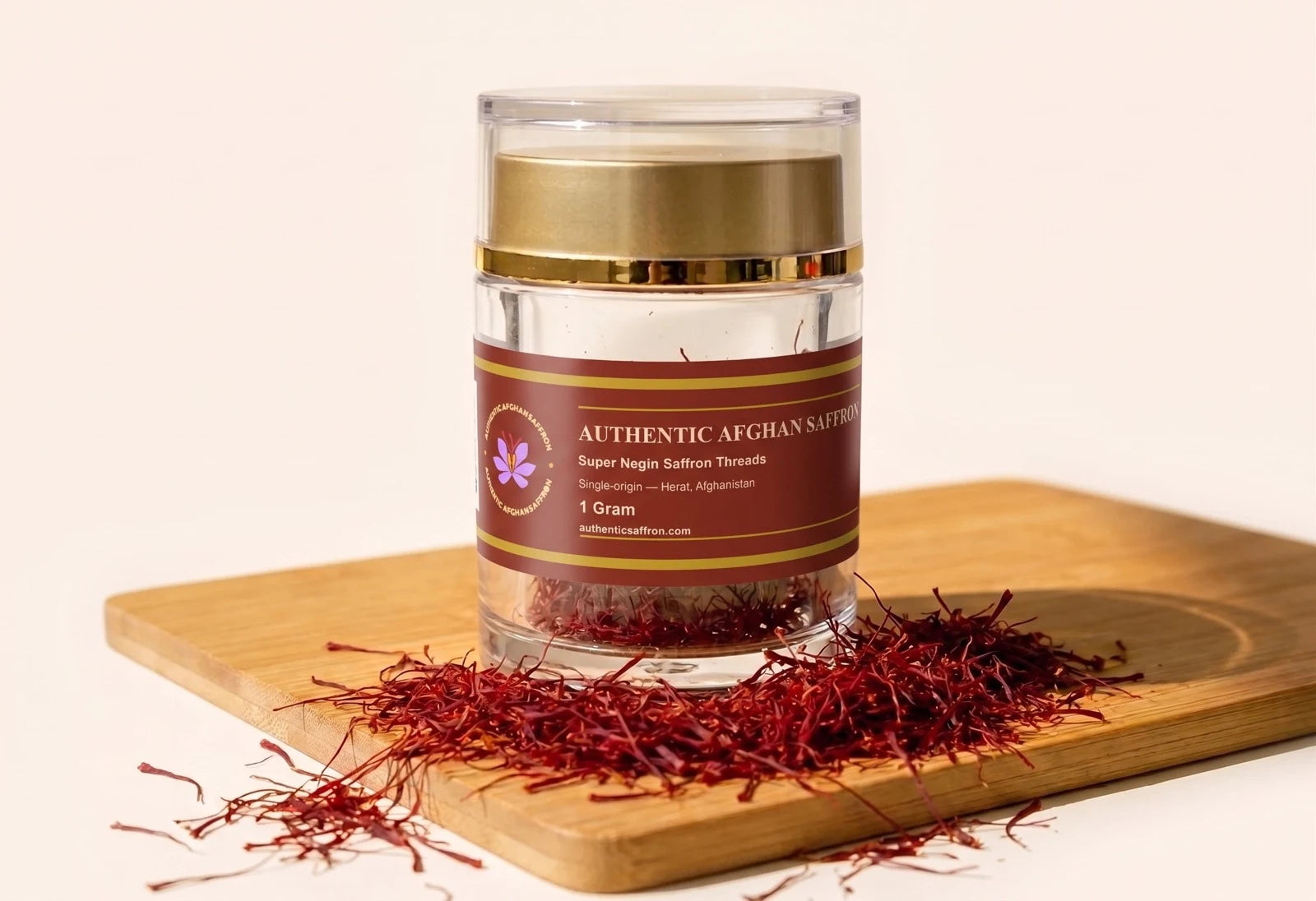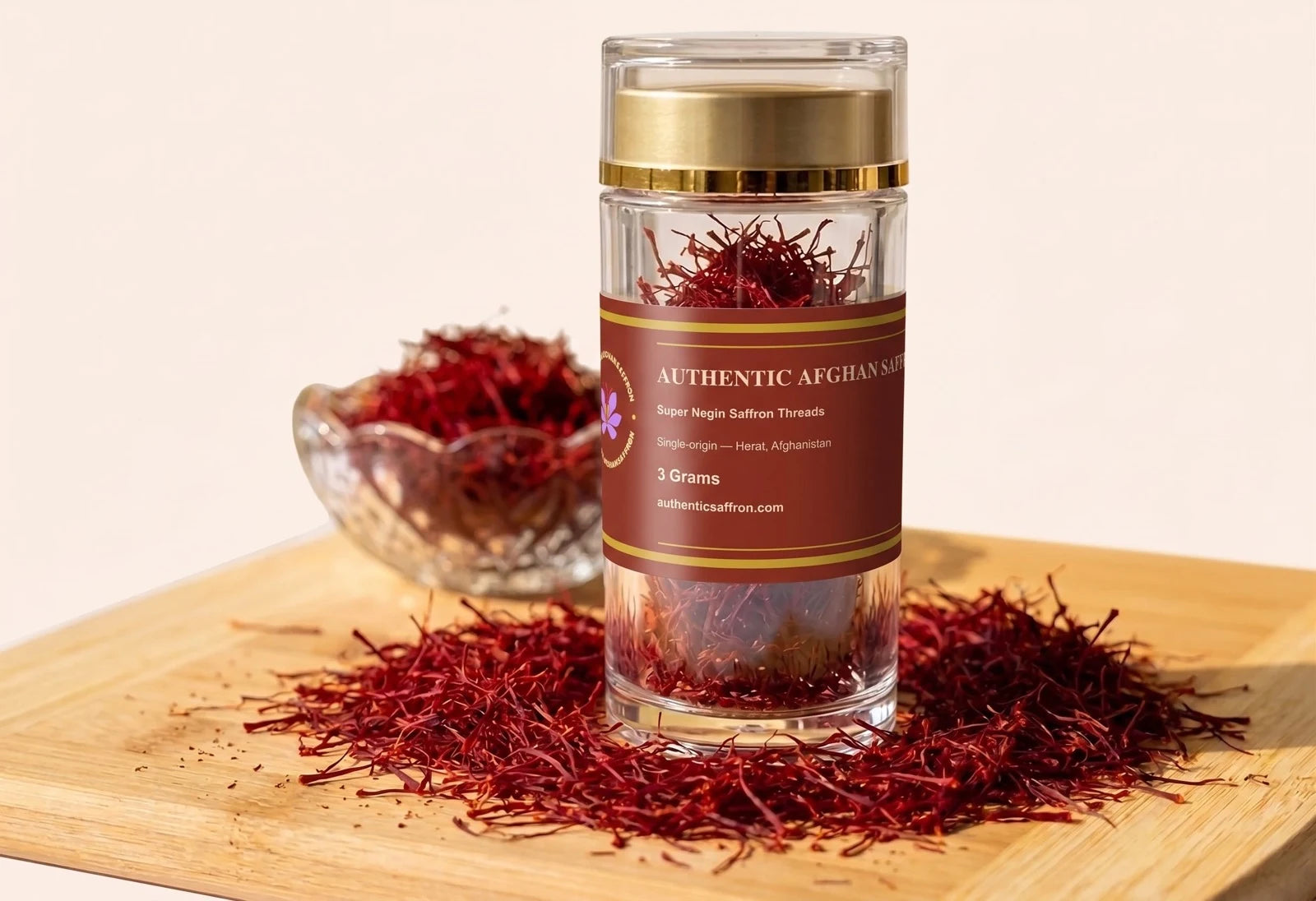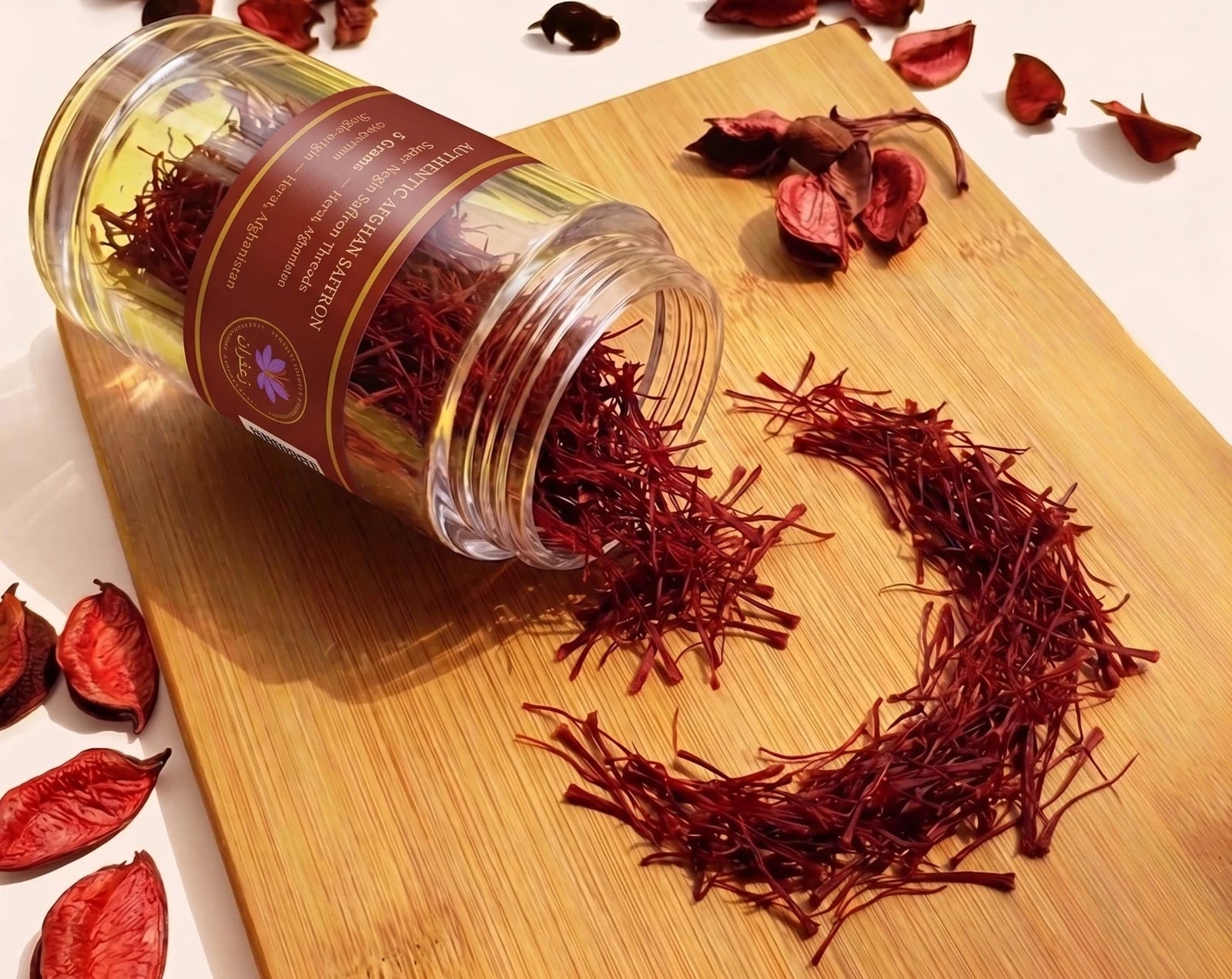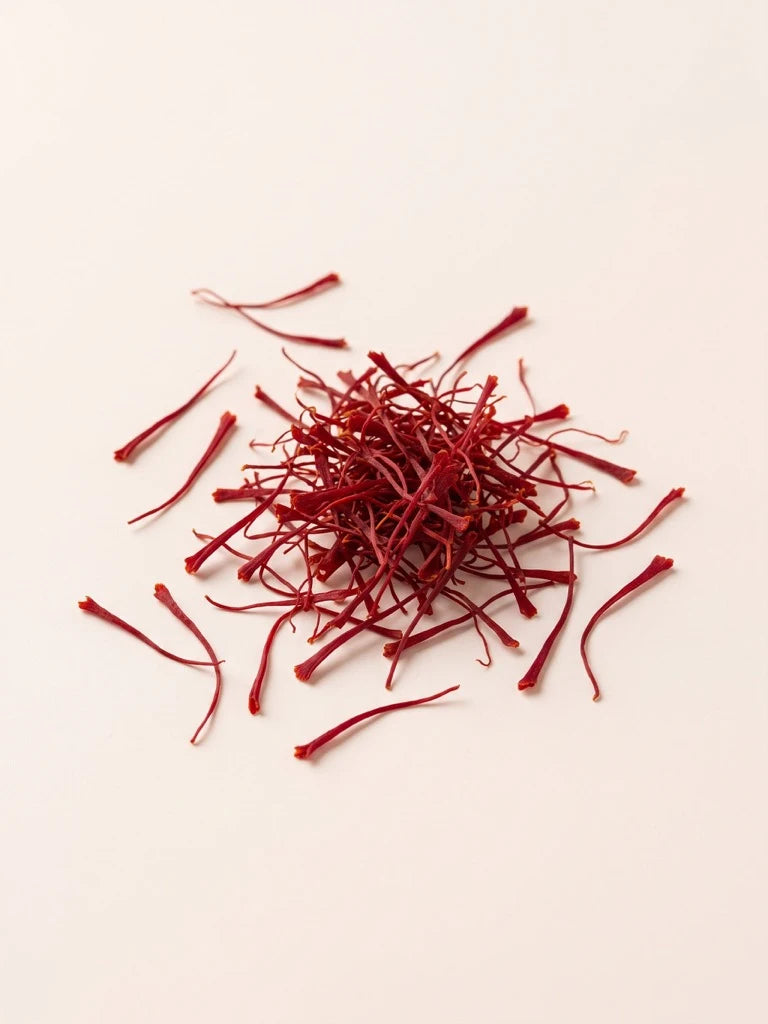
Bulk saffron changes three things at once: the unit price falls, the freshness clock starts on a much larger quantity, and the consequences of a bad lot multiply. The arithmetic is attractive. Whether it is a good decision depends almost entirely on how fast you will use it and how well you can store it.
Most advice about buying in volume is written for shelf-stable staples where the only real risk is running out of cupboard space. Saffron is not that. It is a spice bought for aroma and colour, both of which decline steadily from the moment the threads are dried, and neither of which is recoverable once lost.
What counts as bulk?
There is no formal line. In practice the decision changes character at four rough thresholds, and it is worth knowing which one you are standing at before you compare prices.
| Volume | Who buys it | What changes | Main risk |
|---|---|---|---|
| 5–10 g | Keen home cooks, families sharing | Unit price drops noticeably against 1 g jars | Slow use; aroma fading before the tin is finished |
| 1 oz – 100 g | Small restaurants, bakers, caterers | Portioning and decanting become necessary | Repeated opening of one container |
| 100–500 g | Food businesses, packers, gift makers | Lot documentation and sampling start to matter | A single bad lot affects everything you make |
| 500 g – 1 kg and above | Importers, distributors, resellers | Storage conditions, insurance and regulation | Capital tied up in a perishable-quality asset |
For scale, a kilogram is somewhere near 150,000 flowers’ worth of stigmas, on the familiar rule that a gram takes roughly 150 flowers. That is a season of work for a lot of hands, and it is worth holding in mind when a kilogram is offered at a price that seems easy.
Where do the savings actually come from?
Not from the saffron. The threads cost what they cost. The savings come from everything wrapped around them, and knowing which items are being removed tells you how far the discount can honestly go.
- Packaging. One tin instead of twenty jars, one label instead of twenty.
- Handling. Weighing and sealing small quantities is slow, skilled work.
- Shipping. A single parcel rather than repeat orders through the year.
- Payment and platform fees. Charged per transaction, so fewer transactions costs less.
Those together explain a meaningful discount. They do not explain a dramatic one. If a bulk price is a fraction of the retail per-gram figure rather than a step below it, the difference is being found somewhere else — in style content, in moisture, in age, or in what is in the bag. The saffron price guide sets out how the bands usually behave, and why cheap saffron is cheap covers the mechanics of a manufactured discount.
What is the freshness clock on a large lot?
Saffron kept airtight, dark and cool holds up reasonably well for a year or two, and it does not become unsafe after that — it becomes weaker. Aroma goes first, because safranal and the volatile fraction are the most fragile part. Colour follows more slowly. A three-year-old lot may still dye a rice dish convincingly while smelling of very little.
That matters for bulk because the clock runs on the whole quantity at once. Buying five years’ supply does not buy five years of the saffron you tasted at the start. Our pieces on how saffron degrades over time and saffron shelf life and best-before dates go into what actually happens and why the printed date is the weakest signal on the tin.
How should bulk saffron be stored and portioned?
Treat the large container as a vault and never cook from it. The routine below costs a few minutes on arrival and protects the whole purchase.
- Weigh out a small working portion — a gram or two — into a jar you will actually open.
- Split the rest into sealed portions sized to a month or a quarter of use, rather than leaving one large mass.
- Use airtight containers that exclude light: opaque tins, or dark glass kept inside a box.
- Label every portion with the harvest year and the date you opened the parent lot.
- Store cool, dry and away from the stove. Avoid the fridge unless the container is genuinely airtight, because condensation on opening is a real problem for a hygroscopic spice.
- Open the sealed portions in order, and do not reopen a portion you have finished with.
Our full guidance is in how to store saffron. The principle is simple: every opening exchanges dry, still air for humid, moving air, so reduce the number of openings the bulk of your saffron experiences.
What extra diligence does bulk require?
More, and of a different kind. At one gram a mistake costs you a dish. At half a kilogram it costs you a season, so the checks move from visual to documentary.
Ask for a lot reference and testing tied to that specific lot, not to a previous one. ISO 3632 covers sampling as well as measurement, which is why a report on a defined lot is worth more than a report on a brand — the standard is published by the International Organization for Standardization. Ask for a sample before committing to a large order; a seller confident in the lot will usually send one. And ask what the sample was drawn from, since a hand-picked handful is not a sample.
We hold to the same standard we ask of others: our current lot is with a laboratory, and the results will go up in full on the lab report page whatever they say. If you want to start small before considering volume, the saffron range lists the retail sizes.
Frequently asked questions
How much do you really save buying saffron in bulk?
Enough to matter, but the saving comes from packaging, handling, shipping and fees rather than from the saffron itself. Expect a step down in unit price at larger volumes, and treat a very large discount as a question about what is in the bag rather than a bargain.
How long will bulk saffron last?
Kept airtight, dark and cool, it stays good for a year or two and remains safe well beyond that, but aroma fades first and colour follows. Buy a quantity you will finish inside that window rather than one that looks efficient on a spreadsheet.
Should bulk saffron be frozen?
Only if the container is truly airtight and you accept that it should be brought fully to room temperature before opening. Saffron absorbs moisture readily, and condensation on cold threads does more harm than the cold prevents.
Is buying in bulk sensible for a restaurant?
Often yes, because turnover is fast enough that the freshness clock is not the binding constraint. The important changes are portioning into daily working jars, keeping the reserve sealed, and asking for lot-specific documentation rather than brand-level claims.
Read next
- Pack sizes and the per-gram trick.
- What to ask a saffron seller before you buy.
- The buying saffron hub, for the decision end to end.