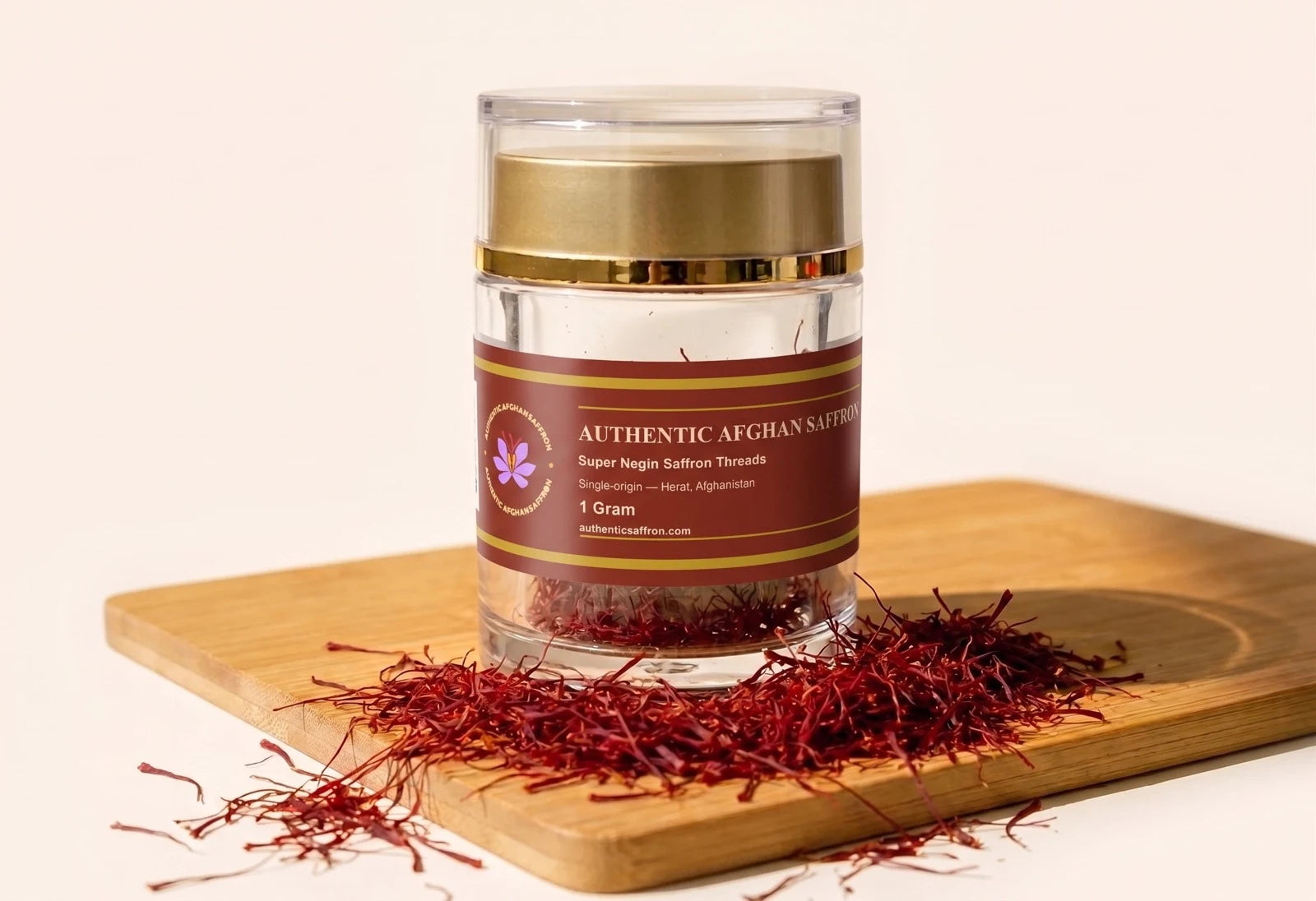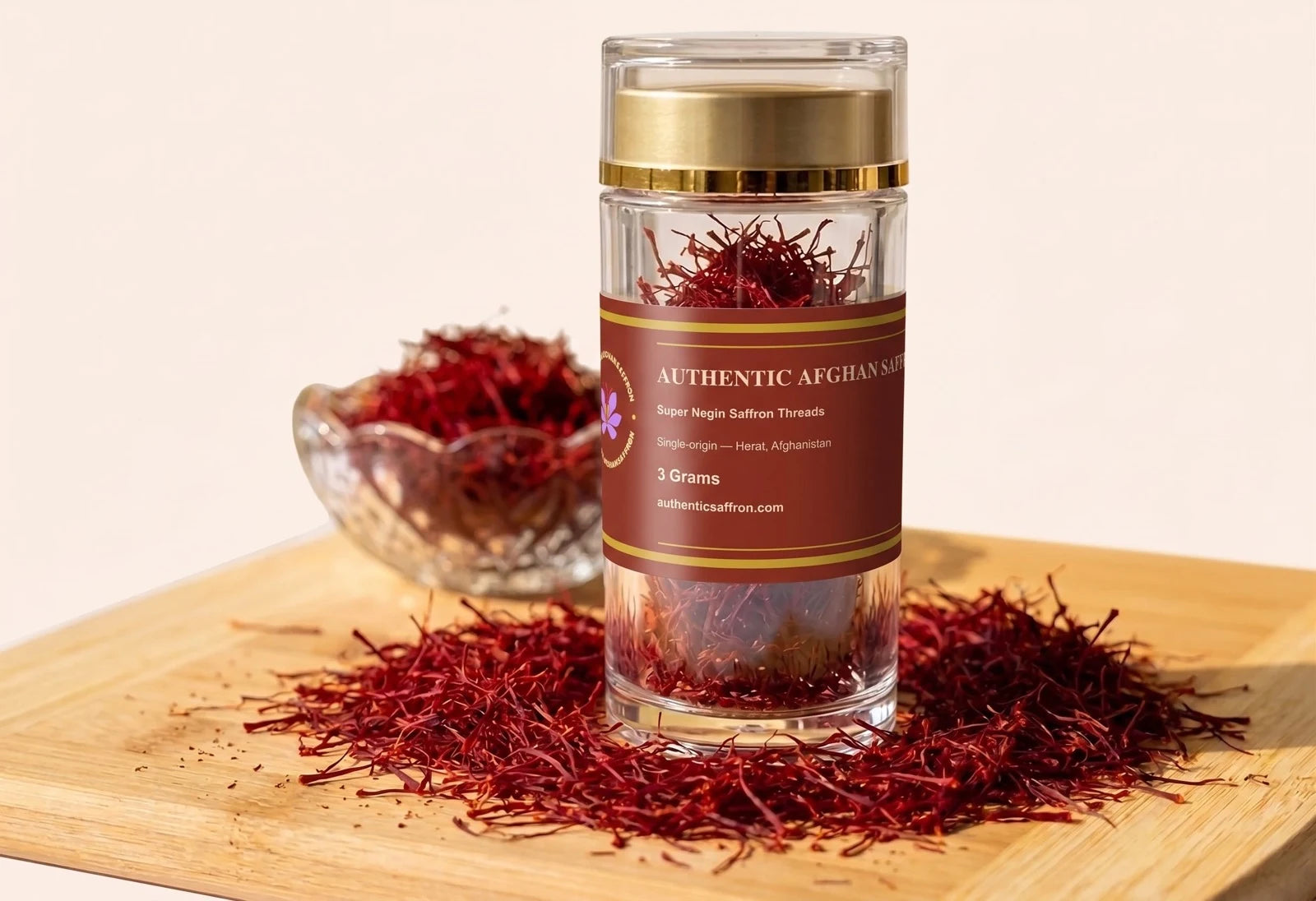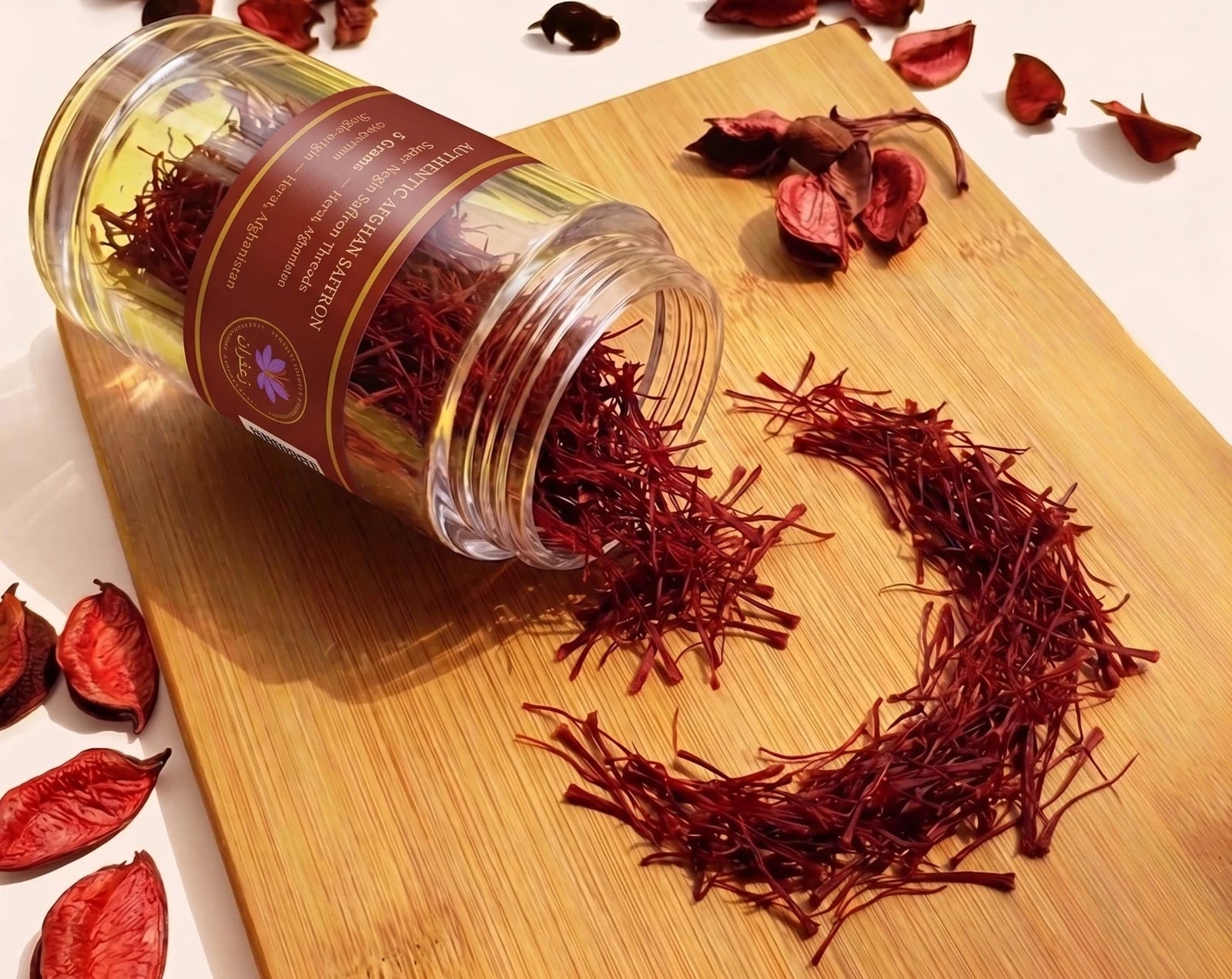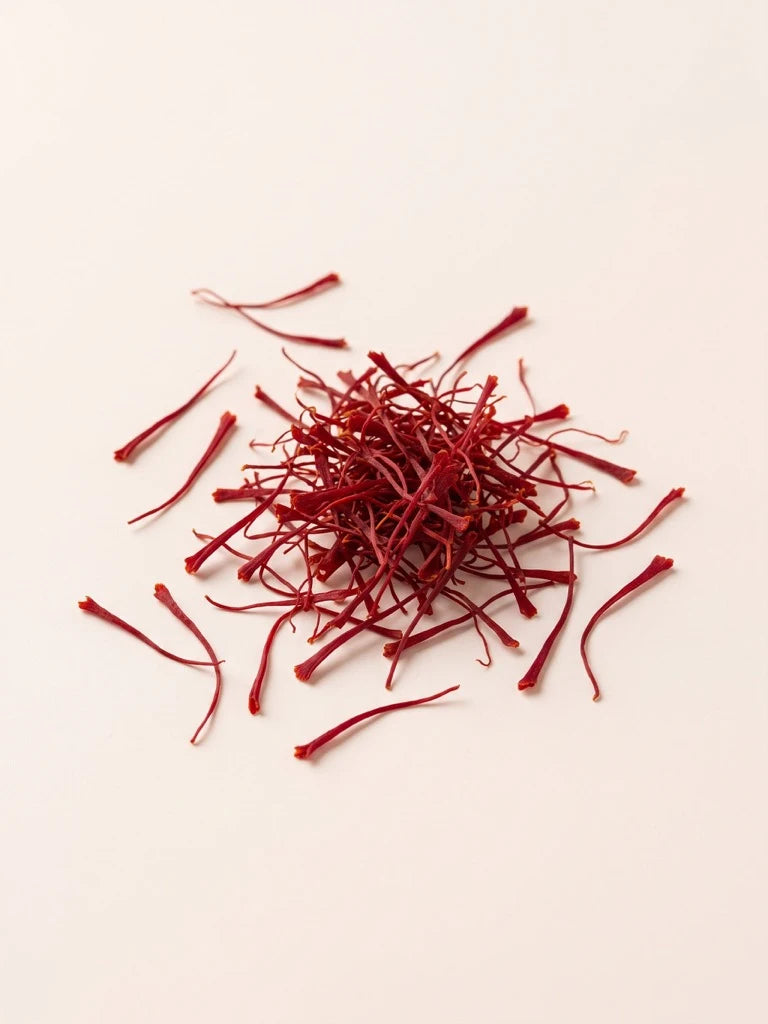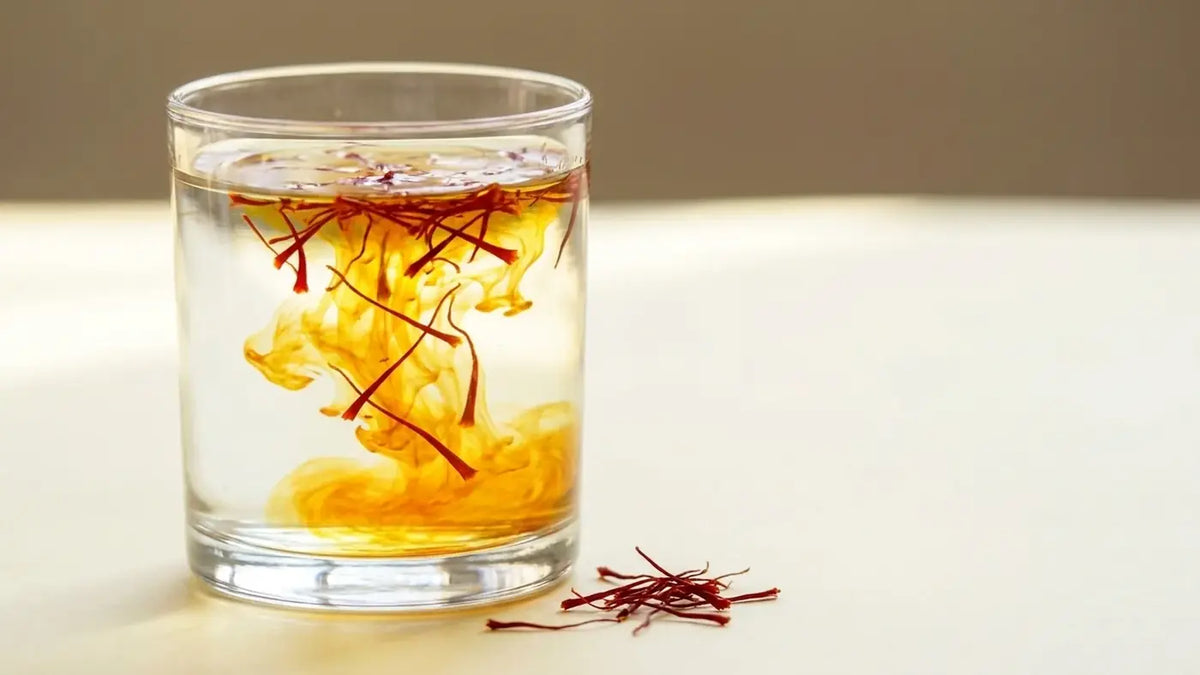
The saffron antioxidants people mean are mostly crocins, the water-soluble pigments that make saffron yellow, along with crocetin, safranal and a set of flavonoids. They perform well in test-tube assays. What that means inside a person is a separate question, and a much less settled one.
Which compounds are we talking about?
Saffron’s chemistry is unusual because the same handful of compounds carry the colour, the taste and the aroma, and those compounds are also what the antioxidant research examines. Three of them are the ones ISO 3632 measures when it grades saffron, each read at its own wavelength on a spectrophotometer.
| Compound | Chemical class | Read at | What it contributes |
|---|---|---|---|
| Crocins | Water-soluble carotenoid glycosides | 440 nm | The yellow-red colour; the main focus of antioxidant work |
| Crocetin | Carotenoid aglycone | Not read separately in ISO 3632 | What crocin becomes in the gut; the form that is absorbed |
| Picrocrocin | Glycoside | 257 nm | The bitter, hay-like taste |
| Safranal | Volatile aldehyde | 330 nm | The aroma; forms as picrocrocin breaks down during drying |
| Kaempferol glycosides | Flavonoids | Not read in ISO 3632 | Present mostly in the petals rather than the stigma |
The wavelengths are not arbitrary. Each compound absorbs light most strongly at a particular point, so reading absorbance there gives a proportional measure of how much is present. The method is set out in ISO 3632-1, and we explain the grading side of it in what an ISO 3632 grade actually means.
How is antioxidant capacity actually measured?
Usually in a tube, not in a person. The common assays — DPPH, FRAP, ORAC and their relatives — put an extract in with a coloured radical or an oxidising agent and watch how fast the colour changes. A faster change means a higher score.
Saffron extracts score well on these tests. So do a great many plant extracts, including several that do nothing measurable in a human. The assay is a chemistry measurement, and it was never designed to predict a physiological outcome.
The clearest illustration is what happened to ORAC. The USDA published an ORAC database of food values for years and then withdrew it in 2012, stating that the values had no demonstrated relevance to human health and were being misused in marketing. When the body that produced the numbers takes them down, that is worth noticing.
Does a test-tube result carry over into the body?
Only partly, and the crocin story shows why. Crocin is a large, water-soluble molecule and it is not absorbed intact in any meaningful quantity. It is hydrolysed in the gut to crocetin, a smaller molecule, and crocetin is what actually enters circulation.
So the compound tested in most test-tube studies is not the compound your body deals with. Anything measured on crocin in a beaker has to be re-established for crocetin in a person, at whatever concentration a realistic dose produces. That work is ongoing rather than finished.
Human research on saffron has mostly looked at outcomes rather than antioxidant chemistry: mood, appetite, vision. Those trials are small and short, and we describe them on the saffron research page and in saffron dosage used in clinical studies.
This is research, not medical advice. Speak to a doctor before using saffron therapeutically.
Do you get a useful amount from cooking?
No, and it is worth saying so plainly. A pinch of saffron in a dish for four is around 40 milligrams of spice in total, so about ten milligrams a plate. Even if every compound in it survived cooking and was fully absorbed, the quantity is trivial next to what you get from ordinary fruit, vegetables, tea or coffee.
That is not a mark against saffron. It is a reminder of what saffron is for:
- Colour that no other spice produces in the same way.
- An aroma that carries through fat, dairy and rice.
- A bitterness that gives sweet dishes a spine.
Anyone selling saffron as an antioxidant supply for the diet is selling the wrong thing, at a price that makes no sense for the purpose.
Does grade or freshness change the compound content?
Yes, and this is the one place the numbers become practical. Colouring strength at 440 nm is a direct proxy for crocin content, and ISO 3632 sets its categories on that reading: Category I from 190 upward, Category II from 150, Category III from 100. Higher-category saffron holds more crocin, which is the compound in question here.
Freshness matters at least as much. Crocins degrade with light, heat, oxygen and moisture, and a jar left on a sunny shelf loses pigment steadily. Faded threads mean lost crocin, whatever the grade was on the day it was packed. How to store saffron covers the practical side, and how saffron degrades covers the chemistry.
Frequently asked questions
Which compound in saffron is the main antioxidant?
Crocin, or more precisely the group of crocins, which are the water-soluble pigments responsible for the colour. They are also the compounds ISO 3632 measures at 440 nm, which is why colouring strength and crocin content move together.
Is saffron a good source of antioxidants in the diet?
Not in any practical sense. You use around ten milligrams a portion. A handful of berries or a cup of coffee delivers orders of magnitude more antioxidant compounds by weight. Saffron earns its place with colour and aroma, not as a dietary supply of anything.
Does a high ORAC or DPPH number mean saffron is healthy?
No. Those assays measure how a substance behaves in a test tube, not what happens after digestion and absorption. The USDA withdrew its ORAC database in 2012 for exactly this reason, noting the values were being misused to imply health effects.
Does old saffron lose its antioxidant compounds?
Yes. Crocins break down with exposure to light, heat, oxygen and moisture, which is the same process that fades the colour. Faded, pale saffron has lost pigment, and the pigment is the compound in question. Airtight, dark and cool storage slows it down.
Read next
- What is crocin in saffron — the pigment in detail.
- ISO 3632 explained — how the wavelengths become a grade.
- Saffron grading and quality — our hub page on the whole subject.